
Is a sluggish outboard due for a routine service, or is an electrical or mechanical fault affecting its performance? When a boat will not start before a planned trip, guessing at the cause can delay the right repair. A suitable boat mechanic has experience that matches your vessel, engine and symptoms.
Before handing over a valuable vessel, you need to understand how its problem will be assessed. Compass Marine provides engine servicing and mechanical repairs for outboards and inboards, as well as electrical fault diagnostics. Its certified Yamaha and Suzuki mechanics bring brand-specific expertise to servicing and fault assessment for those engines.
This guide explains what to look for in a marine repair company, how to recognise common service and repair needs, and what information to prepare before arranging an assessment. Sharing details such as the engine make and model, service history and when the problem occurs can help the technician investigate more effectively.
Key Takeaways
- Learn when unusual sounds, starting problems or performance changes call for a professional assessment.
- Understand why outboard, inboard and jet ski faults need expertise suited to the engine and vessel.
- Compare mechanics by considering their engine knowledge, approach to diagnosis and proposed repair scope.
- Prepare engine details, service history and symptom information to help guide an assessment.
- See how mechanical servicing and electrical fault diagnostics can help identify the right repair path.
What does a boat mechanic do, and when should you seek help?
A marine mechanic diagnoses, services and repairs boat engines and related systems. The work can include routine engine maintenance, investigating starting or performance problems, and tracing electrical faults. The right assessment depends on the engine, vessel and symptoms. A sound or warning light on its own does not identify the cause.
Recreational boat repairs differ from industrial shipyard work. A boat mechanic typically focuses on the vessel’s engine and connected systems, while shipyard projects may involve larger commercial vessels, fabrication, pipework or dry-docking. These fields share marine expertise, but the work and its scale differ. The broader field of marine engineering covers the design, operation and maintenance of marine systems.
Which boat and engine problems need a marine mechanic?
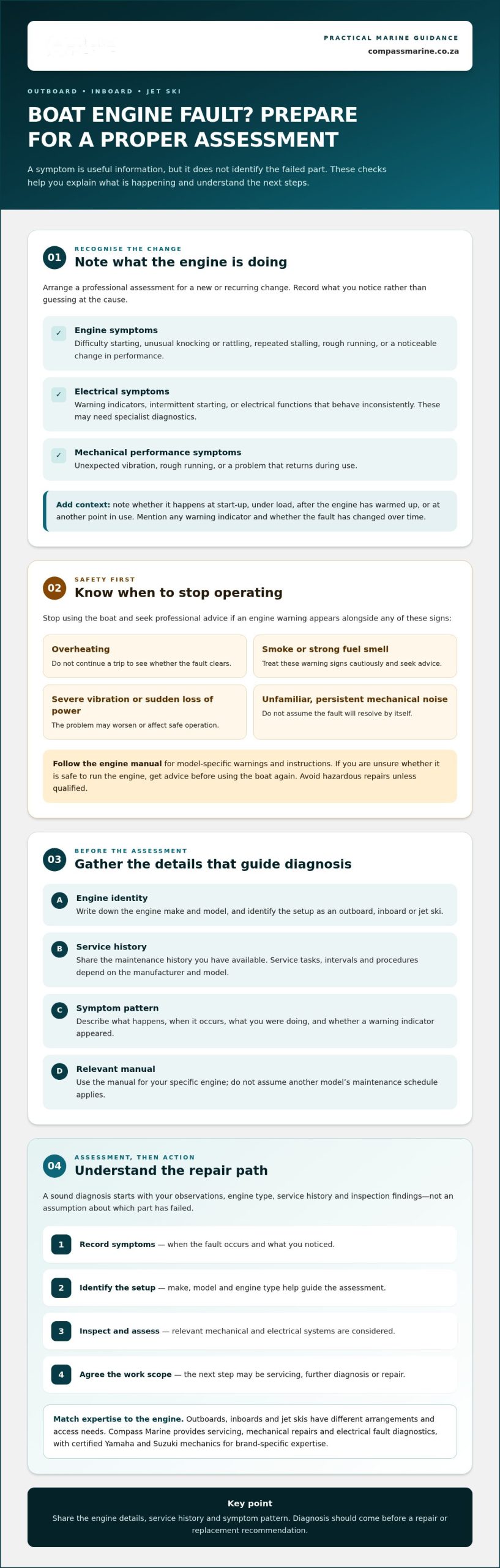
Arrange a professional assessment if you notice a new or recurring change. An outboard that turns over but will not start, an inboard that runs unevenly and a jet ski that loses power can have different underlying causes.
- Engine symptoms: Difficulty starting, unusual knocking or rattling, repeated stalling, or a noticeable change in performance.
- Electrical symptoms: Warning indicators, intermittent starting or electrical functions that behave inconsistently. These may need specialist diagnostics rather than trial and error.
- Mechanical performance symptoms: Unexpected vibration, rough running or a problem that returns during use.
Repeatedly resetting an indicator or guessing at the cause can mask a developing fault. A symptom is useful diagnostic information, but it does not establish which component has failed. Note when it occurs, such as at start-up, under load or after the engine has warmed up. This context can help the mechanic investigate more effectively.
When is it unsafe to keep operating the boat?
Stop using the boat and seek professional advice if an engine warning appears alongside overheating, smoke, a strong fuel smell, severe vibration, a sudden loss of power or an unfamiliar, persistent mechanical noise. These signs can point to a problem that may worsen or affect safe operation. Do not continue a trip simply to see whether the fault clears.
Follow the engine manual for model-specific warnings and instructions. Do not attempt hazardous mechanical or electrical repairs unless you are qualified to do so. If you are unsure whether it is safe to run the engine, err on the side of caution and get advice before using the boat again.
Compass Marine provides marine engine servicing, mechanical repairs and electrical fault diagnostics. An early assessment can help establish whether the issue calls for routine servicing or more involved repairs before it disrupts your next launch.
How do marine mechanics diagnose outboard, inboard and jet ski faults?
A sound diagnosis starts with what you have noticed, not an assumption about which part has failed. Tell the mechanic what the engine is doing, when the symptom appears and whether it has changed over time. An engine that struggles only after a day on the water, for example, may need a different investigation from one that will not start at all.
Diagnosis should come before a repair or replacement recommendation, so the work addresses the cause rather than just a symptom. The mechanic considers your observations alongside the engine type, service history and inspection findings before outlining a suitable repair plan.
- Record the symptoms: Note when the fault occurs, what you were doing and whether a warning indicator appeared.
- Identify the setup: Provide the engine make and model, and say whether it is an outboard, inboard or jet ski.
- Inspect and assess: The mechanic uses your information to guide an assessment of relevant mechanical and electrical systems.
- Plan the work: Once the likely cause has been assessed, the next step can be explained as servicing, further diagnosis or repair.
What changes between outboard and inboard engine servicing?
An outboard is mounted externally, while an inboard is installed within the boat. This affects access and the layout a technician needs to assess. Outboard servicing focuses on the engine unit and its connected systems. Inboard work involves the engine within its onboard installation. Jet skis have a different engine arrangement and should be assessed as personal watercraft, not treated as boat outboards.
Maintenance tasks, intervals and procedures depend on the manufacturer and model. Use the relevant manual for your engine rather than applying a schedule intended for another setup.
How are electrical faults assessed alongside engine problems?
A starting or running fault can have an electrical or mechanical cause, and the symptoms may overlap. A technician considers your observations and the inspection findings to decide what needs further investigation. Avoid opening electrical components or attempting tests that could expose you to moving parts, fuel or electrical hazards.
Compass Marine provides electrical fault diagnostics alongside engine servicing and mechanical repairs. For wider vessel safety information, consult the South African Maritime Safety Authority (SAMSA).
Compass Marine services and repairs outboards, inboards and jet skis. Explore Compass Marine’s engine servicing and repairs to arrange an assessment.
How can you compare boat mechanics and understand the repair scope?
Start by matching the work to your boat’s needs, not by relying on a general promise to “fix anything”. Consider whether the job involves an outboard, inboard or jet ski, whether the fault appears mechanical or electrical, and whether the mechanic has relevant experience with that engine type. Look for a repair plan that explains the work clearly.
Use these points to judge whether the expertise and proposed scope fit your vessel:
- Engine type: Match the mechanic’s experience to your outboard, inboard or personal watercraft.
- Fault category: Establish whether the concern relates to servicing, mechanical operation, electrical wiring or fault diagnostics.
- Relevant expertise: For a Yamaha or Suzuki engine, manufacturer-relevant knowledge can inform servicing and fault assessment.
- Repair scope: Look for a clear account of the findings, the proposed work and how it relates to the reported problem.
A clear explanation is more useful than a broad assurance that every issue can be solved. The right work depends on the engine and fault, and a repair that suits one boat may not be appropriate for another. If the assessment identifies a different cause from the one you suspected, ask how the finding relates to the symptoms and why the proposed work follows from it.
What expertise matters for Yamaha and Suzuki engines?
Manufacturer-relevant experience helps a mechanic interpret servicing needs and faults in the context of a particular engine brand. Compass Marine has certified Yamaha and Suzuki mechanics with relevant expertise for those engines. Maintenance requirements can vary by model, so refer to the engine manual for the applicable schedule and procedures rather than assuming the same guidance suits every motor.
How do you assess whether the repair plan fits the fault?
A sound plan connects what you reported, what the assessment found and what work is proposed. If you described intermittent starting, for example, the explanation should make clear whether the concern points to an electrical fault, a mechanical issue or a need for further diagnosis. The scope can depend on the boat, engine, operating conditions and inspection findings. A suitable recommendation reflects those circumstances rather than offering a universal fix.
Before agreeing to work, make sure you understand what the proposed task covers and whether it addresses the identified cause. For planned maintenance, Compass Marine’s marine engine servicing guide explains how servicing supports engine reliability. If you need an assessment or service, contact Compass Marine about engine repairs.
What should you prepare before booking a boat mechanic?
A few clear details can make the first conversation more useful and give the mechanic context for the fault. You do not need to identify the failed part yourself. Focus on accurate observations and records, especially if the boat is used in saltwater or the problem appears only under certain operating conditions.
What information helps a mechanic assess the boat?
Find the engine make and model in its manual or service records, and note the boat and engine type. Record when the fault began, how often it occurs, what the engine was doing at the time, any recent changes, warning indicators and relevant service history. These details give the mechanic a clearer starting point.
- Engine details: Make, model and any identifying information available in your records.
- Fault pattern: When it occurs, how often it happens and whether it is getting worse.
- Operating conditions: Whether it appears at start-up, after running, under load or following saltwater use.
- Service history: Previous servicing or repairs, and any work carried out shortly before the fault began.
- Warnings and symptoms: The exact indicator shown, sounds noticed or changes in engine behaviour.
Describe what happened rather than interpreting the cause. “The engine hesitated after running for a while” is more useful than guessing that a particular component is faulty. If you can safely record when an indicator appears, do so, but do not run the engine just to reproduce a concerning symptom.
What checks can an owner make safely beforehand?
Limit your checks to visual observations and tasks the manufacturer clearly permits. You can note visible damage or anything unusual around the boat without dismantling components. Do not test wiring, work on fuel systems or reach near moving engine parts. If you are unsure whether a check is safe, leave it to the technician and consult the engine manual for model-specific guidance.
Keep the manual and service records together, and tell the mechanic if the boat has been exposed to saltwater or stored for a period before the issue appeared. For related South African compliance context, see the South African boat COF guide. A COF matter is separate from diagnosing an engine fault, but relevant vessel records can help you organise the information for a service discussion.
Preparing these details before contacting a boat mechanic helps keep the conversation focused on the vessel, symptoms and service history. Contact Compass Marine to arrange boat engine servicing or mechanical repairs.
Choose Compass Marine for boat mechanical servicing and repairs
A suitable repair starts by matching the work to the vessel and the problem. Compass Marine provides engine servicing and mechanical repairs for outboards and inboards, as well as jet ski servicing. Depending on the engine, its condition and the symptoms, the work may involve routine maintenance or investigation of a fault.
Engine-specific knowledge is particularly useful for boats fitted with Yamaha or Suzuki outboards. Compass Marine has certified Yamaha and Suzuki mechanics with relevant expertise for servicing and fault diagnosis on those engine brands. Electrical fault diagnostics are also available when a starting or running concern may involve the boat’s electrical system as well as its engine.
What marine mechanical support does Compass Marine provide?
Compass Marine’s marine mechanical services cover several common recreational vessel needs. The appropriate support depends on what you own and what needs attention:
- Outboard engines: Servicing and mechanical repairs, including work involving Yamaha and Suzuki outboards.
- Inboard engines: Engine servicing and mechanical repairs suited to an inboard installation.
- Jet skis: Servicing and mechanical repairs for personal watercraft.
- Electrical faults: Diagnostics to investigate electrical issues that may affect starting or operation.
- Boat or trailer condition: Refurbishment where this is relevant to the repair or restoration need.
Some concerns cross service categories. An engine that struggles to start, for instance, may need mechanical assessment, electrical fault diagnostics or both. A reported symptom alone does not determine which service is appropriate. The boat and diagnosis guide the scope of work. Compass Marine also brings decades of professional experience to marine servicing and repairs.
What is the next step if your boat needs attention?
Share the engine type, make and model, the symptoms you have observed, when they occur and any available service history. These details provide useful context but do not replace an assessment. The appropriate work depends on the boat, engine, fault and operating conditions, so the repair scope should follow the findings rather than an assumption about the cause.
Describe the issue clearly and include any warning indicators or recent changes. You do not need to identify the failed component yourself. A practical account of what the boat is doing helps the mechanic understand the problem.
For outboard or inboard servicing, jet ski repairs or electrical fault diagnostics, contact Compass Marine about marine mechanical repairs.
Make your next service decision with confidence
You do not need to know exactly what has failed before arranging an assessment. Explain what you have noticed, share any records you have and let the diagnosis guide the work. This keeps the discussion grounded in your boat’s condition rather than guesswork or a repair plan chosen before the fault is understood.
When choosing a boat mechanic, start by describing the issue clearly and sharing your service records. The appropriate work depends on the assessment and your vessel’s condition, so there is no need to identify the failed component yourself.
Contact Compass Marine about marine mechanical repairs to discuss the next step. A considered assessment can help you make a practical decision and plan your next time on the water with greater confidence.
Frequently Asked Questions
What does a boat mechanic do?
A boat mechanic assesses, services and repairs marine engines and related systems. The work can range from scheduled maintenance to investigating a fault that affects starting, running or performance. If an engine behaves differently after storage, for example, a mechanic can consider its service history and condition to determine what needs attention. The right work depends on the boat, engine and manufacturer guidance.
Can a marine mechanic service both outboard and inboard engines?
Yes. A marine mechanic can work on both when their expertise matches the engine type. An outboard is mounted outside the hull, while an inboard is installed within the boat, so access and the surrounding arrangement differ. When arranging a service, provide the engine make and model and consult its manual for relevant maintenance requirements. Do not assume one engine’s service schedule applies to another.
How do I know if my boat engine needs professional attention?
Arrange an assessment if you notice a change that persists or returns, such as repeated stalling, unusual vibration, difficulty starting or a warning indicator. A symptom may have several possible causes, so it cannot identify the failed component by itself. If the engine shows a serious warning or its behaviour raises concerns about safe operation, stop using it and follow the manufacturer’s instructions before running it again.
What information should I provide when booking a boat mechanic?
Share the engine make and model, the fault’s timing and frequency, any warning indicators and relevant service records. Include what the boat was doing when the problem appeared, such as starting after storage or running under load. This gives the mechanic useful context before assessing the vessel. Describe what you observed rather than guessing at a cause or attempting hazardous checks.
Can electrical faults cause boat engine starting problems?
Yes. A starting problem can involve an electrical fault, a mechanical issue or another cause, and the symptom alone will not distinguish between them. Note whether the engine is completely unresponsive, turns over without starting or behaves intermittently, and report any warning indicators. Avoid testing wiring or dismantling components yourself. A technician can assess the symptoms and decide whether electrical fault diagnostics or mechanical investigation is appropriate.
Does a boat mechanic service jet skis as well as boats?
Some marine businesses also service jet skis, but the work should suit personal watercraft rather than assume the same approach as servicing a boat engine. Compass Marine provides jet ski servicing and mechanical repairs. When arranging an assessment, share the craft’s make and model, service history and a clear description of the problem so the information relates to the correct equipment.