
Could a bracket labelled “marine grade” still be the wrong choice for your boat? Yes. Marine grade stainless steel brackets are often made from 316 stainless steel, which resists saltwater corrosion better than 304. But the material label alone does not tell you whether a bracket suits its position, load or fixings.
To choose well, assess the whole installation, not just the steel grade. Consider what the bracket supports, how salt and moisture reach it, and how it attaches to the boat. This guide explains what to check before buying or specifying a fitting, and when a tailored solution may be more practical than a standard bracket.
If the required shape or mounting arrangement does not suit an off-the-shelf fitting, stainless-steel fabrication can help achieve a better fit. The bracket’s design, material, installation and exposure still need to suit the job.
Key Takeaways
- Choose marine grade stainless steel brackets by considering their application, exposure, load, fit and material documentation together.
- Look for places where salt, moisture or trapped water could collect, and consider how dissimilar metals in a wet installation may interact.
- Compare bracket shape and mounting surface as well as stated material; the direction of the load and how it is supported matter.
- Before buying, identify the component, inspect its mounting area, record dimensions and review available documentation.
- If a standard bracket’s shape or mounting arrangement does not suit the installation, stainless-steel fabrication may provide a more appropriate fit.
Marine grade stainless steel brackets: what should boat owners assess first?
Assess the bracket’s application, exposure, load, fit and material documentation together. A bracket suitable for a sheltered equipment mount may not suit a position exposed to spray, movement and repeated force. The label alone cannot establish whether a fitting will work safely in a particular location.
A marine bracket supports or attaches a boat component, and its suitability depends on the load it carries, the material it is made from and the conditions at its installation point. Start by identifying the bracket’s job. Then consider how it connects to the component and the boat. The supporting surface matters too: even a robust bracket can be a poor choice if its shape or mounting arrangement does not suit the structure.
Before comparing options, note:
- Application: What component will it support or attach?
- Exposure: Will it face spray or standing water, or sit in a sheltered, dry environment?
- Load: Is it supporting a light fitting or a component subject to movement and force?
- Fit: Do its shape, dimensions and fixing positions suit the mounting area?
- Material: Does the product documentation state the stainless-steel grade?
Where are stainless steel brackets used on boats?
Brackets can serve as equipment mounts, supports or attachment points. Their position affects their exposure: a fitting in a protected cabin has different conditions from one on deck that receives spray or holds moisture. Restricted access can also make a bracket harder to clean and inspect.
Distinguish light-duty fittings from structural supports. A small accessory mount and a bracket carrying a heavier component do not face the same demands. If the component moves, vibrates or transfers force into the hull or another support, a visual match is not enough to establish that the bracket is suitable.
What does “marine grade” tell you, and what does it not?
“Marine grade” is a broad description, not a complete specification or a promise that a bracket will resist corrosion or carry a particular load in every installation. Look for the stated alloy grade and supporting product documentation. Grades such as 316 and 304 identify different stainless-steel materials, but the grade alone does not answer questions about bracket design, loading, workmanship or exposure.
Check that the documentation relates to the bracket itself instead of relying on a general seller description. The complete assembly matters: the bracket, fasteners, supporting surface and installation conditions all affect performance. Fastener material has its own considerations, covered in the marine grade fasteners reference.
When a standard bracket’s shape or mounting arrangement does not suit the installation, stainless-steel fabrication and fittings can help address the specific requirements instead of forcing a poor fit.
How bracket material, saltwater exposure and corrosion affect the choice
Salt and moisture can remain on a bracket long after a boat leaves the water. Salt deposits and humid air can keep surfaces damp, while a bracket base, bolt head or enclosed joint may hold water where airflow is limited. These areas need attention because corrosion can begin out of sight and become harder to spot until the fitting is cleaned or closely inspected.
Choosing a suitable stainless-steel grade does not remove the need for sound installation and regular inspection. A suitable grade can improve corrosion resistance, but no grade or finish makes a bracket corrosion-proof. Exposure, drainage, contact with other materials, installation quality and upkeep all influence how it performs. Rinse and inspect fittings as part of routine boat care, especially around joints and surfaces that stay wet.
When should you compare 316 and 304 stainless steel?
Compare the grades in relation to the bracket’s position and exposure, rather than treating “stainless steel” as one material. 316 and 304 are distinct grades, and the product documentation should state which one is supplied. A sheltered interior fitting and a bracket repeatedly exposed to salt spray do not face identical conditions, so do not assume the same choice suits both.
Use the documentation alongside the intended application, construction and access for maintenance. More detail about material selection and fabrication is covered in the marine stainless-steel fabrication guide.
How can mixed metals and trapped moisture affect a bracket?
Galvanic corrosion can occur when different metals are electrically connected while moisture provides a path between them. One metal may then corrode faster than it would on its own. The risk depends on the metals, how they are connected and the conditions around the joint. The presence of mixed metals does not automatically mean a bracket will fail.
Look for water traps around bracket bases, washers and enclosed joints, as well as poor drainage or limited airflow. These spots can stay wet and make corrosion harder to detect. Follow the vessel and equipment manufacturers’ instructions on material compatibility and any isolation methods. Do not improvise a barrier or alter a loaded connection without suitable technical guidance.
- Inspect for persistent salt residue, discolouration, pitting or corrosion around contact points.
- Check whether the joint can drain and be reached for cleaning and inspection.
- Record which materials meet at the fitting and refer to the relevant product instructions.
If the installation needs a different bracket shape or mounting arrangement, Compass Marine provides stainless-steel fabrication and fittings. Learn more about stainless-steel fabrication support.
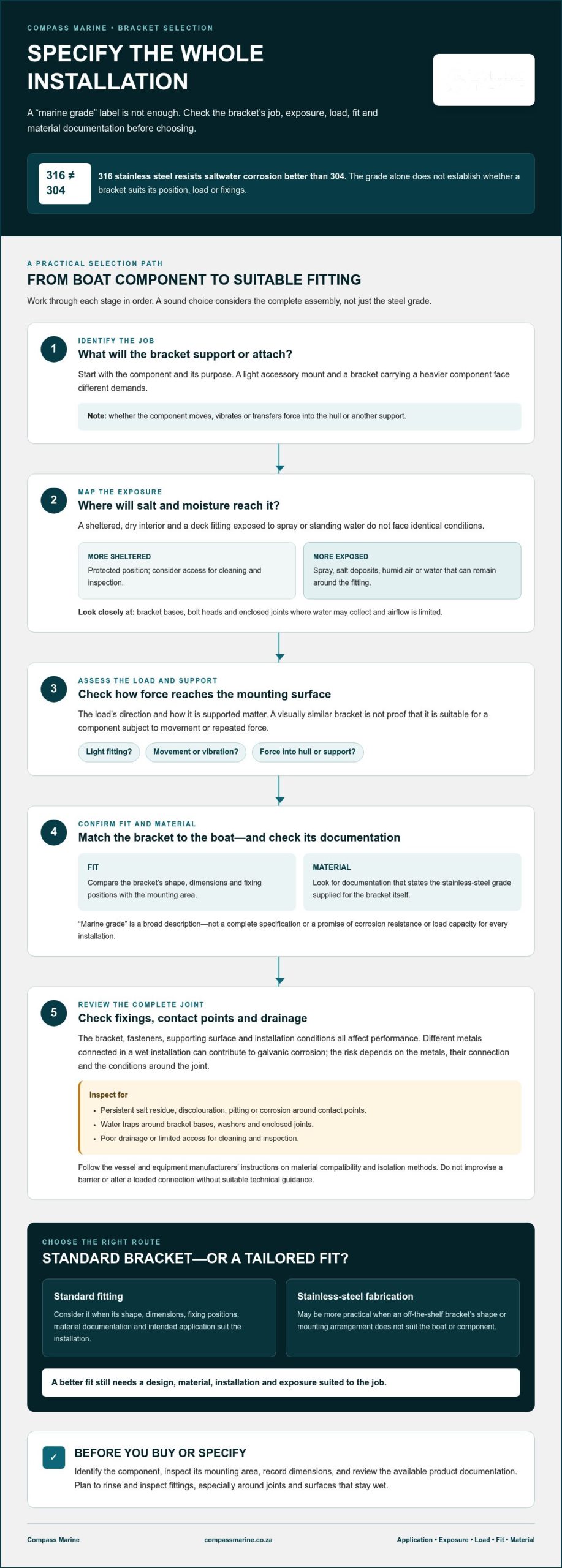
How to compare marine grade stainless steel brackets before buying
Compare each option against the job it must perform, not just its appearance or material label. Suitability depends on the full installation, including the component, load direction, fixing arrangement and supporting surface. Use the table to organise the information before selecting or specifying marine grade stainless steel brackets.
| Application | Shape | Mounting surface | Stated material | Documentation |
|---|---|---|---|---|
| What component will it support or attach? | Does the form suit the component and required position? | What surface will receive the fixings, and is it sound and accessible? | Is the stainless-steel grade clearly stated? | Are dimensions, intended use and any load information supplied? |
This comparison can reveal missing information before you buy. If a product listing gives a material description but no dimensions or intended application, you may not have enough detail to judge fit. Do not assume that a similar-looking bracket will perform the same way.
Which bracket shape and mounting arrangement suit the job?
An angle bracket can join surfaces that meet at a corner. A flat bracket may suit an attachment across aligned surfaces, while a formed or shaped support may follow a particular component or mounting arrangement. These are broad design categories, not proof that a bracket will suit a specific boat. Check the geometry against the component’s position and the direction in which force will act.
Next, consider the fixing points. Can you reach the fasteners for installation and later inspection? Is there suitable backing support behind the mounting surface, and is the surface sound rather than cracked, softened or distorted? A bracket may line up neatly from the outside but still be impractical if its fixings cannot be adequately supported. Follow the boat or equipment manufacturer’s mounting instructions wherever they apply.
What product details should appear in a bracket specification?
Record the information supplied for the bracket and compare it with the actual installation. Useful specification details include:
- Material: The stated stainless-steel grade, rather than only a general “marine grade” description.
- Dimensions: The overall measurements and any relevant bends or offsets.
- Hole positions: Their location and spacing, so you can compare them with the existing mounting points.
- Finish and intended application: Details that help identify how the product is finished and what use it is described for.
- Load information: Any data supplied by the manufacturer for the product and its stated mounting conditions.
Do not treat thickness, size or a sturdy appearance as evidence of load capacity. Use manufacturer-provided load information that applies to the product and its stated conditions. Load direction and the way the bracket transfers force into its mount matter, as do the supporting surface and fixings. If a standard shape does not match the required geometry, a tailored fabricated fitting may be more suitable than modifying a bracket without a clear basis.
How to check bracket fit, loading and installation conditions
A bracket can look like a match and still be unsuitable once fitted. Before selecting marine grade stainless steel brackets, make a safe, non-invasive check of the component, mounting area, dimensions and available product information. Do not remove a loaded fitting or disturb structural parts to inspect them.
- Identify the component. Note what the bracket supports or attaches, whether it moves during normal use and whether the manufacturer specifies a mounting arrangement.
- Inspect the mounting area visually. Look for movement, visible corrosion, cracking, distortion or water collecting around the fitting. A clean-looking outer face does not prove that the hidden support is sound.
- Record dimensions and clearance. Measure the mounting face, available space, hole centres and the supported component’s position. Note anything that could prevent fitting or later inspection.
- Compare the evidence. Review the bracket maker’s drawings and documentation alongside the relevant boat or equipment manual. Resolve differences using the manufacturer’s requirements, not guesswork.
These checks help you describe the installation accurately, but they do not determine a safe load capacity. A component may vibrate, move repeatedly or experience changing forces while the boat is operating. Corrosion or a weakened mounting surface can also affect how the load is transferred. A visual match cannot account for all these factors.
Watch for new movement, cracking around a mounting point, corrosion at the bracket or fixings, and water that remains trapped around the fitting. If a support is loose or damaged, do not rely on it for a safety-critical function until it has been assessed. Work affecting structural support or safety requires a competent marine technical assessment, particularly if the supporting structure’s condition is uncertain.
What measurements should you take before selecting a bracket?
Record the mounting-face length and width, clearance around the bracket, hole centres and the position of the component it supports. Include the space needed to reach the fixings and inspect the area later. Compare your measurements with the bracket maker’s drawings and the equipment manual. Do not enlarge or alter mounting holes just to make a near match fit.
When is fabrication a better fit than a standard bracket?
A tailored bracket may be worth considering if unusual geometry, restricted clearance or an existing mounting arrangement prevents a suitable fit with a standard shape. Custom fabrication does not automatically increase strength or prevent corrosion; the design, material, installation and exposure still need consideration. Share your measurements and installation details when you discuss a stainless-steel fabrication requirement with Compass Marine.
Choose marine grade stainless steel brackets with the whole installation in mind
When planning a refit or equipment upgrade, consider bracket choices alongside the wider work. Record what the fitting supports, its material and how it is mounted. Those details can guide future maintenance and make it easier to identify a suitable replacement if the bracket needs attention.
For marine grade stainless steel brackets, a clear record of the fitting and its intended role helps keep later decisions grounded in the actual installation. If your project calls for stainless-steel fabrication, Compass Marine can discuss the requirement as part of its marine technical work.
Find out more about stainless-steel fabrication.
Turn your bracket requirements into a clear next step
Before ordering or commissioning a fitting, gather the installation details: what the bracket supports, where it sits, how it mounts and what the manufacturer specifies. This gives you a practical basis for deciding whether a standard part is appropriate or a tailored design is worth discussing. It also connects material choice to the boat’s operating conditions instead of relying on a label alone.
The right marine grade stainless steel brackets should suit the complete assembly, including its support and access for future inspection. If your requirement involves a non-standard shape or mounting arrangement, Compass Marine’s stainless-steel fabrication and marine technical services provide a relevant starting point for planning the work.
Contact Compass Marine about your stainless-steel fabrication requirement to discuss the fitting your boat needs.
Frequently Asked Questions
Is 316 stainless steel always the best choice for marine brackets?
No. 316 may suit a bracket exposed to marine conditions, but the grade alone does not determine whether a fitting is suitable. Keep the product description and purchase documentation with the boat’s maintenance records. These provide a reliable reference if you need to replace the fitting, rather than relying on appearance or memory to identify the material.
Can stainless steel brackets corrode in saltwater?
Yes. Stainless steel can corrode and still needs care. During routine cleaning, check for changes in colour or surface condition and compare them with earlier observations. Do not assume a mark is harmless simply because it is small, particularly if it returns after cleaning. Follow the fitting maker’s advice on cleaning products and methods, as unsuitable chemicals or abrasives may damage the surface or finish.
How do I know what load a marine bracket can support?
Use load information that applies to the exact bracket and its specified use. Do not transfer a rating from a similar-looking model or assume it remains valid if you change the supported component. If an upgrade changes what the bracket carries, treat it as a new installation decision. Keep the relevant product details with the boat’s records so a future owner or technician can understand the basis for the fitting.
What is the difference between 304 and 316 stainless steel brackets?
304 and 316 are different stainless-steel grades, and neither is a universal answer for every boat. Check product records to identify the grade; a polished finish or general label does not prove the alloy. Keeping those records is particularly useful if a bracket is removed during a refit, as they help you assess whether a replacement is equivalent.
Should I choose a standard or custom-fabricated marine bracket?
A standard bracket can be a practical replacement when the original fitting is identifiable and the replacement suits the same component and arrangement. Fabrication may be useful for an older boat, unusual equipment or a layout that has changed. If you choose a tailored fitting, keep a drawing or clear project record with the vessel to help plan future inspection, maintenance or replacement.
How often should I inspect stainless steel brackets on a boat?
Follow the vessel or equipment maker’s guidance, as inspection needs vary with use and exposure. Keep dated notes or photographs so gradual changes are easier to recognise. Recheck a fitting after an impact, repair or equipment change rather than waiting for the next routine inspection. If you see damage or the bracket becomes unstable, stop relying on it and seek a competent assessment.