
Could a dependable engine still leave you with a boat that isn’t ready for the water? Marine maintenance services cover more than engine work. Reliability also depends on connected systems, service history and how the vessel is used.
It can be difficult to know which checks you can handle yourself and when a concern needs a qualified marine technician. Saltwater, coastal humidity and sun exposure can accelerate corrosion and wear, so regular attention is useful for boats operating in South Africa’s coastal conditions.
This guide explains the main types of professional maintenance, including engine servicing, mechanical repairs and electrical fault diagnostics. It also compares preventative maintenance, repair-led work and owner upkeep, and shows what information to gather before arranging support. Keep the relevant manufacturer’s requirements in mind, as the right work depends on your vessel, its equipment and its condition.
Key Takeaways
- Marine maintenance services can include planned servicing, repairs and checks across a vessel’s systems. The right scope depends on its condition and use.
- Describe what you’ve observed, such as an intermittent starting issue, rather than assuming a cause. Related systems may need assessment.
- Choose planned servicing, repair-led support or basic owner upkeep according to the task, and follow the relevant equipment manual.
- Gather your vessel and engine details, service history and a clear description of the concern to make the maintenance discussion more focused.
- Compass Marine provides servicing for outboards, inboards and jet skis, supported by certified Yamaha and Suzuki mechanics.
What Do Marine Maintenance Services Cover for a Boat?
What needs attention before you can use your vessel with confidence? It depends on its condition, how often it’s used and the systems fitted. Marine maintenance services can include planned checks, routine servicing and repairs, with the work scoped to the boat rather than treated as a one-size-fits-all package.
Professional support may include engine servicing, electrical fault diagnostics, or refurbishment when a boat or trailer needs more than routine care. Secure indoor storage is another option when a vessel is not in use, but it does not replace maintenance suited to the boat’s condition. A reliable engine does not rule out an electrical fault, and a boat due for servicing may not need refurbishment.
Preventative maintenance is planned work intended to monitor condition and reduce the chance of avoidable problems. Corrective repair addresses a fault or damage that has already appeared.
Which vessel systems may need professional attention?
Engine servicing applies to outboards, inboards and jet skis, but the work depends on the engine and its service history. A starting or running concern is useful information to share, not a diagnosis. A qualified marine technician can assess the engine and determine an appropriate scope of work. Compass Marine provides engine servicing and mechanical repairs, with certified Yamaha and Suzuki mechanics supporting its engine services.
Electrical fault diagnostics address issues such as equipment that behaves intermittently or stops working. Because electrical systems can affect several fitted components, describe what happens and when, rather than assuming the cause. The wider field of marine engineering includes vessel machinery and related systems, showing why maintenance may extend beyond the engine.
If visible wear or damage affects the boat or trailer, refurbishment may be more appropriate than routine engine care. Secure indoor storage can help protect a vessel while it is out of use, but the boat’s maintenance needs still depend on its condition and the relevant manuals.
Why maintenance needs differ between boats
A small fishing boat used occasionally has a different pattern of use from a vessel operated frequently. Engine type, installed equipment, service records and storage conditions all affect what deserves attention. Changes in use, such as launching more often or leaving the boat unused for an extended period, are useful context when discussing service needs.
Operating conditions matter, too. Saltwater exposure and coastal humidity make corrosion a practical concern, particularly around exposed metal and electrical connections. Note visible changes, unusual operation or equipment that has stopped working, but don’t dismantle systems to investigate a suspected fault. Leave technical assessment and repairs to a qualified marine technician.
There is no single service interval that suits every boat or engine. Use the relevant manufacturer’s manual for maintenance schedules and equipment-specific requirements. If guidance differs between the boat, engine and fitted equipment, follow the instructions that apply to each. Keeping service records and describing how the vessel is used helps make maintenance decisions relevant to its condition.
How Do Boat Systems and Maintenance Needs Connect?
A symptom is a starting point, not a diagnosis. An engine that struggles to start, an unexpected warning or equipment that cuts out can involve more than one part of the vessel. Guessing at a single cause may miss useful context, so a technician may need to assess related systems before recommending work. Marine maintenance services should be scoped around what the boat is doing, not just the first fault a boat owner suspects.
“A symptom is useful information for an assessment, not proof of what has failed.”
What observations can help explain a maintenance concern?
Keep a brief record of what changed and when. For example, note whether a new noise began on the latest outing, a warning appeared during starting or underway, or a performance change has happened more than once. Describe what you noticed without naming a fault you can’t verify.
Conditions can help put the observation in context. Record whether it happened during starting, at a particular engine speed, after the boat had been unused or while other equipment was operating. Don’t recreate a problem if doing so could put you or the vessel at risk.
- Note when the concern first appeared and whether it has recurred.
- Describe what was happening at the time, including any warning or change in sound or performance.
- Share service records and anything that has changed since the previous outing.
These details separate what you directly observed from what still needs technical investigation. A clear account is more useful than an attempted repair or an assumed diagnosis.
When should a marine technician assess the vessel?
Arrange a professional assessment for persistent or unfamiliar engine symptoms, repeated warnings, erratic electrical equipment or a change that affects the vessel’s operation. For instance, if an instrument display dims at the same time as an engine concern appears, report both observations. They may justify checking related systems, but they don’t prove that one caused the other.
Limit owner checks to observations and routine tasks described as suitable in the relevant manual. Don’t open electrical equipment, bypass a warning or modify engine systems to see if the problem disappears. This can create additional faults or safety risks. If the concern could affect safe operation, don’t rely on guesswork before using the vessel.
The American Boat & Yacht Council (ABYC) develops standards for recreational boat design, construction, maintenance and repair. Its material can provide useful background, but it isn’t a substitute for the manufacturer’s instructions or applicable South African requirements. Where procedures or specifications differ, follow the guidance for the specific boat, engine and equipment.
Compass Marine provides electrical fault diagnostics and engine mechanical services to help assess concerns based on the symptoms and service history you provide. Explore marine support from Compass Marine when a vessel issue needs professional attention.
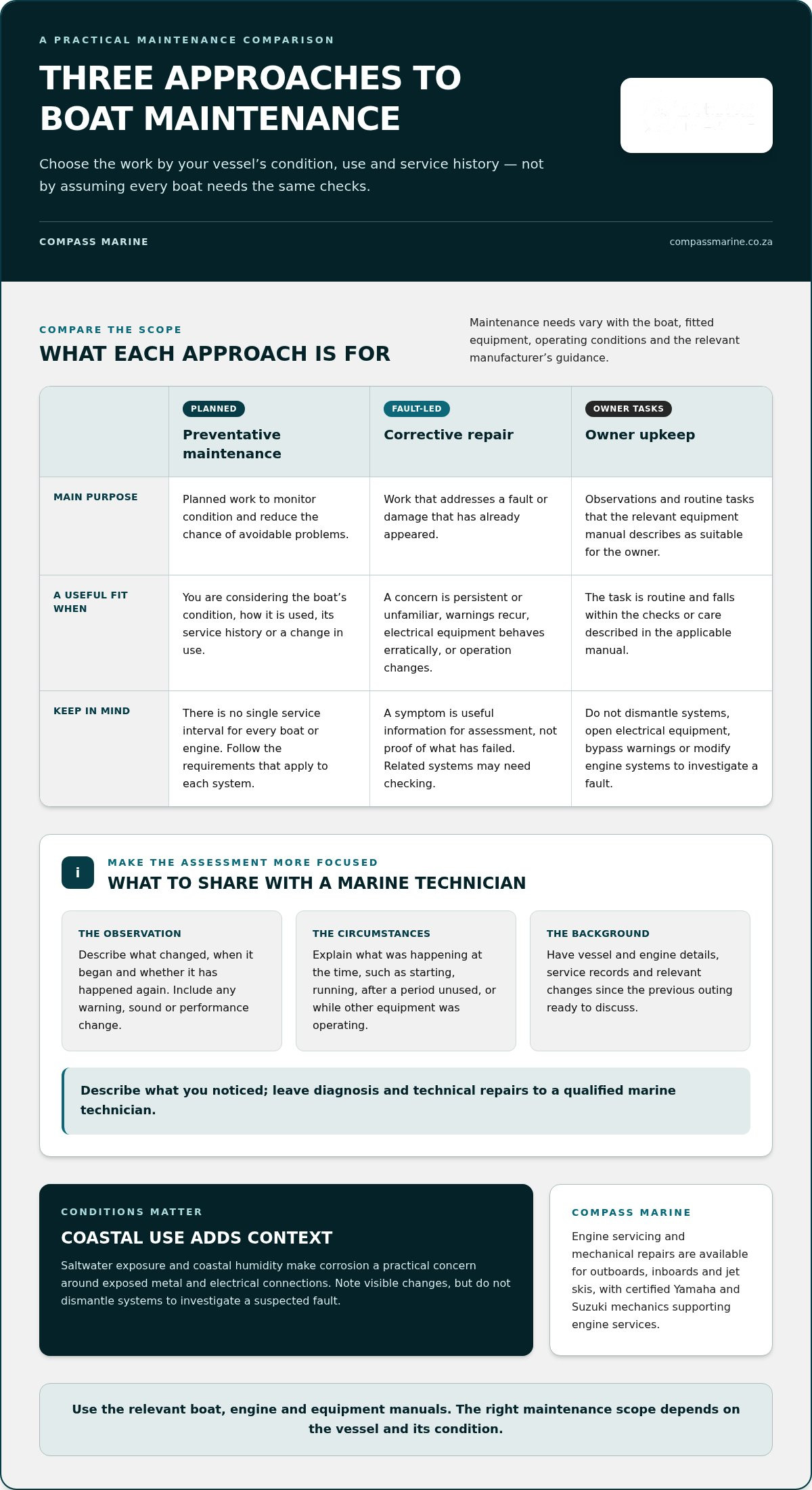
Planned Maintenance, Isolated Repairs or Owner Upkeep: Which Approach Fits?
There isn’t one right maintenance approach for every boat. Planned servicing attends to known requirements, repair-led work responds to a problem, and owner upkeep helps you notice visible changes between professional checks. These approaches can work together, but they aren’t interchangeable. Owner observations cannot replace technical work that requires a qualified marine technician.
| Approach | Purpose and suitable scope | Limits |
|---|---|---|
| Planned professional servicing | Attend to manufacturer-led servicing and known maintenance needs, guided by the engine or equipment manual, use and condition. | It doesn’t guarantee that faults won’t arise between services. |
| Repair-led visit | Investigate a specific fault, damage or change in performance, with assessment and work focused on the reported concern. | It may not address other scheduled maintenance unless that work is also identified and agreed. |
| Basic owner upkeep | Carry out manual-approved routine checks and keep a record of changes noticed during use or storage. | It doesn’t replace professional servicing, diagnostics or repairs requiring technical expertise. |
When does planned professional servicing make sense?
Planned servicing is useful when a manufacturer specifies maintenance requirements or the boat’s service history shows work is due. It gives a technician context about what has already been done and what may need attention next. Keep invoices, service records and notes together, even if work was completed at different times. A clear history makes future discussions more focused.
Don’t assume every engine follows the same timetable. Follow the relevant engine manual, taking account of the manufacturer’s requirements, how the vessel is used and its operating conditions. If the manual differs from general advice, follow the instructions for that engine or equipment. Professional servicing can address scheduled needs, but it can’t promise that every breakdown will be prevented.
Structured training and certification are part of the wider marine industry. The Association of Marina Industries (AMI) offers training and certification programmes, reflecting the value of professional development in marina operations. This is useful context, not a substitute for checking the requirements that apply to your vessel and equipment.
What can owners safely monitor between services?
Follow your vessel and equipment manuals for owner-level checks. You can note visible changes, such as damage, signs of corrosion, fluid traces or equipment that appears loose, without dismantling components or attempting repairs. Record when you noticed a change and whether it has happened again.
Arrange a professional service assessment if an observation persists, worsens or affects normal operation. Share your records and relevant service history. This helps distinguish routine monitoring from work that needs technical assessment, and keeps the scope grounded in the boat’s condition rather than guesswork.
How to Prepare for Marine Maintenance Services
A focused service discussion starts with clear information about the vessel and the concern. Before arranging marine maintenance services, work through these steps. You don’t need to diagnose the problem. Useful observations, records and equipment details help establish a relevant scope for assessment.
- Identify the main concern. Write down what needs attention, such as a change in engine behaviour, an electrical item that has stopped working or visible damage to the boat or trailer. Keep the description factual.
- Record when it happens. Note when you first noticed the issue and whether it occurs during starting, while underway, after storage or in particular operating conditions. Avoid recreating a symptom if doing so could be unsafe.
- Gather vessel and equipment details. Use the boat, engine and equipment documentation to record the identifying details shown there. Include relevant manuals, service records and maintenance notes.
- Agree the scope. Explain the main concern and any related changes. Discuss whether engine servicing, electrical diagnostics, trailer work or refurbishment is relevant, then allow the technician’s assessment and manufacturer guidance to inform the final scope.
What vessel information should you gather?
Bring the vessel and engine details recorded in the relevant documentation, along with manuals for the systems involved. Service history helps show what work has been completed and what may be due under the manufacturer’s instructions. If records are incomplete, say so rather than filling gaps with guesses. Summarise recent use, periods out of service and changes noticed since the last outing.
Separate what you observed from what you think may have caused it. For example, “the engine took longer to start after storage” describes an observation; “the battery has failed” assumes a cause. That distinction gives the technician a clearer starting point without steering the assessment towards an unverified fault.
How to describe the work you need
State the primary concern first, then mention related changes. If an engine symptom appeared alongside an electrical issue, report both rather than assuming they share a cause. For visible damage to a boat or trailer, describe its location and what has changed, without dismantling components to investigate further.
Keep the requested work aligned with the relevant manuals and the vessel’s condition. The technician’s assessment may refine the scope once the concern is understood. This allows for the appropriate work without treating every service category as necessary for every boat.
With the concern, records and equipment details organised, you can have a more useful discussion about the next step. Discuss your vessel’s maintenance needs with Compass Marine, including engine servicing, electrical diagnostics or boat and trailer refurbishment.
Compass Marine Support for Your Vessel’s Maintenance Needs
Once you’ve identified what needs attention, agree a scope that fits the vessel rather than assuming every system needs work. Compass Marine provides engine servicing and mechanical repairs for outboards, inboards and jet skis, as well as electrical fault diagnostics and boat and trailer refurbishment. The appropriate work depends on the vessel and the findings of a professional assessment.
Technical support shaped around the concern
Different symptoms call for different kinds of assessment. A change in engine behaviour, an electrical issue and visible deterioration to a boat or trailer are distinct concerns. Describe each one clearly and share relevant service records. This helps keep the discussion focused on work that relates to your vessel, without treating an initial observation as a confirmed diagnosis.
Where the concern extends beyond routine maintenance, the scope may involve mechanical work or condition-related refurbishment. The details matter: the affected area, what has changed and any relevant manufacturer instructions can help frame the next step. Explain what you’ve observed and leave technical assessment to the marine professional.
Discussing the next maintenance step
Before arranging support, gather the boat and equipment details shown in your documents, along with available manuals and service history. Note when the concern began and whether it has changed. If an issue appeared after the vessel had been unused, mention that context without assuming it caused the problem.
The requested scope can then be considered against the vessel’s condition and the manufacturer’s guidance. Some concerns call for attention to one system, while others may need a broader assessment. The aim is to discuss relevant work clearly and avoid assuming that every boat requires the same maintenance.
Contact Compass Marine to discuss your vessel’s maintenance requirements and share the details that will help frame the conversation.
Make Your Next Maintenance Decision with Confidence
Good vessel care is an ongoing process, not a single appointment. Use each outing as a chance to notice changes, and each service as an opportunity to keep your records current. Over time, that history can help you make better-informed decisions about what deserves attention next, rather than waiting until uncertainty affects your plans.
The right marine maintenance services depend on your vessel’s condition, use and equipment. You don’t need to arrive with a diagnosis; a clear account of what you’ve noticed is a sensible place to start. From there, the next step can be shaped around the boat and relevant manufacturer guidance.
Contact Compass Marine to discuss maintenance for your vessel and agree a practical next step. With clear information and the right technical support, you can approach your next day on the water with greater confidence.
Frequently Asked Questions
How often should a boat receive professional maintenance?
Follow the service schedule in the relevant engine and equipment manuals, then account for how often and under what conditions the boat is used. A vessel used regularly in saltwater may need different attention from one used occasionally and stored indoors. Keep a record of completed work and operating hours if the manufacturer’s guidance uses them. Compass Marine’s marine maintenance services can be discussed in line with your vessel’s requirements.
Can saltwater exposure affect a boat even after rinsing?
Yes. Rinsing with fresh water helps remove salt from accessible surfaces, but it can’t guarantee that salt has been cleared from every crevice, fitting or enclosed area. Allow the boat to dry and watch for visible corrosion, deposits or changes around exposed components. If you notice deterioration or equipment behaving differently, record where it appears and arrange an assessment rather than dismantling parts.
What information should I provide when arranging marine maintenance?
Give the boat and engine details shown in your documents, the equipment involved and a clear description of what you’ve noticed. Include when it began, whether it has happened more than once and any recent work that might be relevant. If a display shows a warning, note its wording rather than interpreting it. Manuals or records can help clarify model-specific requirements and previous maintenance.
Do all boats need the same maintenance schedule?
No. Service needs depend on the engine and equipment, manufacturer guidance, use and storage conditions. Two similar boats may need different attention if one is used frequently and the other spends long periods unused. Start with each relevant manual rather than borrowing another owner’s timetable. Where several systems have separate requirements, keep their guidance together so an equipment check isn’t mistaken for a complete vessel service.
What should I do if an engine develops an unfamiliar noise?
Take an unfamiliar noise seriously, particularly if it persists or comes with a warning or change in performance. If you can do so safely, stop operating the engine and follow the manual’s instructions; don’t open components or attempt a repair. Note when the noise occurs and describe it to a marine technician. Avoid further use if you’re unsure whether the engine can be operated safely.
Should a boat be checked after spending time in storage?
Yes. Before launching, look over accessible areas for visible damage, corrosion, signs of water ingress or changes to equipment, and consult the relevant manuals for recommissioning and start-up procedures. Storage doesn’t confirm that every system is ready for use. If something looks unusual, or the engine or equipment doesn’t behave as expected, pause and arrange a professional assessment before heading out.