
The most sheltered option isn’t automatically the best fit for your boat. When comparing a marine storage facility, match the storage type to your vessel, trailer and plans for using it again. A boat kept outdoors between regular trips has different needs from one laid up for an extended period, particularly where salt air, humidity and strong sun can contribute to corrosion and wear.
To choose well, compare indoor, covered and outdoor storage, then assess security, access, space and practical requirements such as trailer dimensions. Before storage, clean and dry the boat, record its condition and follow the care guidance in the relevant manufacturer’s manual. Compass Marine provides secure indoor boat storage for owners who want a sheltered option. The checks in this guide can help you select suitable storage and prepare your vessel responsibly.
Key Takeaways
- Choose a marine storage facility according to your boat, how long it will be stored and how you’ll access it.
- Compare indoor, covered and outdoor arrangements for weather exposure, space needs and suitability for your craft.
- Look beyond a security claim: understand the access arrangements, responsibilities and storage environment.
- Before storage, organise your documents, clean and dry the boat, record its condition and follow the relevant manuals.
- Compass Marine provides secure indoor boat storage for owners considering a sheltered storage option.
Marine storage facility: when does your boat need dedicated storage?
A marine storage facility is a managed place to keep boats, trailers or related equipment between outings. Whether it suits your boat depends on the vessel, how long it will be stored and how often you need access. A small craft used most weekends has different practical needs from a larger boat laid up between seasons.
Dedicated storage can be useful when a boat and trailer take up too much room at home, when there’s a long break between trips, or when the vessel would otherwise be exposed to coastal humidity, salt and strong sun. These conditions can contribute to corrosion and wear, particularly if a boat is put away damp. Storage can help manage space and exposure, but it doesn’t replace cleaning, maintenance or care specified by the manufacturer.
Which boat owners may benefit from dedicated storage?
Owners without suitable space at home may find it easier to keep the boat and trailer at a dedicated facility than to manoeuvre them into a tight driveway or leave them obstructing the property. Seasonal anglers and recreational boaters can also plan storage around periods when they expect to use the boat less, rather than making space at home between trips.
Consider your routine as well as the boat’s size. If you regularly tow to launch, the storage arrangement needs to work with the trailer and your access plans. If the craft is used occasionally, the time it spends unused makes a deliberate storage and care plan more valuable. A boathouse is one recognised form of boat storage, traditionally associated with keeping smaller craft near the water.
What storage can and cannot do for a vessel
Storage gives a boat a designated place between outings and may reduce exposure, depending on the arrangement. It can’t guarantee that a vessel will remain in perfect condition. Indoor, covered and open storage offer different levels of exposure, and the actual environment matters as much as the label used to describe it.
Keep the boat, engine and trailer in your own maintenance plan. Before a longer lay-up, consider the following:
- Boat: Check for damage, water ingress or damp areas that need attention before storage.
- Engine: Follow the manufacturer’s storage and maintenance instructions rather than relying on a general routine.
- Trailer: Keep up with its condition and maintenance, even when it isn’t being used for regular trips.
If you’re unsure how to prepare an engine or equipment for an extended period, consult its manual or seek qualified marine assistance. A marine storage facility can support a practical storage plan, but preparation and ongoing care remain essential to having the boat ready for its next outing.
Indoor, covered, or outdoor marine storage: which format fits your boat?
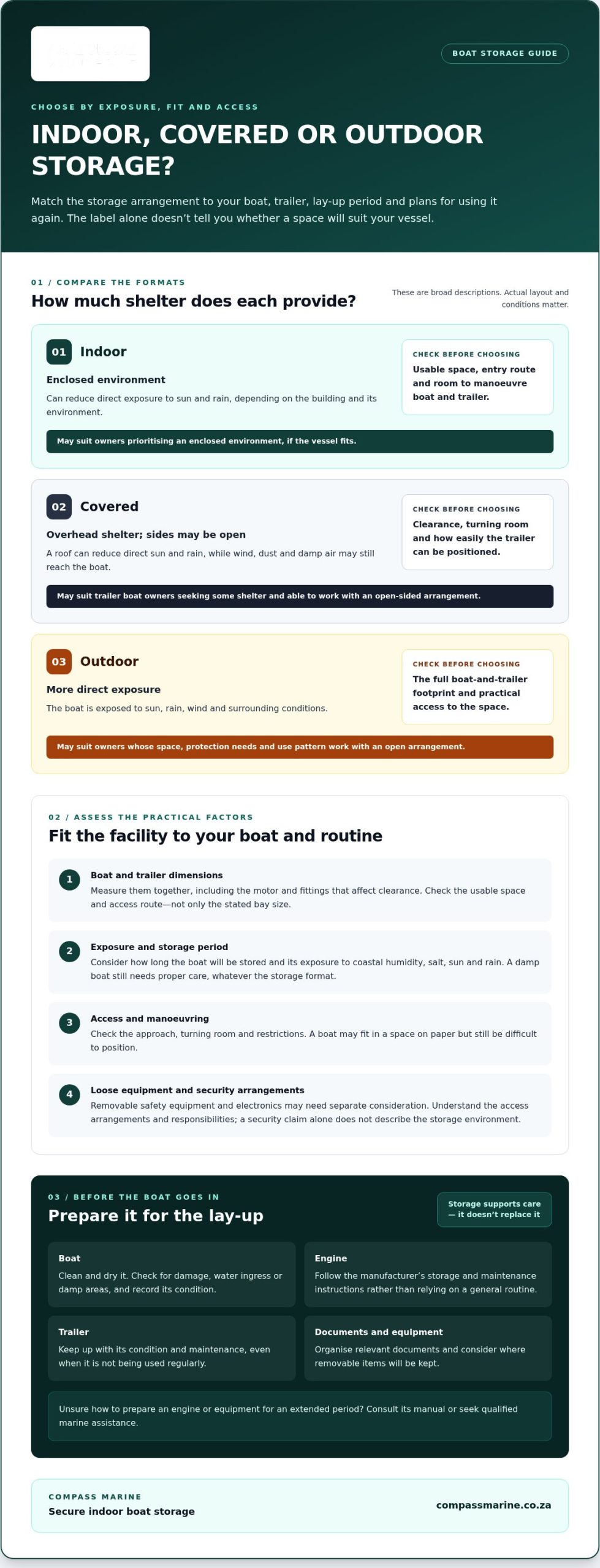
Choose a storage arrangement by weighing weather exposure against space, access and how the boat will be kept. Indoor storage is enclosed; covered storage generally provides overhead shelter while leaving some sides exposed; outdoor storage leaves the boat exposed to the elements. These are broad descriptions, not universal standards, so the actual layout and conditions matter.
| Storage format | Weather exposure | Space and access considerations | May suit |
|---|---|---|---|
| Indoor | Can reduce direct exposure to sun and rain, depending on the building and its environment. | Check the usable space, entry route and room to manoeuvre the boat and trailer. | Owners prioritising an enclosed environment for a vessel that fits the available space. |
| Covered | Overhead shelter can reduce direct sun and rain, but the sides may remain open to wind, dust and damp air. | Consider clearance, turning room and how easily the trailer can be positioned. | Trailer boat owners who want some shelter and can work with an open-sided arrangement. |
| Outdoor | The boat is more directly exposed to sun, rain, wind and surrounding conditions. | Confirm the parking area suits the full boat-and-trailer combination and allows practical access. | Owners whose space, protection needs and use pattern are compatible with an open arrangement. |
When indoor boat storage may be the better fit
Owners of a valuable vessel may prefer an enclosed environment to limit direct exposure to sun and rain, particularly during a longer period ashore. Indoor storage still isn’t a substitute for suitable preparation or care. Before choosing a marine storage facility, measure the boat and trailer together, including the motor and any fittings that affect clearance. Compare those dimensions with the usable space and access route, not just a stated bay size.
When covered or outdoor storage may suit the arrangement
Overhead cover and indoor storage aren’t interchangeable. A roof can shield the boat from direct weather while leaving it open to windblown moisture and salt. Outdoor parking may be practical if regular trailer access is a priority and you accept greater exposure. Removable items such as safety equipment or electronics need separate consideration, since a boat bay doesn’t necessarily provide indoor space for loose gear.
Whatever the format, check the approach and manoeuvring area as well as the parking footprint. A boat that fits on paper may be difficult to position if the trailer needs turning room or the route has restrictions. The actual dimensions and layout determine fit, so don’t assume a space will accommodate a particular hull or trailer based on its category alone.
Safety language also needs context. The US OSHA Regulations for Marine Terminals address marine-terminal workplace safety. They aren’t South African storage requirements or a measure of whether a boat bay suits your vessel. Compass Marine provides indoor boat storage for owners considering secure indoor storage.
Is a secure marine storage facility enough to protect your boat?
No. A security claim is only one part of deciding whether storage suits your vessel. It doesn’t explain the conditions the boat will be kept in, how access is managed or who is responsible for what while it’s stored. A well-secured space may still be a poor fit if the boat is exposed to damp, can’t be accessed as planned or hasn’t been prepared for a period ashore.
Facility suitability depends on both the storage environment and the owner’s vessel-specific care. Consider security, access, storage conditions and your maintenance plan together, rather than treating one feature as a guarantee of protection.
Assess security and access in practical terms
Understand who can enter the storage area and under what arrangements. Find out how you access your boat, whether access needs to be arranged in advance, and how visitors or people working on the vessel are handled. Procedures vary, so make sure they fit the way you expect to use and maintain the boat.
Clarify where the facility’s responsibility ends and yours begins. For example, establish who is expected to report a concern, how you’ll be notified about an issue and whether you’re responsible for arranging checks or maintenance. Don’t assume a general description of security explains what happens in every situation. Clear expectations help avoid confusion if you need to retrieve the boat or attend to it during storage.
Consider coastal exposure and ongoing boat care
Keeping a boat ashore doesn’t remove the effects of coastal conditions. Salt residue left after a trip and moisture retained in enclosed areas can contribute to corrosion if cleaning and care are neglected. Humidity may also remain relevant in a sheltered space. Storage can reduce some direct exposure, but the result depends on the environment and how the vessel is prepared.
Before storage, consider the boat’s recent use and condition. A craft returned from saltwater may need appropriate cleaning and drying, while an engine or electrical item may have specific storage instructions. Follow the relevant boat, engine, battery and equipment manuals, as requirements can differ. If a maintenance task is outside your experience or requires technical work, arrange qualified marine assistance rather than improvising.
Apply the same care to the trailer and removable equipment. Note existing damage or signs of corrosion, and keep maintenance needs on your schedule rather than assuming storage will address them. Recording the boat’s condition beforehand makes it easier to assess any changes during storage.
For more practical considerations, see this secure indoor boat storage guide. Weigh the storage arrangements and conditions against your boat’s materials, equipment and intended storage period, then keep up with the care its manufacturer recommends.
How to prepare your boat before placing it in marine storage
A few checks before drop-off can make it easier to spot changes later and help prevent avoidable problems while the boat is ashore. Preparation requirements vary with the vessel, engine, equipment and storage period. Use this checklist as a general guide, then follow the instructions for your particular boat and gear.
Complete owner-level checks before storage
Prepare the boat in a clear sequence: gather relevant records, remove loose items, clean and dry suitable areas, then document its condition. Check care instructions before using cleaning products or covering materials, as hull finishes, upholstery and onboard equipment may have different requirements.
- Organise documentation. Keep together the vessel and engine details, maintenance records and any documents required by the storage arrangement. This information helps you track previous work and plan servicing before the next outing.
- Remove loose belongings. Take out food, rubbish and personal items that shouldn’t remain aboard. Sort removable fishing, safety and electronic equipment according to its care instructions, and store it in an appropriate place.
- Clean the boat appropriately. Remove dirt and salt residue using methods suitable for the boat’s surfaces and equipment. Avoid a product or technique if the manufacturer’s care guidance advises against it.
- Allow damp areas to dry. Check accessible spaces where water or moisture may remain, such as lockers and the bilge. Dry them as appropriate for the vessel, and don’t close damp items away where they may stay wet.
- Review engine, battery and equipment guidance. Storage requirements differ between models and setups. Read the relevant manuals before carrying out any storage-related procedure, particularly for fuel systems, batteries or electrical equipment.
- Make a final condition record. Photograph the hull, interior, engine and trailer, and note existing marks or damage. A dated record gives you a useful reference when you inspect the boat before using it again.
Know when maintenance needs a marine professional
Owner-level preparation doesn’t mean attempting every maintenance task yourself. Fuel handling, engine work, battery procedures and electrical repairs can carry risks or require model-specific knowledge. Don’t improvise based on a generic checklist. If the manual calls for technical work or you’re unsure how to do it safely, leave it to a qualified marine technician.
If storage preparation raises questions about an engine’s condition or servicing needs, Compass Marine provides marine mechanical support, including engine servicing. The professional marine engine servicing guide offers further context on engine care. Information about indoor boat storage is available through Compass Marine.
Choose Compass Marine for secure indoor boat storage
Choosing a marine storage facility means weighing the boat’s needs against the storage arrangement, access and care it will require while ashore. Compass Marine provides secure indoor boat storage for owners looking for an indoor option. It can suit a vessel whose size and storage needs fit an enclosed arrangement.
Storage is only one part of looking after a boat. A fishing boat used regularly, for example, may need storage plans that work with its trailer and your launch routine. A vessel that will be ashore for longer also needs an appropriate care plan. The right decision depends on your boat, engine, equipment and how you intend to use the vessel again.
How marine expertise supports a storage decision
Planning storage alongside the boat’s mechanical needs can help you prepare for the next outing. If your engine is due for maintenance before a period ashore, Compass Marine provides marine mechanical services, including engine servicing. The work required depends on the engine, its condition and the manufacturer’s instructions, so use the relevant manual to guide storage-specific care.
This joined-up view is useful when storage planning raises practical questions about readiness for the next trip. An engine concern isn’t resolved simply because the boat is stored indoors. Equally, routine storage preparation shouldn’t replace servicing that’s due or technical attention for a fault. Keep the tasks distinct: plan the storage arrangement, follow equipment guidance and address mechanical work appropriately.
Take the next step with Compass Marine
Before arranging storage, bring together the details that shape your choice: the vessel and trailer dimensions, the length of time it will be stored, your expected access needs and any care requirements in the manuals. These details provide a clear basis for deciding whether indoor storage suits your boat. The space and arrangement must fit the actual craft, rather than assumptions based on boat type alone.
With those practical needs in mind, you can make a storage plan that suits your vessel. Compass Marine provides secure indoor boat storage and marine mechanical support, including engine servicing when it’s part of your preparation.
For an indoor storage option, contact Compass Marine about secure indoor boat storage.
Plan your boat’s next storage period with confidence
Before arranging storage, think ahead to the boat’s first outing after its time ashore. What will need attention before launch, and how much time will you need to make those checks? Build this into your plan now to avoid a last-minute scramble and keep your storage decision connected to how you use the vessel.
The right marine storage facility should fit your boat and the way you intend to care for it, rather than simply offering a space. If indoor storage is the option you’re considering, Compass Marine provides secure indoor boat storage.
Contact Compass Marine to discuss indoor boat storage. With a clear plan in place, you can prepare for your next time on the water with greater confidence.
Frequently Asked Questions
What is a marine storage facility?
A marine storage facility is a managed place where boats are kept between uses, and some arrangements also accommodate related equipment. The term doesn’t tell you whether a boat is stored indoors, under cover or outdoors. A trailer boat and its removable electronics, for example, may need separate storage arrangements. Establish what the storage space is intended to hold before planning drop-off, so you don’t arrive with items that have no designated space.
Is indoor boat storage better than outdoor storage?
Indoor storage can be preferable when limiting direct exposure to sun and rain is a priority, but it isn’t automatically better for every owner. A boat used frequently may benefit more from convenient retrieval and room to prepare it before launch. Consider how long it’ll be ashore, which surfaces or equipment need protection, and whether the access arrangement fits your routine. The right choice depends on your priorities and the actual storage conditions.
Can I store a boat on its trailer at a marine storage facility?
That depends on whether the layout can accommodate the complete boat-and-trailer combination. Measure the overall length from the trailer’s furthest point to the back of the boat, the widest point, and the highest fixed fitting with the engine in its storage position. Include items such as a spare wheel or projecting fittings. Hull length alone won’t show whether the full setup can fit or be manoeuvred into place.
How should I prepare my boat for long-term storage?
Use the boat, engine, battery and equipment manuals to guide preparation, since instructions can differ between models. For example, battery guidance may specify particular storage or charging conditions, while engine procedures depend on the engine. Keep a note of the preparation date and any maintenance you’ve deferred. If you identify a fault or a task that requires technical work, arrange qualified marine assistance rather than relying on a generic checklist.
Does indoor boat storage prevent saltwater corrosion?
No. Indoor storage can reduce direct exposure to outdoor conditions, but it can’t reverse existing corrosion or replace appropriate care. During checks, look for changes such as pitting, powdery deposits on metal, or deterioration around fittings and electrical connections. Signs vary with the material, so avoid scraping or treating an affected part without suitable guidance. If corrosion is worsening or affecting a mechanical or electrical component, seek marine expertise.
What should I check before choosing a boat storage facility?
Check that the storage arrangement suits your boat’s configuration, intended storage period and access needs. Take measurements and photographs of the boat and trailer, and review your insurer’s terms for storing the vessel. Note when you expect to retrieve the boat and what preparation it’ll need before its next outing. These details help you compare storage arrangements against your actual plans.