
Could the sealant that seems right for a leaking deck fitting be the wrong choice for the joint? If you’re searching for Sikaflex marine sealant, look beyond the product name. The right option depends on what you’re sealing or bonding, the materials in contact and whether the joint faces saltwater, movement or sunlight.
Choosing by name alone can lead to poor adhesion or a repair that doesn’t suit the job. Before selecting a product, identify the joint’s purpose, check compatibility and read the product-specific instructions. Surface preparation, working conditions and curing requirements also matter. If the repair is structural or the materials are uncertain, ask a marine professional to assess it. Compass Marine operates a marine store and provides marine technical services, but its current Sikaflex stock isn’t confirmed, so check availability directly.
Key Takeaways
- Choose a sealant for the joint’s purpose and movement, not simply by product name.
- Check the manufacturer’s current technical data sheet for guidance on the specific boat material and application.
- Before applying sealant, inspect the surface for salt, dirt, moisture, loose coatings and old repair material.
- Use this guide to assess Sikaflex marine sealant Durban options without assuming every product suits every repair.
- If the joint’s function or material compatibility is unclear, seek advice from a marine professional. Compass Marine’s specific Sikaflex stock is unconfirmed.
What Sikaflex marine sealant does, and what to check before choosing it
A marine sealant helps close a suitable joint against water, air or other unwanted ingress. Some products are designed to accommodate movement, but that doesn’t mean every sealant suits every joint. For a plain-language overview of what sealants do, see the general definition, then use the specific product documentation to assess your repair.
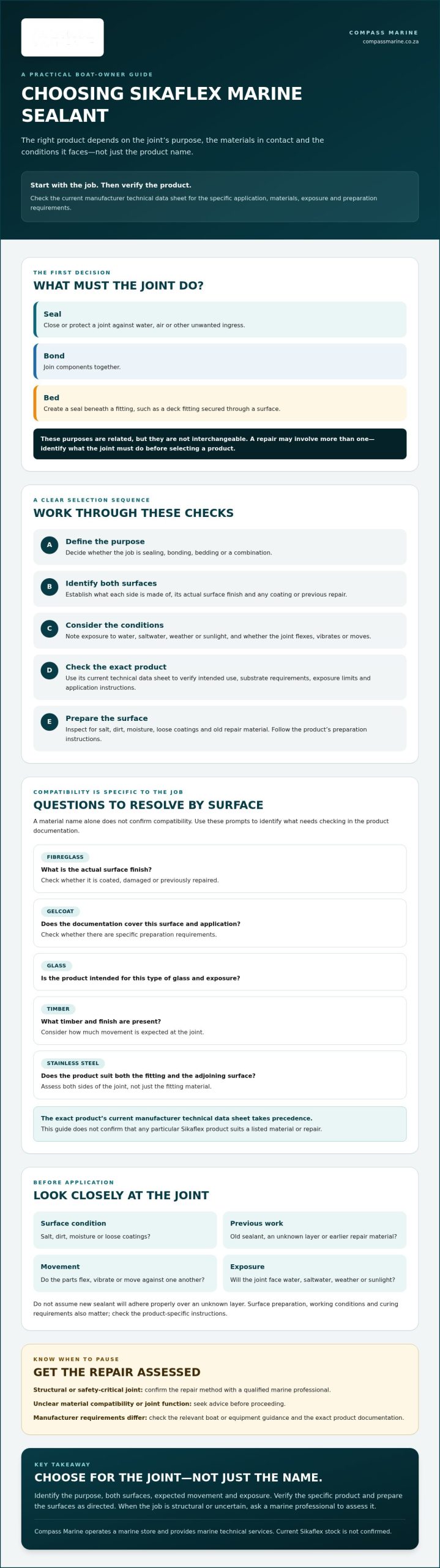
Sealing, bonding and bedding are related, but they aren’t interchangeable. Sealing closes or protects a joint; bonding joins components; bedding creates a seal beneath a fitting, such as a deck fitting secured through a surface. A repair can involve more than one purpose, so first decide what the joint must do. Then check that the product is documented for the application, the materials in contact and the expected movement.
Use general advice as a starting point, not as a product specification. The exact product’s current manufacturer technical data sheet takes precedence. Check its intended use, substrate requirements, exposure limits and application instructions before proceeding.
Is Sikaflex marine sealant suitable for every boat repair?
No. A product that may suit one sealing task isn’t automatically appropriate for bonding, bedding or a different substrate. Saltwater, sunlight and joint movement are factors to check against the product documentation, not reasons to assume suitability.
Routine sealing questions differ from structural or safety-critical repairs. If a joint helps retain a major component, or its failure could affect safe operation, don’t treat it as a simple sealant job. Confirm the repair method with a qualified marine professional and check the boat or equipment manufacturer’s guidance.
Which repair details should you identify first?
Before choosing a product, note what each side of the joint is made from and where the joint sits on the boat. Record whether it is exposed to weather or water, and whether the parts flex, vibrate or move against one another during normal use. These details help you compare the job with the product’s documented applications.
Also note any previous coating, sealant or repair material, plus visible dirt, salt, moisture or other contamination. Don’t assume new sealant will adhere properly over an unknown layer. A clear description of the joint and its condition can help a marine professional assess what preparation or further inspection may be needed.
How to assess Sikaflex marine sealant compatibility with boat materials
A material name alone doesn’t establish compatibility. “Fibreglass”, for example, might describe a gelcoat surface, a painted area or an older repair with unknown coatings. Identify the actual surface and check the product’s current technical data sheet before deciding. The guide below helps you identify questions to resolve; it doesn’t confirm that any particular Sikaflex product suits a listed substrate.
| Substrate | Application to clarify | Questions to verify | Source |
|---|---|---|---|
| Fibreglass | Sealing or bonding a joint | What is the actual surface finish? Is it coated, damaged or previously repaired? | Current product technical data sheet |
| Gelcoat | Bedding or sealing a fitting | Does the documentation name this surface and application? Are there preparation requirements? | Current product technical data sheet |
| Glass | Sealing glazing or a glass-to-hull joint | Is the product intended for this type of glass and exposure? | Current product technical data sheet |
| Timber | Sealing a seam or joining components | What timber and finish are present, and how much movement is expected? | Current product technical data sheet |
| Stainless steel | Bedding a fitting against a hull or deck | Does the product suit both the fitting and the adjoining substrate? | Current product technical data sheet |
What should you check for fibreglass, gelcoat and timber?
Be precise about the surface, not just the boat’s main construction material. A gelcoat panel may have paint, polish residue or an earlier repair over it; timber may also have a coating or treatment. These layers can affect what contacts the sealant. Don’t infer compatibility from a general material label. Check the exact product documentation, including any surface preparation instructions.
How do stainless steel and other fittings affect the decision?
Assess both sides of the joint. A stainless fitting bedded against a gelcoat deck involves two surfaces, and the joint’s shape and expected movement matter alongside material compatibility. For background on related marine hardware, read Compass Marine’s 316 stainless steel fasteners guide. Published independent adhesion tests can provide additional context, but they don’t replace the manufacturer’s instructions for your specific repair.
If the surface or previous repair material is uncertain, share those details with a marine professional before proceeding. Compass Marine provides marine technical services and can discuss related boat work. You can contact Compass Marine about marine technical support.
Compare marine sealant options by application, movement and exposure
A useful comparison starts with the job, not a preferred product name. Check whether the manufacturer describes the product for sealing, bedding or bonding, then confirm that the stated substrates match both sides of your joint. Consider whether the joint is rigid or flexes during normal use, and whether it is exposed to sunlight, water or changing conditions.
Salt and humidity are part of a boat’s operating environment, but they don’t prove that a particular sealant is suitable. The product documentation must support the intended application and exposure. For background on how sealant types and material limitations can differ, read this guide to choosing the right type of marine sealant, then verify any proposed product against its current manufacturer data sheet.
When does the repair need a sealant rather than a bonding product?
Follow the manufacturer’s stated purpose rather than relying on informal labels such as “marine grade” or “general purpose”. A product described for sealing shouldn’t automatically be treated as a structural adhesive, and a bonding product may not suit a joint that needs a flexible seal. If the repair carries a load, affects structural integrity or could have serious consequences if it fails, have a qualified marine professional assess it before work begins.
Which selection questions belong in a product comparison?
Compare the exact product documents side by side. Note what each says about intended application, approved substrates, expected movement, surface preparation and application conditions. Check curing instructions too, including any requirements affected by temperature or humidity. If the data sheet doesn’t answer a question that matters for your boat, treat it as unresolved rather than assuming the product will work.
- Function: Is the product intended to seal, bed or bond this type of joint?
- Materials: Are both surfaces named, including coatings or existing repair layers?
- Movement and exposure: Does the documentation cover the joint’s movement and conditions in service?
- Application: Can the specified preparation and curing conditions be met?
For Sikaflex marine sealant Durban searches, use these checks to narrow the options, not to select a variant without product-specific evidence. If the repair remains uncertain, Compass Marine’s marine technical services may help you discuss the related boat work. Contact Compass Marine about marine technical support.
Prepare a boat surface carefully and avoid common sealant mistakes
A durable repair starts before the sealant is opened. Confirm the repair purpose, materials and exact product instructions first. General preparation advice can help you inspect the area, but it can’t replace the manufacturer’s requirements for a particular product. On boats exposed to salt and humidity, a surface may look clean while still carrying residue or moisture that affects the work.
What should you check before applying marine sealant?
Use this checklist as a starting point, then follow the product’s current technical data sheet and safety instructions. If you find damage beyond the joint itself, pause and arrange an assessment rather than treating it as a straightforward sealing task.
- Confirm the application: Check that the product is documented for the repair and the surfaces involved.
- Inspect the area: Look for dirt, salt, moisture, loose coating and traces of previous repair material.
- Check the preparation instructions: Use only the specified cleaning products and surface preparation method.
- Confirm application conditions: Follow the manufacturer’s documented requirements for applying and curing the product.
- Review safety guidance: Use the stated precautions and stop if you can’t work safely or reach the area properly.
Don’t assume a surface is ready because it appears dry. If an existing coating or old sealant is unidentified, record what you can see and seek advice before applying a new product over it.
Which mistakes can undermine a boat sealant repair?
Applying over residue, loose paint or an unsuitable previous product can compromise the result. So can improvising with a solvent, primer or preparation method that isn’t specified. Use only products and methods approved in the current instructions. If those instructions don’t address the surface in front of you, don’t fill the gap with guesswork.
Curing time and conditions are product-specific. Don’t assume a repair is ready for water exposure or movement because the surface feels dry; follow the manufacturer’s curing guidance. Salt, moisture and changing conditions can make it tempting to rush, but uncertainty is a reason to check the documentation, not shorten the curing period.
Stop and seek qualified help if the repair area is difficult to access, damage extends beyond the joint, or failure could affect safety. Compass Marine provides marine technical services and boat refurbishment. Contact Compass Marine to discuss related boat work.
Choose a marine sealant confidently and know when to ask for help
Before choosing a marine sealant, answer five questions: What must the repair do? Which materials meet at the joint? What exposure and movement will it face? What does the current product documentation allow? And are you confident the repair is within your ability? If any answer is unclear, pause before applying a product.
- Purpose: Identify whether the job is sealing, bedding or bonding.
- Materials: Name both surfaces, including coatings or previous repair products where known.
- Conditions: Consider the joint’s location, exposure and movement.
- Documentation: Check the exact product’s current technical data sheet and follow its instructions.
- Confidence: Consider the consequences if the repair fails, not only how easy it looks to reach.
Compass Marine’s specific Sikaflex products and current stock are unconfirmed. Check availability directly rather than assuming a particular product can be supplied. Product availability and technical suitability are separate questions: having a product available doesn’t by itself confirm that it suits your repair.
When should a marine professional assess the repair?
Ask for a professional assessment if the repair is structural, safety-critical or difficult to access. Do the same if you can’t identify the material, the source of damage or the product previously used. A leak around a fitting, for example, may involve damage beyond the visible seal. Don’t cover an uncertain problem with sealant or rely on a general guide as a repair specification. For context on relevant support, see Compass Marine’s marine technical services guide.
What information should you provide when asking for guidance?
Describe the boat materials, the joint’s location and what the repair needs to achieve. Note the exposure and any movement, and share the product name and documentation details if you have them. Clear photographs can help explain the area, but they may not reveal hidden damage or confirm surface compatibility; an inspection may still be needed.
Key takeaway: The right choice depends on the repair, materials, conditions and product instructions, not the name alone. If you’re unsure, contact Compass Marine to discuss the related marine technical work. Contact Compass Marine about marine technical services.
Make your next sealant decision with confidence
A lasting marine repair starts with matching the product to the joint, the materials and the conditions it will face. Check the exact product’s current technical data sheet, follow its preparation and curing instructions, and don’t treat a sealant as a structural adhesive unless the manufacturer specifies that use. If compatibility or the source of damage is unclear, get a professional assessment before proceeding.
Use these checks when comparing Sikaflex marine sealant Durban options, but don’t assume a particular product is suitable simply because it is intended for marine use. Compass Marine operates a marine store and chandlery, although its specific Sikaflex products and availability are unconfirmed. The business also provides marine technical services, boat refurbishment and stainless steel fabrication.
For advice related to your repair, contact Compass Marine to discuss your marine repair requirements. Share the joint’s materials, purpose and condition so you can discuss the relevant work and decide on a sensible next step.
Frequently Asked Questions
Is Sikaflex marine sealant suitable for fibreglass boats?
It may suit a particular fibreglass repair, but check the exact product’s current technical data sheet first. “Fibreglass” may have a gelcoat, paint, polish residue or previous repair layer that affects the surface in contact with the sealant. Confirm that the product documentation covers the application and actual surface, and follow its preparation instructions. Don’t assume every Sikaflex product suits every fibreglass joint.
Can marine sealant be used on stainless steel boat fittings?
Only if the product documentation supports the intended application and the materials on both sides of the joint. A stainless steel fitting may meet gelcoat, fibreglass, glass or another surface, so check compatibility with each one. Also consider whether the fitting is being sealed, bedded or bonded, and how the joint may move. If the fitting is load-bearing or safety-critical, seek advice from a qualified marine professional.
How do I prepare a boat surface before applying marine sealant?
Start by confirming the repair and reading the exact product’s current technical data sheet. Inspect the area for salt, dirt, moisture, loose coatings and previous repair material. Use only the cleaning products, preparation methods and application conditions specified by the manufacturer. Don’t improvise with solvents or primers, or guess at curing requirements. If you can’t identify an existing coating or residue, pause and get advice before applying sealant.
What is the difference between marine sealant and marine adhesive?
A sealant is intended to close a suitable joint, while an adhesive is intended to bond components. Some products are described by their manufacturer for more than one purpose, so don’t rely on informal labels or assume one can replace the other. Check the exact product’s stated application and limits. A product intended for sealing shouldn’t be treated as a structural adhesive unless its documentation specifically supports that use.
When should a boat sealant repair be handled by a marine professional?
Seek professional input for structural or safety-critical joints, hard-to-access areas, damage beyond a simple joint, or repairs where the materials or cause of failure are unclear. If you’re comparing Sikaflex marine sealant Durban options but can’t verify suitability from the current product documentation, don’t guess. Compass Marine provides marine technical services and boat refurbishment; its specific Sikaflex products and availability are unconfirmed, so check directly.