
The fitting that looks right on the shelf may not be the one that lasts on your boat. A search for quality marine hardware is often the start of a more specific question: which fitting suits the job, fits the boat and can handle its conditions?
The right choice depends on the fitting’s function, location, material and installation. A part used occasionally may have different demands from one handled repeatedly, while a fitting exposed to salt and moisture needs a suitable care routine as well as the right material.
This guide explains how to check compatibility, compare fittings for different uses and spot signs that call for professional attention. Compass Marine’s chandlery, stainless steel products and marine technical support can help you plan a boat project with the relevant details in hand.
Key Takeaways
- Choose boat fittings for their function, fit and operating conditions, not appearance alone.
- When comparing marine hardware, consider salt and moisture exposure as well as the care each material requires.
- Compare options by intended use, frequency of handling and access for inspection and maintenance.
- Before replacing a fitting, record its dimensions, photograph the installation and note relevant boat or equipment details.
- Compass Marine’s chandlery offers marine products, including stainless steel products, safety equipment, marine paint and Lowrance fish finders.
What marine hardware durban boat owners need, and why does fit matter?
A fitting can look suitable and still be wrong for the job. Marine hardware includes the fittings and equipment selected for use on boats, with each item matched to its function, fit, exposure and installation. This can include items used to secure, open, operate or protect parts of a vessel. The right choice depends on the boat’s design and how it is used, not appearance alone.
Hardware is one part of a vessel’s equipment, not a catch-all term for everything onboard. Engines and their components, electronic systems such as fish finders, and major structural parts such as the hull are separate categories, even though they work alongside fittings. The wider field of marine technology covers many aspects of working on and around the water. Knowing what each component does helps you compare like with like.
Which boat hardware functions should owners think about first?
Start with the task, then identify where and how the fitting will be used. A fishing boat, family runabout and working vessel can have different requirements, even when a fitting looks similar.
- Securing: Cleats and attachment points help manage lines or secure equipment. Their suitability depends on their intended use and the boat’s design.
- Access: Hinges, latches and handles help open or close compartments and access points. Check the available space and whether the fitting can be reached comfortably.
- Operation: Controls and other frequently handled fittings need to suit their position and purpose, so they are practical to use underway.
- Protection: Guards or protective fittings may help shield exposed areas from knocks or contact. Their placement and material need to suit the location.
These are examples of functions, not a universal shopping list. Define the job first, then compare fittings designed for that purpose. A fitting suited to occasional use may not be appropriate for repeated handling or a more demanding setting.
Why does correct fit matter beyond appearance?
Dimensions and position affect whether a fitting works properly. A handle that catches on a lid, a latch that does not align with its catch, or a fitting that obstructs movement can make a simple task awkward. A mismatch at the mounting point can also mean that the existing fixing arrangement is unsuitable for the replacement.
Before choosing a substitute, check the boat documentation and the fitting or equipment manufacturer’s guidance. Compare measurements, mounting locations and intended use rather than relying on a visual match. The material and installation method must also suit the fitting’s environment and purpose, and requirements can differ between boats and equipment.
If the mounting location, compatibility or installation is uncertain, pause before fitting a replacement. A qualified marine technician can assess the application, particularly where the work involves structural areas, loads or systems that affect safe operation. A careful match from the outset supports reliable use and makes future inspection and maintenance more straightforward.
How do marine conditions affect hardware materials and corrosion?
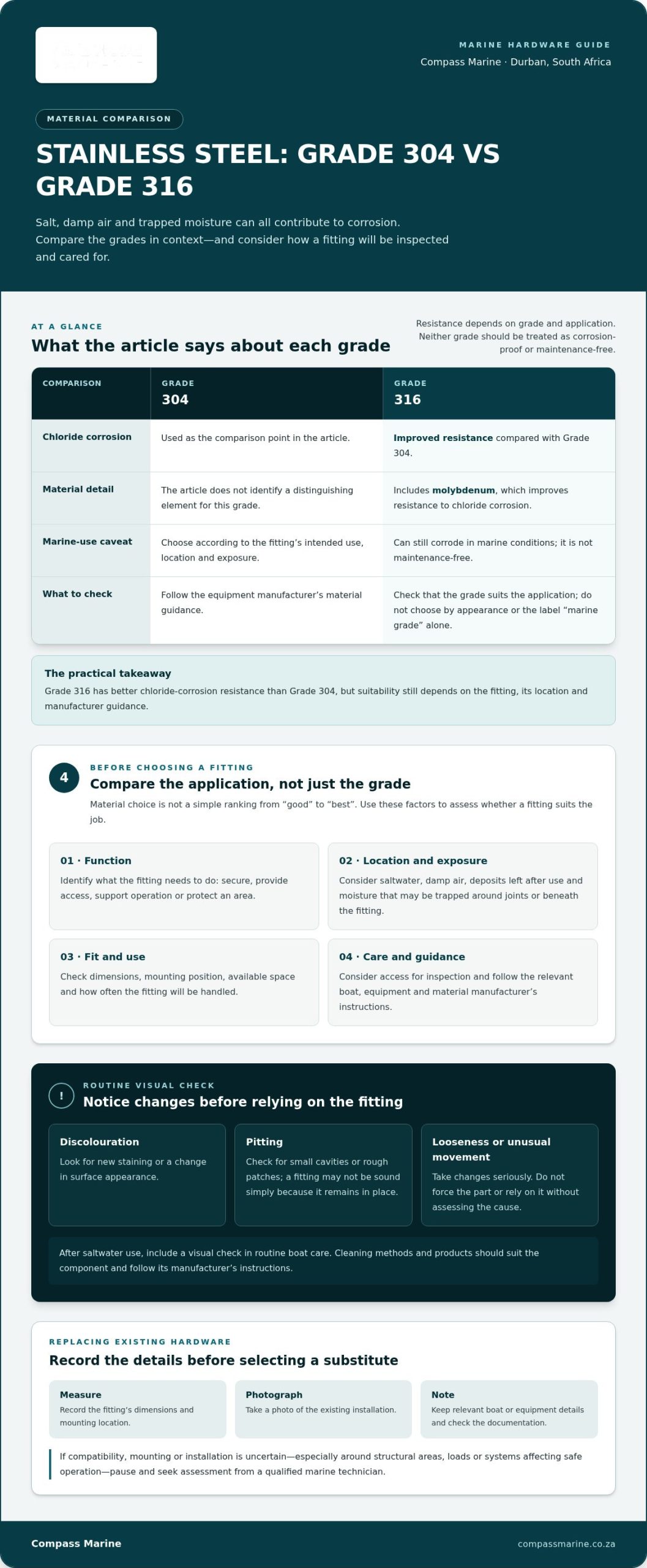
Saltwater, damp air and deposits left behind after use can all contribute to corrosion. Salt may remain on a fitting as water evaporates, while moisture trapped around joints or beneath a fitting can make inspection difficult. Discolouration, pitting or damage may develop out of sight. Choose hardware with its exposure in mind, and make sure its material and care routine suit the conditions it will face.
Material choice is not a simple ranking from “good” to “best”. Consider the fitting’s location, function, exposure and manufacturer guidance. Stainless steel may suit some applications, while other equipment uses different materials or protective finishes. No material should be assumed to be corrosion-proof or maintenance-free. For boat owners comparing marine hardware durban options, salt and moisture exposure make it sensible to consider how a fitting will be inspected and cared for, not just how it looks when new.
What should owners understand about stainless steel in marine use?
Stainless steel comes in different grades, and its resistance to corrosion depends on both grade and application. Grade 316 includes molybdenum, which improves resistance to chloride corrosion compared with Grade 304, but it can still corrode in marine conditions. For fasteners and other stainless components, follow the equipment manufacturer’s material guidance rather than choosing by appearance or the broad label “marine grade”.
The 33 CFR Part 183 reference covers US federal requirements for boats and associated equipment. It is not South African regulation. Use the applicable boat documentation and manufacturer instructions for your vessel rather than treating a US reference as a local requirement.
Which simple habits help owners spot corrosion early?
Include a visual check in routine boat care, especially after saltwater use and before relying on a fitting. Look for changes around it and notice whether it moves or operates differently. A clean surface can make changes easier to see, but cleaning products and methods must suit the component and follow its manufacturer’s instructions.
- Discolouration: Note new staining or a change in the surface appearance.
- Pitting: Look for small cavities or rough patches. A fitting is not necessarily sound just because it remains in place.
- Looseness or unusual movement: Take changes in a handle, latch or other moving part seriously. Do not force it or rely on it without assessing the cause.
Keep a note of recurring changes and the fitting’s location. If corrosion affects a safety-related fitting, its attachment point or structural integrity, cleaning is not a repair. Arrange a professional assessment before relying on it. Compass Marine’s stainless steel fabrication and marine technical support can help with relevant boat projects. Explore Compass Marine’s marine support for practical assistance.
How should you compare marine hardware for different boat uses?
Start with the job a fitting must do, then consider the conditions around it. A fitting used occasionally on a sheltered recreational boat may need different priorities from equipment handled repeatedly on a workboat. The comparison below is a decision aid, not a specification or a list of products in stock. Confirm the right choice for your vessel against its documentation and the equipment manufacturer’s guidance.
Recreational boating: Consider the fitting’s function, exposure during normal outings, ease of use and access for routine checks. A boat used for occasional cruising may have different handling demands from one used regularly for fishing.
Fishing: Consider how often equipment is handled and whether the fitting’s position remains practical while moving around the boat. Regular cleaning and access for inspection matter too.
Workboat use: Frequent operation and repeated handling can make durability, reliable fit and maintenance access especially important. Suitability still depends on the fitting’s purpose and manufacturer guidance.
Regular launching: Consider how launch preparation and retrieval affect access to fittings, and include the surrounding environment in your exposure assessment. Boat and trailer equipment each need to suit their own use.
These comparisons help narrow the questions, but they do not replace the correct dimensions, material requirements or installation details for a specific boat. Safety equipment and other marine products serve different purposes, so compare each item against its intended role rather than treating broad product categories as interchangeable. When researching marine hardware durban, use the same practical checks: intended use, exposure, fit, frequency of handling and access for care.
What changes between fishing, cruising and regular launch use?
The way you use a boat affects how often a fitting is handled and how much attention it may need. An angler who moves gear regularly may value clear access and straightforward inspection. A boat used for cruising may call for comfortable operation and fittings that remain usable between trips. Frequent launching can make preparation and post-use checks part of the routine. If the boat or equipment manual sets different requirements, follow that guidance.
When should a marine specialist assess hardware or fabrication?
Do not dismiss movement, cracking or corrosion close to a fitting, especially if it is safety-related or attached near a structural area. These signs may point to an issue beyond the fitting itself. A marine specialist can assess whether repair, replacement or stainless steel fabrication is appropriate. Compass Marine provides stainless steel fabrication and marine technical support for relevant boat projects.
Fabrication is not simply a matter of making a part that looks similar. Its design and installation must suit the vessel, the fitting’s function and the conditions it will face. If a fitting repeatedly loosens, no longer aligns or shows damage around its mounting area, do not rely on appearance alone to judge it safe. Keep the boat and equipment details available for a technical assessment.
What should you check before buying or replacing boat fittings?
A careful check before purchase can prevent a fitting that looks suitable from becoming an awkward or unsafe replacement. Use the same practical sequence for any boat: identify the fitting’s job, record its dimensions, assess its exposure and check compatibility before committing to a replacement. Do not guess where fit, safety or structural support is involved.
Which details help confirm that a fitting is compatible?
Start with the fitting already on the boat, if it can be inspected safely. Note what it does and where it sits, then take clear photographs from more than one angle. Record relevant measurements, including the mounting area and the space available around moving parts. Include the boat make and model, equipment details and any identifying information in the relevant documentation.
Check the boat, equipment and manufacturer documentation for requirements that apply to the installation. Similar-looking fittings can differ in dimensions, purpose, material or mounting arrangement. A replacement that does not align properly may interfere with access or operation, so do not assume that appearance alone means it is interchangeable.
Use this checklist before buying:
- Identify the function: What does the fitting secure, open, support or protect?
- Record dimensions: Measure the fitting and its location carefully, using millimetres where appropriate.
- Assess exposure: Note whether it faces regular spray, damp storage conditions or frequent handling.
- Check compatibility: Compare your notes with the boat and equipment manuals and manufacturer guidance.
- Keep a record: Save photographs and measurements with the boat or equipment details for future reference.
This checklist helps guide a decision, but it does not replace manufacturer specifications. If the existing installation is damaged or inaccessible, do not force parts off just to obtain a measurement.
Which installation and upkeep tasks need professional help?
Owners can carry out safe visual checks and follow the product maker’s care instructions, but structural, electrical or uncertain installation work calls for qualified technical support. Stop if you find cracking, movement at the mounting area, corrosion around a load-bearing fitting or damage that extends into the surrounding structure. A different fastener or tighter fit is not an automatic fix.
If replacement fasteners are the main concern, consult dedicated marine fastener guidance and follow the equipment manufacturer’s requirements. The correct choice depends on the application and installation, so do not substitute parts based only on similar appearance. Compass Marine provides relevant marine support for work involving stainless steel fittings, fabrication or technical assessment. Contact Compass Marine about fitting support for your boat project.
Where can you find marine hardware and practical boat support?
Choosing a fitting is easier when product guidance sits alongside practical marine knowledge. Compass Marine’s marine store and chandlery brings together marine products and boating support. Start with the boat, the job the item must do and the conditions it will face, then compare products against those needs.
What marine products and support does Compass Marine bring together?
The store offers Lowrance fish finders, safety equipment, marine paint and stainless steel products. Each serves a different purpose: a fish finder supports finding and interpreting underwater information, safety equipment addresses onboard preparedness, and marine paint is used for relevant boat-care projects. Stainless steel products may suit projects that call for that material, but suitability depends on the application and manufacturer guidance.
A broad product category is not a guarantee that a particular fitting or specification suits every boat. Bring your equipment details into the conversation and compare intended use, fit and care requirements. This keeps product decisions grounded in the actual installation rather than a similar-looking item or a generic description.
Some boat projects call for more than a retail product. Where a project involves a stainless steel fitting or a component that needs to be made for the application, Compass Marine’s stainless steel fabrication and marine technical capabilities can support the work. The right approach depends on the boat and the job involved.
What are sensible next steps for your hardware requirement?
Before exploring options, write down the fitting’s purpose and location. Gather the boat or equipment make and model, relevant manual or manufacturer information, and clear photographs of the current installation. If you are replacing a part, note its dimensions and describe any damage, corrosion or change in movement. These details provide a clearer starting point than guesswork.
Describe how the boat is used and what the fitting needs to withstand in ordinary service. If compatibility or installation is uncertain, especially where safety or structural support is involved, seek technical advice rather than treating appearance as proof of a match. Compass Marine’s marine store and chandlery can help you explore relevant marine products, while its fabrication and technical support can assist with appropriate project requirements.
Choose with the boat in mind. A clear description of the job, equipment and operating conditions gives you a stronger basis for selecting marine products and planning next steps.
Explore Compass Marine for marine products, chandlery and relevant technical support for your boat project.
Make your next fitting decision with confidence
Use your next maintenance window to deal with small hardware concerns before they disrupt a day on the water. Keep a simple record of fittings that need attention, with photographs and relevant boat details. This gives you a clearer starting point for planning a replacement or discussing an uncertain installation.
For marine hardware durban projects, choose fittings that suit the boat’s use and can be inspected and cared for over time. If the work involves more than a straightforward product choice, technical guidance can help you decide on a sensible next step without relying on guesswork.
Compass Marine’s marine store and chandlery is a resource for boat owners planning their next project. Explore the marine products and support relevant to your requirements, and keep the details of the installation to hand.
Explore Compass Marine’s marine store and support to plan your next boat project.
Frequently Asked Questions
How do I choose marine hardware for my boat?
Match the hardware’s job and location to the boat’s design and how you use the vessel. Identify what the fitting connects to and whether another part must move or align with it. For example, replacing a hatch latch means considering both the latch and its catch. Use the boat or equipment manual for requirements, and keep photographs and measurements to help avoid an unsuitable purchase.
Does stainless steel marine hardware still corrode?
Yes. Stainless steel can corrode in marine conditions, and its resistance depends on the grade, application and care. Salt deposits or moisture trapped around a joint may contribute to damage, even when the visible surface initially looks sound. Inspect areas where water or grime can collect, and follow the manufacturer’s cleaning instructions. If corrosion is deep, spreading or close to an important attachment point, have the fitting assessed rather than relying on cleaning alone.
How can I tell whether a boat fitting needs replacing?
Look for changes that affect the fitting’s condition or operation, such as cracking, persistent looseness, deep pitting or parts that no longer move as intended. Inspect the surrounding surface too, as damage there may matter as much as wear on the fitting itself. A mark or stain alone does not always mean replacement is needed, but deterioration on a safety-related component calls for a closer assessment before the next trip.
Can I replace a boat fitting with one that looks similar?
Not safely by appearance alone. Two fittings may look alike but differ in dimensions, mounting arrangement or intended purpose. A replacement that does not line up with its mating part, such as a latch and catch, may not work reliably. Compare the relevant measurements and documentation before buying. Do not enlarge mounting holes or alter a structural area to make a substitute fit unless a qualified technician has assessed the work.
What marine products does a chandlery typically provide?
A chandlery commonly brings together boating accessories and products for equipment, safety and vessel upkeep. The exact range differs between businesses. Compass Marine’s marine store and chandlery includes safety equipment, marine paint, Lowrance fish finders and stainless steel products. Match any item to your boat and intended use. For electronic equipment, check the relevant manufacturer’s compatibility guidance before planning an installation.
When should a marine technician assess a fitting or installation?
Arrange a technical assessment if a fitting moves at its mounting point, the surrounding area is cracked or damaged, or you cannot establish whether a replacement is compatible. Professional input is especially appropriate for work involving structural support or electrical connections. Avoid relying on a fitting that may affect safe operation until it has been assessed. Compass Marine provides stainless steel fabrication and marine technical services for relevant boat projects.