
Leaving your vessel exposed to the Durban salt air isn’t just a storage choice; it’s a slow-motion mechanical gamble that often costs far more than the monthly fees themselves. Whether you’re navigating the high humidity of the KwaZulu-Natal coast or the logistical hurdles of municipal restrictions, finding the right home for your boat is about more than just securing an empty floor. It’s about protecting a high-value asset from the unique environmental pressures of our coastline.
We understand that the primary concern for most local mariners is the boat storage cost durban, yet the price tag is only one part of the equation. You likely want the peace of mind that comes with knowing your engine won’t seize during the off-season and that your vessel remains fully compliant with insurance and COF regulations whilst in professional care. It’s frustrating to arrive for a weekend on the water only to find a flat battery or a corroded connection.
This guide offers a comprehensive look at the factors affecting marine storage rates across South Africa, focusing on the technical requirements that keep a boat in peak condition. We’ll preview the essential maintenance steps that ensure your vessel is water-ready the moment you collect it, alongside practical advice on protecting your investment from the corrosive coastal environment.
Key Takeaways
- Learn how vessel length and beam width determine your primary rental rate and why indoor positioning is a strategic investment against the elements.
- Discover how to mitigate the hidden boat storage cost durban owners face by preventing saltwater corrosion and UV damage through secure, climate-conscious storage.
- Understand the technical “cost of neglect,” including how to prevent outboard engine seizing and battery failure during extended periods of inactivity.
- Master the essential preparation steps, from thorough freshwater flushing to hull protection, that ensure your boat remains water-ready for its next launch.
- Explore the benefits of integrated technical support, where on-site certified mechanics can perform engine services or refurbishments whilst your vessel is stored.
Understanding the Variables of Boat Storage Cost in South Africa
Determining the monthly commitment for professional vessel protection involves several technical factors that extend beyond a simple floor rate. In KwaZulu-Natal, the boat storage cost durban owners encounter is primarily driven by the physical footprint of the craft, including the trailer. Unlike the basic moorings or berths found in what a marina offers, dry storage facilities must account for the total square meterage occupied on a warehouse floor or secure yard.
Length and beam width are the standard metrics used to define your primary rate. It’s a common oversight to measure only the hull; however, the trailer’s drawbar and the overhang of outboard engines often add significant length to the final calculation. Facilities typically charge per linear metre or by total area, meaning a wide-beam catamaran will naturally command a higher premium than a narrow monohull of the same length. This physical footprint dictates the facility’s capacity and, by extension, your monthly fee.
The choice between indoor and outdoor positioning creates the most significant price variance. Outdoor bays are the more budget-friendly option, yet they expose the vessel to South Africa’s intense UV radiation and the corrosive salt mist prevalent in Durban. Indoor secure storage provides a controlled environment that drastically slows the degradation of gelcoats and upholstery, often offsetting the higher monthly rate by reducing long-term refurbishment expenses. We find that owners of high-value offshore boats almost exclusively prefer indoor options to preserve their resale value.
Size and Type of Vessel
Vessel type dictates the complexity of the storage arrangement. A jet ski on a single trailer requires minimal square meterage, whereas a large cabin boat necessitates specialised manoeuvring space. Height is another critical variable. Boats equipped with permanent T-tops, flybridges, or radar arches require high-clearance doorways, which may limit your options to specific sections of a facility. Always ensure your measurements include the highest point of the vessel when it sits on its trailer to avoid surprises during the move-in process.
Security Standards and Insurance
Security infrastructure is a non-negotiable component of any professional storage agreement. Most marine insurance providers in South Africa mandate specific security protocols, such as 24-hour physical guarding, electric fencing, and comprehensive CCTV coverage. A facility with these measures in place provides more than just a deterrent against theft; it ensures your policy remains valid. Indoor facilities also offer the added benefit of fire suppression systems, a vital layer of protection for assets containing fuel and electrical systems. Professional guarding and monitoring naturally impact the monthly commitment but provide essential peace of mind.
Access frequency and service levels also influence the final cost. Some facilities offer a valet style service where the vessel is prepared and moved to a collection point for you. While this adds to the monthly overhead, it saves significant time and reduces the risk of accidental damage during transit within the facility. For the active angler, this level of service is often a primary consideration when choosing a home for their boat.
Indoor Secure Storage vs Outdoor Bays: A Comparison
Choosing between an open-air bay and a warehouse unit is often where the boat storage cost durban debate begins. While the lower monthly fee of an outdoor space is tempting, the environmental hidden costs in KwaZulu-Natal are substantial. Our coastal sun is relentless. It doesn’t just fade the colour; it breaks down the chemical bonds in marine upholstery and gelcoats, leading to costly restoration work later. Indoor storage provides a critical shield against these UV rays, ensuring your vessel’s aesthetic and structural integrity remains intact.
Corrosion control is the second major factor. In Durban, the air itself carries moisture and salt that accelerates the oxidation of stainless steel fittings and electrical connections. An indoor environment acts as a buffer, significantly reducing the volume of salt-laden air that circulates through your engine bay and helm. This protection is vital for the longevity of your marine paint and the reliability of your wiring. When you consider the price of replacing marine electronics or polishing out heavy oxidation, the premium for indoor space often pays for itself.
Security differentials also play a role in the decision. Indoor units offer a psychological and physical barrier that outdoor bays simply cannot match. Opportunistic theft of electronics, fishing tackle, or safety gear is significantly harder when a vessel is behind locked warehouse doors and monitored by 24-hour guarding. This level of protection is often a prerequisite for comprehensive insurance coverage on high-value craft.
Maintaining your vessel in a secure, covered environment also helps ensure you meet the standards required by SAMSA safety regulations. If your safety equipment or hull integrity degrades due to prolonged exposure, you risk failing your next COF inspection. Keeping the boat clean and dry is the simplest way to remain compliant and water-ready.
The Case for Professional Indoor Facilities
Storing your boat indoors eliminates the need for expensive, heavy-duty boat covers that often trap moisture and encourage mildew. It prevents water ingress and deck fatigue during the heavy tropical downpours common in KZN. If you have recently invested in a refurbishment of your boat, indoor storage is the only practical way to protect that investment and maintain the professional finish of your stainless steel and paintwork.
Outdoor Bays and Economic Efficiency
Outdoor storage makes sense for short-term transitions or for older vessels where the gelcoat is already weathered. However, you must implement essential protective measures, such as high-quality, breathable covers and regular freshwater rinsing. Be prepared for higher cleaning costs; soot, bird droppings, and dust accumulate quickly in open-air bays, requiring more frequent maintenance to keep the vessel presentable.
Beyond the Monthly Fee: The Technical Cost of Neglect
Neglecting a vessel whilst it sits in storage often results in repair bills that far exceed the initial boat storage cost durban owners expect to pay. A boat is a complex machine designed for regular use; when left idle in our humid coastal environment, mechanical systems begin to degrade almost immediately. The real expense of storage isn’t found in the monthly rental agreement but in the potential for engine seizing, electrical failure, and fuel system contamination that occurs during long periods of inactivity.
Outboard engines are particularly vulnerable to seizing if the internal components aren’t periodically lubricated and turned. Salt residue trapped within the cooling passages can harden, whilst piston rings may stick to cylinder walls due to moisture in the air. Simply parking a boat and walking away is a recipe for a seized powerhead. Professional care involves more than just a locked door; it requires a technical understanding of how to preserve these high-performance machines against the elements.
Batteries are another silent casualty of inactivity. A marine battery that undergoes deep discharge during the off-season rarely recovers its full cranking capacity. Similarly, modern fuel can degrade in as little as three months, leading to varnish deposits and gumming within the fuel injectors or carburettors. Cleaning these systems is a labour-intensive process that can be easily avoided with the correct stabilisers and periodic maintenance cycles.
Mechanical Maintenance Requirements
To ensure your vessel remains in peak condition, we recommend following a comprehensive boat maintenance checklist that includes thorough engine flushing and cylinder fogging. In Durban, having a certified Yamaha mechanic or a certified Suzuki mechanic oversee these technical tasks provides an essential layer of protection. These professionals can identify early warning signs, such as salt-crust buildup or minor electrical fault diagnostics, before they escalate into critical failures that ruin your first weekend back on the water.
Compliance and Certification Risks
Storage is the ideal time to manage your maritime legalities without losing valuable fishing days. Organising your Certificate of Fitness (COF) survey and ensuring your buoyancy certificates are current should be handled whilst the boat is easily accessible in a professional facility. A dedicated storage partner can help facilitate these inspections, ensuring your vessel is fully compliant and insurance-ready the moment you decide to launch. This proactive approach to compliance management removes the stress of last-minute renewals and keeps you focused on the maritime lifestyle.
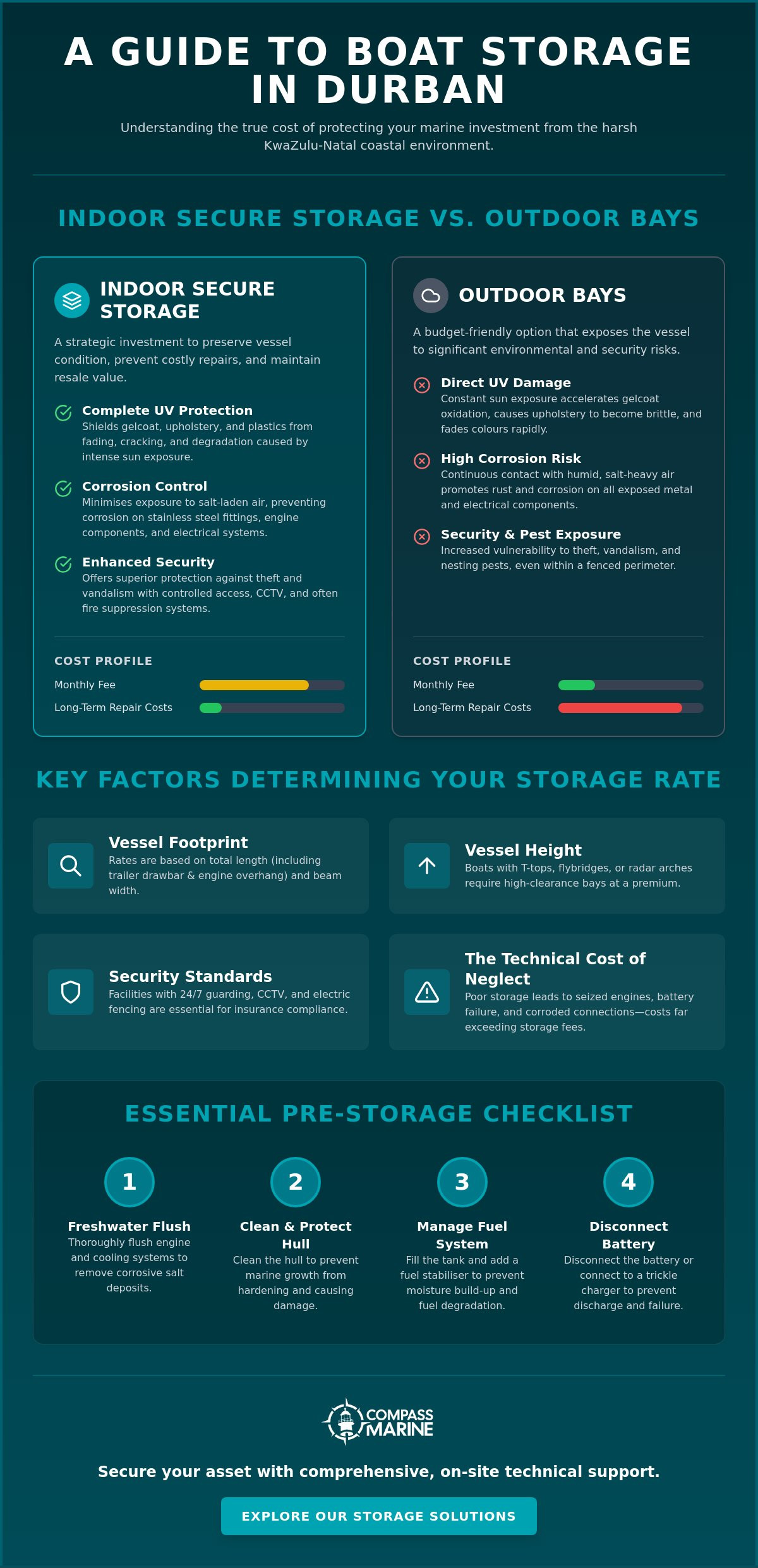
How to Organise Your Vessel for Long-Term Storage
Preparing your boat for a season in a professional facility is a methodical process that ensures your investment remains in the same condition as the day you left it. Whilst the boat storage cost durban facilities charge covers the space and security, the physical preparation of the vessel is the owner’s responsibility to prevent long-term degradation. A thorough freshwater flush of the cooling system is the first and most critical step. You must remove every trace of salt-laden residue from the internal passages to prevent the “salt-crust” buildup that leads to overheating.
Hull and deck surfaces require more than a simple wash. We recommend a deep clean using marine-grade detergents followed by a protective wax coating. This layer acts as a barrier against dust and airborne contaminants, making the eventual recommissioning much easier. Don’t forget the internal systems; check bilge pumps for debris and ensure all plumbing, including live wells and freshwater tanks, is completely drained to prevent stagnant water from causing odour or mould.
Trailer maintenance is frequently neglected but remains vital for safety. When a boat sits in a static position for months, the tyres are subject to constant pressure on a single point, which can lead to flat spots or sidewall cracking. Inflate tyres to the maximum recommended pressure and apply a fresh layer of high-quality bearing grease to protect the hubs from moisture. A well-maintained trailer ensures that your vessel is ready for the road the moment you decide to launch.
Engine Winterisation Steps
Mechanical protection starts with the fuel system. Add a high-quality stabiliser to the tank and run the engine for several minutes to ensure the treated fuel reaches the injectors. This prevents the ethanol separation and gumming that ruins fuel systems during inactivity. We also suggest applying a light coating of anti-corrosion spray to the engine block and electrical connections. For batteries, the safest approach is professional isolation. Use a dedicated marine charger to maintain the voltage, as a battery left at a low state of charge for months will likely need replacement.
Interior and Hull Protection
Remove all perishable items and soft goods that could trap moisture. Clean all upholstery with a UV-protectant and leave locker doors slightly ajar to encourage airflow, which is essential amongst the humid conditions of KwaZulu-Natal. If your vessel has been recently treated with marine paint, a fresh coat of wax will preserve that finish whilst in storage. Secure all loose safety equipment and fishing gear to prevent movement during transit to the facility. For total peace of mind, consider our secure boat storage services, which include options for technical oversight and preparation.
The Compass Marine Advantage: More Than Just a Space
Choosing a storage partner is a decision that directly impacts the longevity and resale value of your vessel. While a general-purpose warehouse might offer a competitive boat storage cost durban rate, it often lacks the technical infrastructure required to maintain a maritime asset. Compass Marine provides a facility designed by mariners, for mariners, where the focus extends beyond simple floor space to include total vessel care. We act as guardians of your investment, ensuring that the environmental pressures of the KwaZulu-Natal coast do not compromise your boat’s performance.
Having on-site technical support fundamentally changes the storage experience. Our facility houses a certified Yamaha mechanic and a certified Suzuki mechanic who understand the specific needs of outboard engines in coastal conditions. Instead of your boat sitting idle and potentially deteriorating, it can undergo necessary maintenance or electrical fault diagnostics whilst it is out of the water. This integrated approach ensures that small issues, such as minor corrosion or a failing bilge pump, are resolved before they become expensive failures that ruin your time on the water.
Our one-stop chandlery access further simplifies the ownership experience. You can replace safety gear, update electronics, or restock boating accessories without leaving the facility. Whether you need marine paint for a hull touch-up or a new Lowrance fish finder installed, our team coordinates these upgrades during the storage period. This efficiency means your vessel is not just stored; it is improved and prepared for its next launch whilst it is in our care.
Why Specialised Marine Care Wins
A dedicated marine workshop offers capabilities a standard lock-up cannot match. We provide on-site stainless steel fabrication and fittings, alongside comprehensive refurbishment of boats and trailers. Managing maritime compliance is a core part of our service. We handle the technical requirements for COF renewals and buoyancy certificates, ensuring your vessel remains legal and insurance-compliant. This proactive management keeps you focused on the lifestyle rather than the paperwork.
Integrated Servicing and Storage
The most efficient way to manage boat ownership is to schedule your annual engine service to coincide with your storage period. Our team ensures a “water-ready” handover upon collection, meaning your batteries are charged, your fuel system is stabilised, and your engines have been professionally inspected. This seamless transition from storage to sea is the ultimate benefit of a professional maritime partnership. To protect your investment and simplify your boating lifestyle, Contact Compass Marine to secure your professional storage bay today.
Protecting Your Maritime Investment for the Long Term
The footprint of your vessel and the choice of environment are the primary drivers of boat storage cost durban, but the long-term health of your boat depends on consistent technical oversight. By prioritising indoor protection and methodical engine preservation, you avoid the hidden expenses of mechanical seizing and saltwater corrosion. Professional storage should be viewed as an active maintenance strategy rather than a passive expense. It ensures that your vessel maintains its value and reliability for years to come.
Compass Marine offers a comprehensive solution that combines professional indoor storage in KZN with the technical mastery of certified Yamaha and Suzuki mechanics. Our facility integrates a full-service chandlery and expert compliance support, ensuring your COF and buoyancy certifications are always current. We take the weight of maintenance off your shoulders, providing a safe pair of hands for your most valued asset. This integrated approach means your boat is always prepared for the next launch.
Secure your vessel with South Africa’s marine storage experts at Compass Marine. We look forward to helping you make your time on the water safer and more enjoyable.
Frequently Asked Questions
Is indoor boat storage worth the extra cost compared to outdoor storage?
Yes, the investment in indoor space is highly recommended for Durban boat owners. The primary boat storage cost durban facilities charge for indoor units is offset by the thousands of Rand saved on gelcoat restoration and upholstery replacement. South Africa’s intense UV rays and salt mist cause rapid degradation that outdoor covers cannot fully prevent. Indoor storage keeps your vessel in a controlled environment, significantly slowing the oxidation of stainless steel and electrical components.
Does marine insurance require specific security features for storage facilities?
Most South African marine insurance providers mandate specific security protocols to maintain coverage. These typically include 24-hour physical guarding, electric fencing, and monitored CCTV systems. If you store your vessel in a facility that lacks these features, you may find your theft or damage claims are rejected. We recommend checking your specific policy requirements before signing a contract to ensure the facility meets all necessary safety standards for your asset.
How often should a boat engine be started during long-term storage?
We recommend turning and lubricating your outboard engine every four to six weeks during the off-season. A simple start on “muffs” isn’t always sufficient; the engine should ideally reach operating temperature to ensure oil circulates through the entire powerhead. This prevents piston rings from sticking and stops salt residue from hardening in the cooling passages. Professional oversight ensures these technical steps are handled correctly to prevent the engine from seizing.
Can I have my boat serviced whilst it is in storage?
You can absolutely have your vessel serviced whilst it is in professional care. In fact, scheduling your annual maintenance with a certified Yamaha or Suzuki mechanic during the storage period is the most efficient way to manage your boat. This ensures that any mechanical issues or electrical fault diagnostics are handled while the boat is idle. You’ll avoid the seasonal rush and ensure your boat is water-ready for the next launch.
What documents do I need to provide for professional boat storage?
You’ll need to provide a copy of your South African ID, proof of residence, and valid marine insurance documents. Some facilities also require your current Certificate of Fitness (COF) and buoyancy certificates to confirm the vessel’s safety status. Providing these documents ensures that the facility can verify ownership and maintain a secure environment for all stored craft. It’s a standard procedure that protects both the facility and the boat owner.
How do I prevent my boat trailer tyres from flat-spotting during storage?
Preventing flat spots requires maintaining maximum tyre pressure and periodically shifting the trailer’s position. When a boat sits in one spot for months, the weight can cause the rubber to deform permanently. If the vessel is staying in storage for an extended period, consider using jack stands to lift the trailer frame slightly. This removes the static load from the tyres and preserves the integrity of the sidewalls for future road use.
What is the minimum period for a boat storage contract?
Most professional facilities offer flexible monthly rolling contracts to accommodate the seasonal nature of boating. While some specialised indoor units might have a minimum three-month commitment, many providers allow for short-term arrangements during transitions. You should always clarify the notice period required for collection. Understanding these terms helps you manage the total boat storage cost durban and ensures you aren’t tied into a commitment that doesn’t suit your schedule.
Will storing my boat indoors help maintain its resale value?
Storing your boat indoors is one of the most effective ways to preserve its resale value. Prospective buyers in the pre-owned market look for vessels that don’t show signs of coastal weathering, such as faded gelcoats or brittle upholstery. A boat that has been kept in a secure, indoor environment looks significantly newer and better maintained than one left outdoors. It demonstrates a level of care that justifies a higher asking price.