
Could the safety kit that suited your last trip leave a gap on your next one? If you’re searching for marine safety equipment, start by checking more than what’s in the storage locker. The right equipment depends on your vessel, planned operating area and whether each item is serviceable and easy to reach.
It can be difficult to know what applies, especially when gear is worn, damaged or past its expiry date and certificate requirements depend on the vessel. This checklist will help you assess what you carry, identify potential gaps and work out what to verify before departure.
We’ll cover essential equipment, condition, marking and access, then explain how to confirm the requirements for your vessel and outing. Safety needs vary by vessel category and use, so treat the checklist as a starting point and check current requirements against relevant guidance and your vessel’s documents. Compass Marine’s chandlery stocks safety equipment, and the team can assist with equipment needs and certificate support.
Key Takeaways
- Assess equipment against your vessel and planned outing, rather than relying on a one-size-fits-all kit.
- Review equipment by function, including personal protection, communication, navigation, signalling and emergency response.
- Use a repeatable inspection routine: locate each item, check its condition, test it only as instructed and note anything that needs attention.
- Keep safety gear identifiable and accessible so it can be reached quickly and checked before departure.
- Gather your vessel documents and equipment details before confirming requirements or asking about COF and buoyancy certificate support.
Marine safety equipment: what should you check before going afloat?
Before going afloat, check that your safety equipment suits the vessel and planned trip, is in serviceable condition and can be reached quickly. Then confirm the current requirements for your specific vessel and activity. A kit may look complete but still contain damaged items, gear that is difficult to access or gaps against applicable requirements.
Use this checklist to prepare, not as a substitute for official guidance or your vessel’s documents. The broad range of essential life-saving appliances includes items such as life-jackets, lifebuoys and flares, but that overview is not a vessel-specific compliance list.
- Whether the equipment suits your vessel and intended operating area.
- Whether items are intact, in date where applicable and accessible.
- Whether your vessel documents and current official guidance confirm the applicable requirements.
Start with the boat and the planned outing
Identify the vessel’s category, capacity and intended operating area. Check your vessel documents and relevant official guidance instead of assuming that a list for another boat applies. Requirements and practical needs can differ according to the vessel and activity.
A short outing in sheltered water may call for different preparation from a longer passage farther offshore. Consider who is aboard, how long you expect to be out and the conditions you may encounter. If someone is unfamiliar with the boat’s equipment, show them where it is and explain how it is intended to be used.
Separate preparedness from compliance
Preparedness means having suitable, serviceable equipment readily available when it’s needed. Check that gear is not damaged or obstructed by other items, and follow the manufacturer’s instructions for inspection and testing. If something is faulty or its condition is uncertain, don’t rely on it as ready for use.
Compliance is different. It depends on the current requirements for that specific vessel and activity. Confirm these against current official guidance and your vessel’s documentation. A general checklist can help you identify questions to resolve, but it cannot establish compliance on its own.
Your boat’s safety checklist should reflect its category, voyage and current requirements. Once those are clear, assess equipment against the trip rather than simply counting what’s onboard. If you’re unsure which items are suitable, Compass Marine’s chandlery stocks safety equipment and can help you review your needs.
Build a marine safety equipment checklist around essential functions
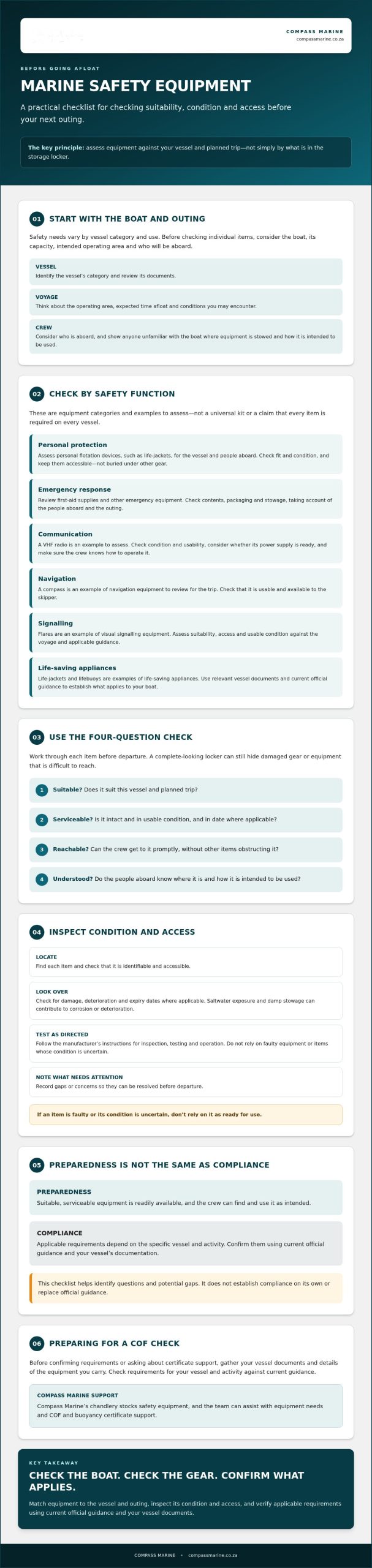
Organising a checklist by function makes it easier to see what each item is for and where a gap could leave the crew without support. The examples below are categories to assess, not a universal kit or a claim that every item is required on every vessel. Suitability depends on your boat, intended activity and applicable current requirements.
For each item, ask four questions: Is it suitable for this trip? Is it in usable condition? Can the crew reach it promptly? Do the people aboard know where it is and how to use it? Saltwater exposure and damp stowage can contribute to corrosion or deterioration, so include condition checks in your routine. Keeping surfaces and fittings clean also supports regular inspection; if you’re sourcing Star brite boat cleaning products in Durban, matching each product to the right surface and task helps protect equipment and finishes between outings.
Personal protection and emergency readiness
Assess personal flotation devices, such as life-jackets, against the vessel, the people aboard and applicable guidance for selection and use. Check fit and condition, and make sure they’re accessible rather than buried under fishing tackle or spare clothing. Before departure, point out where they are stowed and ensure intended users understand how to put them on.
Review first-aid supplies and other emergency equipment as well. For offshore voyages where having an independent source of fresh drinking water is part of your contingency plan, explore Sale of QuenchSea 3.0 Desalination Devices to see how manual watermakers can bolster emergency preparedness. Consider the people aboard and the nature of the outing, then check the contents, packaging and stowage. Use current official guidance and relevant vessel documents to establish what applies. A generic checklist cannot settle that question.
Communication, navigation and signalling
Communication equipment can support calls for assistance, while navigation equipment helps the skipper maintain awareness of position and direction. A VHF radio and compass are examples to assess, not universal requirements. Check their condition and usability, and follow the manufacturer’s instructions for operation and checks. For powered equipment, consider whether its power supply is ready and whether the crew knows how to operate it.
Review visual signalling equipment against the voyage and applicable guidance. Check that items are accessible and in usable condition, and that people aboard know where they’re stowed. Don’t test or handle signalling devices in a way that conflicts with their instructions.
Requirements can differ by vessel category. For a category-specific reference, SAMSA publishes a category R pleasure vessel COF checklist. Use it for its stated scope, and verify the current guidance for your vessel rather than treating it as a universal list. To review suitable safety equipment categories, explore the Compass Marine marine store and chandlery.
How to inspect boat safety equipment and spot gaps
Make your inspection systematic: locate each item, examine it, test it only as the manufacturer instructs, record its condition, then replace it or seek advice if there’s a concern. Check before departure, not while loading other gear at the launch. Safety equipment should be identifiable and reachable without shifting bags, fishing tackle or other stores.
Salt, damp and repeated handling can take a toll. Corrosion, cracked casings, frayed straps, missing components and unreadable labels are reasons to investigate further. Don’t assume an item is serviceable simply because it’s still onboard. Your bilge pump system deserves the same scrutiny — a blocked intake, faulty float switch or wiring fault can prevent it clearing water even when it appears ready; a dedicated bilge pump maintenance and troubleshooting guide can help you carry out systematic checks before and after boating.
Check condition, instructions and accessibility
Work through the equipment one item at a time. Look for visible damage, deterioration, corrosion and missing parts. Check labels and any dates or service markings where the manufacturer or applicable guidance provides them. Confirm each item is stored securely and can be retrieved promptly, then make sure the crew knows where it is.
Follow the manufacturer’s instructions for inspection, testing, servicing and replacement. Avoid improvised tests: activating a signalling device or dismantling equipment without guidance could damage it or make it unusable. If a label is unreadable, an item is damaged or you’re uncertain about its status, seek advice or assess whether it needs replacing rather than treating it as ready for use.
For current notices and relevant official information, consult the South African Maritime Safety Authority (SAMSA). Requirements depend on the vessel and activity, so use applicable guidance and vessel documents to resolve compliance questions rather than relying on a general inspection routine.
Keep a simple onboard equipment record
A short record helps you track what was checked and what still needs attention. Keep a paper list with the vessel documents or use another format that’s easy to update. For each relevant item, record:
- Item and its location onboard.
- Condition and inspection date.
- Any follow-up action, such as seeking advice or assessing replacement.
- Manufacturer-specific servicing or replacement guidance, where applicable.
Don’t set a blanket inspection or replacement interval. Follow the item’s instructions and applicable guidance, and update your record after checks or follow-up work. Equipment is only useful when it is suitable, serviceable and reachable.
If you’re unsure what safety equipment to review or replace, Compass Marine’s chandlery stocks safety equipment. You can review marine safety equipment with relevant assistance.
Marine safety equipment Durban: choose equipment that fits your vessel, crew and operating conditions
Match equipment to your vessel and planned use
The right equipment depends on your boat, planned trip and the people aboard. A sheltered outing with an experienced crew presents different practical considerations from a longer trip with passengers unfamiliar with the vessel. Check current South African guidance for requirements that depend on vessel category or activity.
Choose equipment for the boat and its use, then verify requirements against current guidance. Use this comparison to organise your decisions, not as a universal equipment list.
- Personal protection: Consider the needs of the people aboard and whether intended users can manage the equipment. Check its instructions and storage needs.
- Communication: Think about how the crew would contact others or seek assistance during the outing. Consider who can operate the equipment and what upkeep it requires.
- Navigation: Match tools to the route and the skipper’s familiarity with them. Keep them accessible and ensure the person responsible knows how to use them.
- Signalling and emergency response: Consider who may need to use each item and whether its instructions, maintenance needs and stowage are clear.
Questions to ask before buying
Ask whether an item suits your vessel, intended use and the people who may rely on it. Check that its instructions are clear, you understand its maintenance needs and it can be stored accessibly. If suitability or compliance is uncertain, consult current official guidance or seek informed assistance before purchasing.
Avoid common buying mistakes
Don’t copy another boat’s equipment list without checking differences in category and use. Appearance or price alone won’t establish suitability. New equipment still needs correct stowage, user familiarisation and upkeep. Compass Marine’s chandlery stocks safety equipment; ask about suitable safety equipment for your vessel and intended use.
Prepare for a COF check and get help reviewing your safety equipment
Consider a Certificate of Fitness (COF) or buoyancy certificate check in light of the requirements that currently apply to your vessel. A general checklist can help you prepare, but it can’t confirm that your boat meets those requirements. Verify details with the appropriate authority or a qualified professional, using your vessel’s documentation.
What to prepare before asking about a COF
Gather the vessel’s available documents and existing certificate information before discussing a check. Having them to hand keeps the conversation specific to your boat instead of relying on a generic equipment list.
Make a separate note of any safety item that’s missing, damaged, difficult to identify or uncertain in condition. Include relevant equipment details and any manufacturer instructions you have. Describe what you’ve observed rather than assuming an item will be accepted or is suitable. Then confirm applicable requirements against current official guidance or with a qualified professional.
When to ask a marine professional for help
Seek informed assistance if you’re unsure whether equipment suits your boat or intended use, or if its condition, servicing needs or markings are unclear. This is particularly useful when vessel documents and equipment onboard don’t appear to match. Don’t treat general checklist advice as confirmation of compliance or rely on assumptions based on another vessel.
Compass Marine facilitates COFs and buoyancy certificates, and its chandlery stocks safety equipment. The business can help you discuss equipment needs and certificate support, but requirements for your vessel should still be verified through appropriate guidance or with a qualified professional.
Good preparation starts with clear documents, an honest list of equipment concerns and current, vessel-specific guidance. For help reviewing marine safety equipment and certificate-related needs, contact Compass Marine about marine safety equipment.
Make your next departure a confident one
A sound safety plan is built around your vessel and the trip ahead, with equipment choices and certificate questions checked against current, applicable guidance. If you searched for “marine safety equipment Durban”, use this checklist to focus on your own boat’s documents and needs.
Compass Marine’s marine store and chandlery stocks safety equipment, and the business facilitates COFs and buoyancy certificates. For assistance discussing equipment and certificate support, contact Compass Marine.
Check your vessel documents, make a note of any equipment concerns, then contact Compass Marine to discuss safety equipment and certificate support.
Frequently Asked Questions
Is there one marine safety equipment checklist that applies to every boat?
No single checklist should be assumed to suit every vessel. Equipment needs and applicable requirements can depend on your boat’s category, intended activity and current South African guidance. Use a general list to organise your review, then check your vessel documents and confirm what applies. If the requirements or documentation are unclear, seek advice from the appropriate authority or a qualified professional before relying on assumptions.
What safety equipment should I check before taking my boat out?
Check relevant personal protection, communication, navigation, signalling and emergency equipment for suitability, condition and access. The precise items depend on your vessel and planned outing, so a general marine safety equipment checklist is not proof of compliance. Follow the manufacturer’s inspection instructions, review your vessel documents and confirm current applicable guidance. Make sure people aboard know where equipment is stowed and how to use it.
How often should boat safety equipment be inspected?
Follow the manufacturer’s instructions and applicable official guidance for inspection, servicing and replacement. Before each outing, visually check that relevant items are present, accessible and not obviously damaged. Keep a simple record of condition and follow-up action, noting specific servicing guidance where relevant. Don’t guess about unclear dates, service markings or replacement needs. Ask the manufacturer or a qualified marine professional to clarify what applies to the item.
Can I use an expired or damaged item of boat safety equipment?
Don’t assume an expired, damaged or poorly maintained item will work when needed. Check the manufacturer’s instructions and applicable guidance to establish whether it requires servicing or replacement. Until its condition has been assessed, don’t rely on uncertain equipment for an emergency. If you can’t confirm that it’s suitable and serviceable, seek advice from a qualified professional or relevant supplier, and consider suitable replacement equipment for the vessel.
What is a COF and how does it relate to boat safety equipment?
A Certificate of Fitness (COF) is associated with checks of a vessel’s fitness and compliance, including applicable safety equipment requirements. The process and requirements depend on the vessel and current South African rules. An online checklist can help you prepare, but it can’t confirm that your boat meets the requirements. Review your vessel documents and consult the appropriate authority or an experienced service provider about checks relevant to your vessel.
Where can I get help choosing marine safety equipment in South Africa?
Start with your vessel documents, planned use and current guidance for your boat. A marine chandlery can help you discuss equipment categories and product suitability; confirm certificate-related requirements with the appropriate authority or a qualified professional. Compass Marine operates a marine store with safety equipment and facilitates COF and buoyancy certificate support. Contact the business directly to discuss your needs.