
What if the anchor that looks strongest is the wrong choice for the seabed beneath your boat? Choosing small boat anchors South African boaters can rely on means looking beyond size: the design must suit your boat, the bottom and the conditions you expect to face.
It’s reasonable to wonder whether an anchor will hold, especially when sand, mud and rocky ground call for different approaches. The anchor is only one part of the set-up, too. The chain, rope, boat size, load and wind exposure all affect how securely your boat lies.
This guide compares common anchor designs and their trade-offs, then explains how to match an anchor and rode to your boat and intended use. You’ll also find practical checks to make before anchoring, ways to monitor changing conditions and signs that it’s time to reassess your position. The aim is a considered set-up, not a one-size-fits-all recommendation.
Key Takeaways
- Choose an anchor for your boat, the seabed and expected exposure, rather than relying on boat length alone.
- Compare anchor designs by their general suitability for different bottoms, while recognising that conditions affect performance.
- Use the manufacturer’s sizing guidance and consider the anchor, chain and rope as one connected system.
- Check conditions and inspect your gear before anchoring. Monitor the boat and reassess if circumstances change.
- Use this practical framework to compare small boat anchors in South Africa, and draw on Compass Marine’s chandlery and marine experience for informed boat ownership.
Why small boat anchor choice depends on more than boat length
A suitable small-boat anchor depends on more than the length in a boat’s specifications. The boat’s type, displacement and usual load affect how it responds to wind and current. The seabed and exposure at your anchoring spots influence how an anchor may set and hold. The anchor, chain and rope must also work as a complete system.
The connected chain and rope between the anchor and the boat are called the anchor rode. Each component, its connection points and the way it is handled matter. An anchor cannot do its job reliably if the rest of the arrangement is poorly matched, damaged or difficult to deploy.
What should you assess before choosing a small-boat anchor?
Start with how you use the boat. Consider its type and size, its displacement, and the weight and distribution of people, fuel and equipment on a typical trip. Two boats of similar length can have different loads and wind exposure, so length alone is not a sound basis for selecting an anchor.
Next, consider where you usually stop. Sand, mud and rocky ground present different holding conditions. Wind and current can also place changing loads on the boat and rode. A sheltered stop for a short break is not necessarily comparable to an exposed anchorage. Use the boat and anchor manufacturer’s guidance for the specific model and intended use, and compare it with the conditions you expect to encounter.
Why the anchor is only one part of the set-up
The anchor should suit the bottom, but the chain, rope and connection points must also be appropriate for the boat and the way you anchor. Check the rode for visible wear, corrosion or damage, and make sure it can be handled and stored without tangling or obstruction. If a connection or fitting looks compromised, don’t rely on guesswork or an improvised repair.
There’s a practical balance between compact storage and dependable use, particularly when outfitting craft from retailers such as Inflatable Boats where onboard room is limited. Smaller, lighter gear may be easier to stow and handle, but convenience does not establish that it is suitable for your boat or conditions. Follow the equipment maker’s recommendations and consider the whole set-up, rather than choosing by anchor weight or storage space alone.
For background on anchor components, design history and related gear, see this comprehensive overview of anchor types. General information is a starting point, not a substitute for model-specific instructions. A marine chandlery and practical marine knowledge can help you consider anchoring equipment as part of the boat’s wider set-up, rather than reducing the decision to a single measurement.
Small boat anchor types compared: match the design to the seabed
No anchor design is best for every small boat or bottom. Shape affects how an anchor may set, but the result also depends on the seabed’s composition, the boat’s exposure and how the anchor is deployed. Use the comparison below as general guidance, not a guarantee of holding performance.
| Anchor design | General characteristics | Possible suitability |
|---|---|---|
| Grapnel | Folding arms or tines catch on the bottom. | Often considered for compact boats and rocky ground, though it may snag and be difficult to recover. |
| Plough-style | A shaped body is intended to turn and bury into the seabed. | May suit some sand or mud conditions; results depend on the particular bottom and design. |
| Fluke-style | Broad flukes are designed to engage with the seabed. | Often considered for sand or mud, but weed, firm ground and deployment technique can affect setting. |
| Scoop-style | A concave shape is intended to dig into the bottom. | Can be considered across different seabeds, but performance still depends on conditions and correct use. |
When might a grapnel, plough or fluke-style anchor suit a small boat?
A grapnel’s multiple arms make it a compact option that can catch on rocky structure. That can be useful in some situations, but catching is not the same as setting securely. The anchor may also be difficult to retrieve if it hooks into rock or debris.
Plough-style and fluke-style anchors take different approaches to engaging the seabed. A plough’s shape is intended to turn and bury, while a fluke-style anchor relies on its broad blades gaining purchase. Either may be considered for sand or mud, but the boat, actual bottom and expected exposure all affect the choice. Don’t assume an anchor suited to a sheltered stop will perform the same way in more exposed conditions.
How do seabed conditions affect small boat anchors Durban boaters use?
Sand can vary in firmness, while mud can be soft or dense. These differences affect how readily an anchor beds in. Weed may obstruct contact with the bottom, while rocky ground can prevent an anchor from setting or leave it snagged. What you know about your usual anchoring spots is more useful than choosing for an idealised seabed you rarely encounter.
Flukes or scoop shapes may suit some sand and mud, whilst a grapnel may catch on rocky ground. The seabed and setting technique determine the result. Lower the anchor in a controlled manner and follow its manufacturer’s instructions for setting. Reassess if the boat moves unexpectedly or conditions change.
When comparing small-boat anchor options, start with the bottom you actually use, then consider how the anchor fits your boat and usual conditions. Compass Marine’s marine chandlery and store supports informed boat ownership with a range of marine products and practical expertise.
How to assess anchor size, chain and rope as one system
Size an anchor according to the manufacturer’s guidance for your specific boat and intended use. Boat length is only part of the picture: configuration, displacement, typical loading and exposure to wind or current all influence the demands on the ground tackle. The anchor, chain and rope need to work together, rather than being chosen as separate pieces of equipment.
A heavier anchor on its own doesn’t guarantee secure holding. If the design doesn’t suit the seabed, the rode is unsuitable or a connection is worn, extra weight won’t solve the underlying problem. Check the recommendations for the anchor model and your boat, then assess the complete set-up against the conditions you actually encounter.
What role do anchor chain and rope play?
Chain and rope form the anchor rode, linking the anchor to the boat. Their material and condition affect handling, storage and deployment. The connection between each component and the boat’s attachment point must also suit the equipment. Inspect for visible wear, corrosion, damaged rope or questionable fittings, particularly after regular saltwater use. If a component looks compromised, don’t rely on an improvised repair.
There’s no single chain or rope specification that suits every small boat. For a closer look at the considerations involved, read this guide to choosing boat anchor chain in Durban. Use it alongside the anchor maker’s instructions and your boat documentation, not as a substitute for them.
How can you judge whether an anchor is appropriate?
Review the anchor maker’s sizing guidance and relevant boat documentation before settling on a choice. Consider how the boat is configured and loaded, where you usually anchor, the conditions you may face and whether the equipment can be stored and deployed safely. A set-up that is awkward to handle or stow may be less practical for your use, even if the anchor itself appears suitable.
Rope selection is part of the same decision. Check the guidance for the rope and anchor together, and consider handling and storage. Compass Marine’s guide to choosing anchor rope in Durban offers further detail. A dependable choice is the one that suits the boat, expected conditions and complete rode, not simply the heaviest anchor that fits aboard.
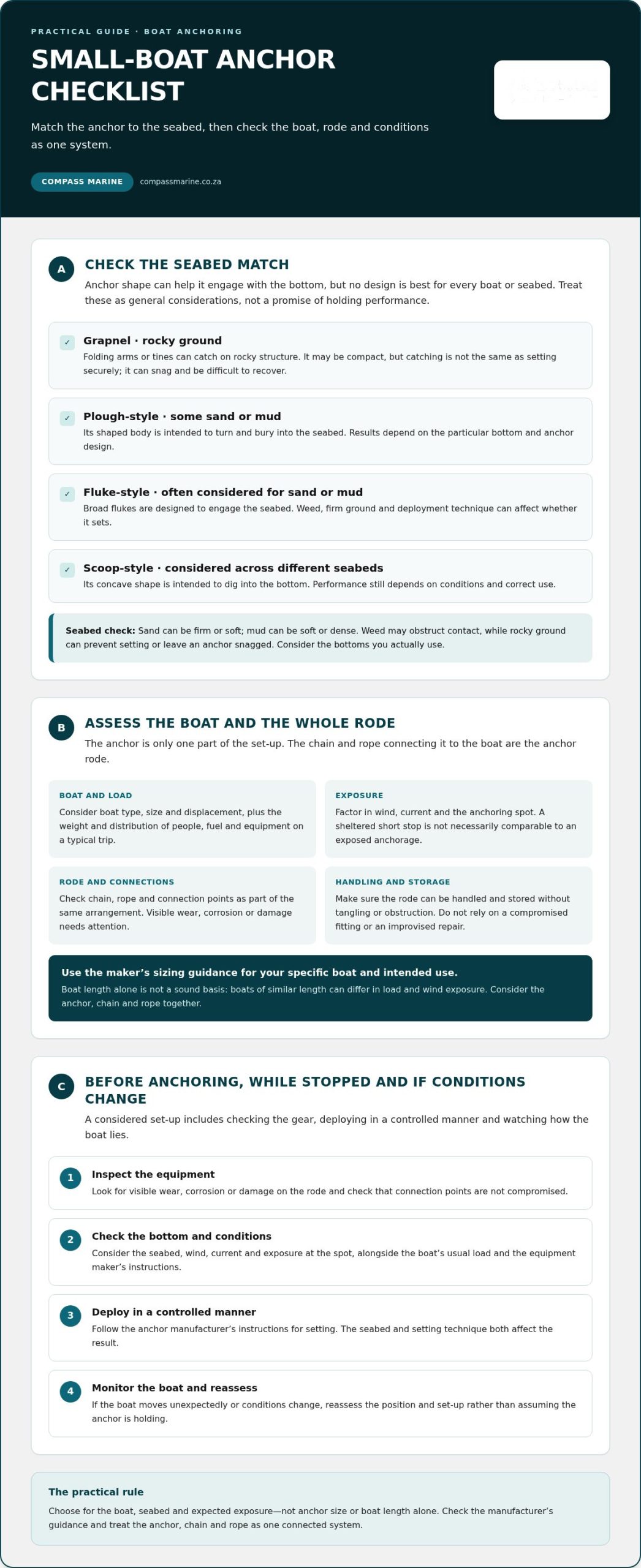
A practical checklist for preparing to anchor and checking your set-up
A dependable anchoring routine starts before the anchor goes overboard. Conditions can change, so treat anchoring as an ongoing decision: check the surroundings, inspect your gear, prepare for controlled deployment, then keep watch on the boat. Follow your vessel and equipment manuals, along with safety guidance that applies to your circumstances.
What should you inspect before deploying an anchor?
Visually check the anchor, shackles, chain, rope and the boat’s attachment points. Look for obvious wear, damage, corrosion, deformation or fraying. Confirm the rode is accessible, connected as intended and clear to run out without catching on other equipment or creating a trip hazard.
If anything appears damaged or you’re unsure about a connection, don’t use that equipment until it can be assessed safely. Avoid an improvised repair or relying on a suspect fitting simply because the anchorage looks calm.
Prepare, deploy and monitor
- Check conditions: Consider wind, current, nearby traffic, available space and how the weather may change. Choose a position that leaves room to respond if the boat moves.
- Prepare the crew and gear: Make sure everyone understands their role, the rode is ready to run freely and the anchor can be handled without placing hands or feet where they could be caught.
- Deploy deliberately: Follow the anchor maker’s and vessel’s instructions. Avoid rushing or allowing the rode to tangle as it goes out.
- Keep watch: Observe the boat’s position relative to fixed surroundings and other vessels. Recheck conditions instead of assuming the initial set will remain suitable.
When should you reassess, reset or retrieve the anchor?
Unexpected movement, a change in wind or current, or increasing traffic can make the original position less suitable. If the boat appears to be dragging or the anchor is holding poorly, prioritise crew safety and reassess the situation. Don’t respond with forceful improvisation or put anyone at risk while trying to free or reset equipment.
Resetting or retrieving may be appropriate if it can be done safely and in line with your vessel’s guidance. If conditions make handling the rode unsafe, focus on the crew and follow applicable boating safety guidance. Keep monitoring and respond early when circumstances shift.
For practical support with your boat’s wider marine equipment and care, explore Compass Marine’s marine services and products.
Choosing small boat anchors with practical marine support
Choosing well means bringing the whole picture together: your boat and its usual load, the seabed where you anchor, the conditions you expect, the anchor design, the connected chain and rope, and safe handling. No single anchor choice suits every small boat. A set-up that works for a lightly loaded boat in a sheltered spot may not be appropriate for a different boat or more exposed conditions.
What information helps make an informed anchoring decision?
Before comparing options, note your boat’s type, length and typical loading, including the people and equipment usually aboard. Record the places where you commonly anchor and the seabed you encounter, such as sand, mud, weed or rocky ground. Include the conditions you’re likely to face and any practical limits on storing or handling the gear.
Use the boat documentation and the manufacturer’s guidance for the anchor and rode as part of your decision. These details keep the choice grounded in the actual equipment and intended use, rather than a general rule of thumb. The right combination depends on the individual boat, its fittings and the conditions in which you operate.
How can Compass Marine support wider boat ownership?
Compass Marine’s chandlery and marine store are part of a wider base of practical marine knowledge, supported by decades of experience and marine technical expertise. Anchoring equipment sits within the boat’s broader set-up: its fittings, condition, storage and preparation all contribute to responsible ownership.
Key takeaway: Match the anchor and rode to the boat, seabed and expected conditions, then check the equipment and handle it safely. Use model-specific guidance and assess the complete system, not just the anchor.
For practical support with your boat’s wider marine needs, contact Compass Marine.
Build a dependable anchoring set-up for your next trip
A suitable anchor is only one part of a dependable set-up. Match its design and sizing guidance to your boat, the seabed and expected conditions, then consider the chain, rope, connections and safe handling as a complete system. Check the equipment before use and keep monitoring conditions once you’re anchored.
The practical question is not simply which anchor is strongest. It’s which combination suits your boat and the places you use it. Manufacturer guidance matters because the right choice depends on your specific vessel and equipment.
Compass Marine brings professional marine experience, technical and mechanical expertise, and a comprehensive marine store and chandlery to wider boat ownership. For practical marine support, contact Compass Marine.
Key takeaway: Choose for the whole anchoring system, inspect it before deployment and reassess if conditions change. A considered set-up can help you head out with greater confidence.
Frequently Asked Questions
What type of anchor is best for a small boat?
There’s no single best anchor design for every small boat. The suitable choice depends on your boat, the seabed, expected conditions and how you plan to use the anchor. Compare designs with the bottoms you actually encounter, then follow the anchor maker’s guidance for your boat. General recommendations are a useful starting point, not a promise that an anchor will hold in every situation.
How do I choose the right anchor size for my boat?
Start with the anchor manufacturer’s guidance for your boat type and usual loading, then consider where and how you anchor. Boat length alone doesn’t account for every factor. Check your boat and equipment documentation, and assess the anchor, chain and rope together. Avoid relying on a generic size chart instead of guidance for your specific equipment and boat.
Is a grapnel anchor suitable for a small boat?
A grapnel anchor’s compact design may suit some small-boat uses, but its suitability depends on the seabed and conditions. Don’t assume any design will hold reliably everywhere. Consider the bottoms you encounter, how the anchor is intended to be used and the manufacturer’s instructions. Before use, inspect its components for visible wear or damage. If the boat doesn’t remain where expected, reassess rather than assuming the anchor is holding.
How much chain and rope should I carry for a small boat anchor?
The appropriate anchor rode depends on your boat, anchor, operating conditions and equipment guidance. There’s no single length or specification that fits every small boat, so check the relevant manuals rather than applying a universal figure. Assess the chain, rope and connectors as one system, and consider whether the rode can be stored and handled safely. Keep it in serviceable condition, and don’t use components that appear damaged.
Can one small boat anchor work on every seabed?
No anchor should be treated as universally suitable. An anchor that sets in one type of bottom may perform differently in sand, mud, weed or rocky ground. Wind and current can also affect how the boat lies. Choose with your usual anchoring locations in mind, monitor the boat after deployment and reassess if conditions change. Follow equipment guidance, and don’t assume a successful set in one place guarantees the same result elsewhere.
What should I check before anchoring a small boat?
Check the conditions and surroundings, then visually inspect the anchor, chain, rope, connections and attachment points for wear or damage. Make sure the rode is accessible, correctly connected and clear to deploy. Consider whether the planned location and equipment suit your boat and the conditions. If anything looks damaged or uncertain, prioritise safety and avoid improvised repairs. Follow your vessel and equipment instructions for your circumstances.