
With the adoption of IoT-connected devices on boats increasing by 18% in 2026, your electronics are no longer just optional gadgets; they’re the central nervous system of your vessel. Precision matters on the water. It’s understandable if the technical jargon and transducer options feel overwhelming, as no one wants to spend their weekend troubleshooting interference instead of finding the shoals. You need equipment that works as hard as you do.
This guide will help you master the complexities of marine electronics, ensuring you select the perfect fish finder for your vessel and fishing style. We’ll provide a clear framework for understanding sonar types, matching devices to your boat, and securing a reliable installation that protects your investment. By the end of this article, you’ll have the confidence to choose a system that delivers professional-grade results every time you leave the jetty.
Key Takeaways
- Understand why the modern fish finder is now a sophisticated Multi-Function Display (MFD) that integrates navigation and engine diagnostics into a single interface.
- Distinguish between CHIRP, DownScan, and SideScan technologies to choose the sonar capabilities that best suit your specific target species and depth requirements.
- Learn how to tailor your electronics package to your environment, from high-power offshore units to the SideScan systems essential for shallow South African estuaries.
- Identify the common installation pitfalls, such as poor transducer placement and electrical interference, that can compromise the accuracy of your readings.
- Discover the value of technical integration and why specialised professional support is vital for maintaining the longevity and performance of your marine hardware.
Selecting the Right Fish Finder for National Waters
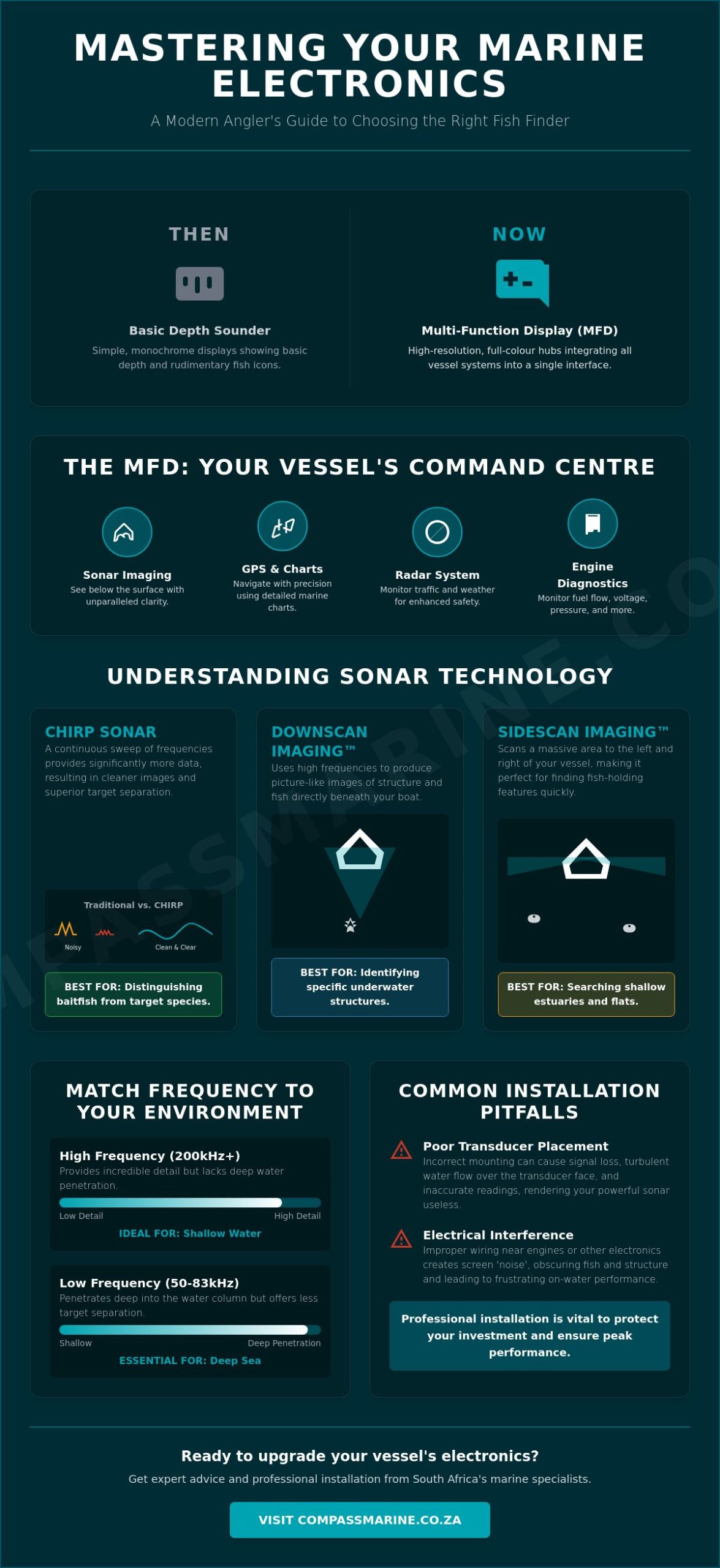
Choosing a modern fish finder is no longer about simply measuring the distance to the seabed. In the past, a basic depth sounder was sufficient for most, but today’s technology has transformed these devices into sophisticated Multi-Function Displays (MFDs). You’re no longer just looking for fish; you’re managing a complex array of data points that keep your vessel efficient and your crew safe.
Think of your MFD as the central nervous system of your boat. It doesn’t just show what’s beneath the hull. It integrates your charts, radar, and even real-time engine diagnostics. This shift toward a unified hub means you can monitor fuel flow, battery voltage, and oil pressure from a single, streamlined interface. It’s a professional approach that reduces cockpit clutter and ensures all vital information is exactly where you need it. A well-planned set of boat navigation systems ensures your MFD works in harmony with every other component on board.
Visibility is a critical factor for South African mariners. Our coastal sun is notoriously bright, which can easily wash out inferior displays. High-resolution screens with high-nit brightness ratings are essential for reading data whilst navigating choppy swells or searching for structure in the midday glare. A screen that’s too small or lacks sufficient contrast will lead to eye strain and, ultimately, missed opportunities on the water.
Investing in a reputable brand is about securing long-term reliability. As a dedicated Lowrance agent, we understand that professional support is just as important as the hardware itself. Choosing a global leader ensures your system remains compatible with future software updates and new transducer technology. It’s about protecting your investment and ensuring your electronics package performs as expected for years to come.
The Evolution of Marine Electronics
Modern units have moved far beyond the grainy, monochrome displays of previous decades. Today, all-in-one units are the industry standard for recreational vessels because they combine GPS mapping, sonar imaging, and NMEA 2000 engine data into one cohesive system. The transition to multi-touch, high-contrast screens allows you to swipe between views as easily as you would on a smartphone. This integration simplifies your decision-making process, allowing you to focus on the environment rather than fiddling with buttons.
Frequency and Power: The Core of Performance
The effectiveness of a Fishfinder depends heavily on the relationship between frequency and depth. You must match the unit’s output to your specific fishing environment to get the best results. Consider these primary categories:
- High Frequency (200kHz and above): These provide incredible detail and target separation in shallow water but lack the power to penetrate deep.
- Low Frequency (50kHz to 83kHz): These are essential for deep-sea applications where you need to track the bottom in hundreds of metres of water.
- Power Output (Watts): A higher wattage ensures your signal remains clear and consistent even when surface clutter or aerated water from a choppy sea attempts to distort the reading.
Understanding these technical nuances is the first step toward building a reliable marine network. When your frequency and power are correctly calibrated, you’ll find that the “noise” on your screen disappears, leaving only the clear, actionable data you need for a successful day at sea.
Understanding Sonar Technology: CHIRP, DownScan, and SideScan
Modern sonar technology has redefined what’s possible on the water. When you invest in a premium fish finder, you’re gaining access to three distinct ways of seeing the underwater world: CHIRP, DownScan, and SideScan. Each serves a specific purpose in your tactical toolkit. Understanding how they interact is the key to consistent success. Whilst traditional systems might show you a generic blob, these advanced technologies provide the clarity needed to identify specific species and underwater features with professional precision.
Active Imaging technology takes this clarity to the next level. It’s particularly effective for identifying the subtle differences between dense schools of baitfish and the larger predator fish lurking amongst them. By providing a higher resolution without sacrificing range, it ensures you aren’t wasting time casting into empty water. If you’re still deciding on the right specifications for your vessel, reading a guide on Choosing a New Fishfinder can provide additional perspective on balancing these high-end features.
Why CHIRP is a Game-Changer
Traditional sonar operates by sending a single frequency “ping” at a time. This often results in signal noise and cluttered displays, especially in deeper water. CHIRP, or Compressed High-Intensity Radiated Pulse, changes this by sending a continuous sweep of frequencies. This broad spectrum of data allows the unit to create a much crisper image with superior target separation. CHIRP is a technology that sends a continuous sweep of frequencies to ensure no fish are missed. You’ll notice that fish arches become more distinct, even when they’re holding tight to the bottom or hiding in thick cover.
Structure Imaging vs. Fish Finding
It’s vital to distinguish between finding “the spot” and finding “the fish”. These are two different tasks that require different sonar views. DownScan imaging provides a photo-like view of what’s directly beneath your hull. It’s the perfect tool for identifying submerged trees, old wrecks, or sudden drop-offs that traditional sonar might miss. Whilst DownScan looks down, SideScan allows you to scan wide areas of water on either side of the boat, often reaching up to 100 metres in each direction. This is invaluable for finding isolated reefs or structure in open water without having to drive directly over them.
Combining these views on a split-screen display gives you a comprehensive understanding of the underwater environment. You can use SideScan to locate a promising reef, DownScan to confirm the structure’s layout, and CHIRP to see if there are actually fish present. If you’re unsure which technology fits your hull or fishing style, the team at Compass Marine can help you navigate the options to ensure you get the most out of your electronics package.
Matching Your Fish Finder to Your Fishing Style
Success on the water depends on how well your equipment aligns with your specific environment. A fish finder designed for deep-sea conditions requires vastly different specifications than a unit destined for large inland lakes or shallow estuarine systems. By selecting a device tailored to your primary fishing style, you ensure that every feature on your display contributes to a more productive outing. It’s about matching technical capability to the unique challenges of diverse coastal and inland waters.
The Offshore Specialist
For those venturing into the open ocean, power and precision are non-negotiable. Deep-sea conditions require high-power units paired with specialised transducers capable of reaching depths where game fish roam. Dual-channel CHIRP Sonar is the professional standard here. It allows you to monitor the seabed for structure whilst simultaneously tracking predators in the mid-water column. This dual-view capability ensures you don’t miss bait balls whilst looking for bottom-dwelling species.
Reliability is paramount when you’re kilometres from the harbour. Your hardware must be rugged enough to withstand constant salt spray and the heavy vibrations of a powerboat at speed. Integrated GPS and advanced chartplotting are essential safety features, ensuring you can navigate back to the jetty or mark productive reefs with pinpoint accuracy. Choosing a unit with a high-nit brightness rating is also vital for visibility in the intense glare of the open sea.
The Inshore and Estuary Angler
In the shallow, often murky waters of estuarine systems, SideScan becomes your most valuable asset. It allows you to scan the banks and submerged structure without driving directly over the fish and spooking them. High-frequency imaging is particularly effective in these environments, providing the resolution needed to identify individual fish amongst reeds or bridge pilings. It’s a surgical approach to fishing that relies on clarity over raw power.
Look for units that come pre-loaded with detailed coastal charts and bathymetric data. This information helps you identify tide-driven channels and deep holes where fish congregate. For large inland lake and freshwater fishing, prioritise high-resolution maps. The ability to create custom contours in real-time allows you to map uncharted sections of local freshwater bodies with extreme detail. If you’re on a jet ski, space is at a premium. You need a compact unit that doesn’t compromise on waterproofing or display clarity, ensuring you can read the screen whilst navigating the surf line. A robust mounting system is essential to keep your electronics secure during high-speed transits.
Beyond the Screen: Installation, Transducers, and System Integration
Hardware alone doesn’t guarantee success. A premium fish finder is only as effective as the transducer that feeds it data and the quality of the installation behind it. You could own the most expensive display on the market, but if the transducer is mounted in “dirty” or aerated water, the signal will fail when you need it most. Professional installation ensures that your electronics deliver clear images rather than a screen full of electrical interference.
Electrical noise is the silent enemy of marine electronics. When signal cables are routed too close to high-current engine looms or bilge pump wiring, they pick up “noise” that appears as persistent clutter on your display. Using shielded cables and dedicated, fused power circuits is essential for maintaining signal integrity. This is where professional electrical wiring and fault diagnostics become invaluable, as they protect your high-value assets from the frustrations of inaccurate readings and phantom arches.
Modern vessels rely on NMEA 2000 networking to create a seamless ecosystem. This integration allows your MFD to communicate with every sensor on the boat, turning it into a total command centre. You aren’t just looking at sonar; you’re monitoring a unified dashboard that tracks your position, water temperature, and battery health simultaneously. It’s a structured approach that provides total care for your vessel’s operational lifecycle. Understanding how to correctly plan and install boat navigation systems is essential to ensuring your NMEA 2000 network performs reliably in South Africa’s demanding coastal conditions.
The Transducer Dilemma: Transom vs. Through-Hull
Transom-mount transducers are a popular choice for smaller vessels and jet skis because they’re relatively easy to access and adjust. However, they’re susceptible to turbulence from the hull and propeller. For high-performance hulls or larger offshore boats, through-hull or in-hull transducers are the professional preference. These options provide a cleaner signal by staying in constant contact with laminar water flow. Incorrect transducer placement is the number one cause of poor sonar performance at speed. Choosing the right mounting style depends on your hull design and your typical cruising speed.
Integrating Engine Diagnostics and Performance
One of the most significant advantages of a modern MFD is the ability to display real-time engine data directly on your screen. By connecting your outboard to your fish finder via a gateway, you can monitor fuel flow, RPM, and engine hours without needing separate gauges. This integration offers incredible peace of mind whilst navigating the South African coastline, as you can track your fuel range with surgical precision.
Setting up these digital interfaces requires technical mastery. Our certified Yamaha and Suzuki mechanics ensure that your engine’s ECU communicates perfectly with your Lowrance or other MFD units. This proactive approach to maintenance allows you to spot potential issues before they become costly repairs. If you’re ready to upgrade your vessel’s capabilities, our team provides professional marine electrical services to ensure your system is fully integrated and reliable.
Expert Marine Support and National Technical Services
Purchasing a high-performance fish finder is a significant investment in your maritime lifestyle. However, the value of that hardware is only realised when it’s backed by a partner who understands the technical nuances of your vessel. We pride ourselves on being more than just a retail outlet. As a specialised Lowrance agent, Compass Marine offers a level of institutional knowledge that ensures your electronics are perfectly calibrated for South African conditions.
Choosing a facility that offers both a marine store and a full mechanical workshop provides a distinct advantage. You aren’t just buying a box; you’re accessing a team of experts who can handle everything from stainless steel fabrication for custom mounts to complex electrical fault diagnostics. This integrated approach ensures that your new technology works in harmony with your boat’s existing systems. It’s about building long-term trust through technical mastery and reliable service.
Why Technical Expertise Matters
There is a vast difference between a box-drop retailer and a specialised marine technical centre. A standard shop might sell you a unit, but they rarely have the mechanical background to advise on how that unit will affect your hull’s performance or your engine’s electrical load. Our team includes certified Yamaha and Suzuki mechanics who understand the intricacies of seamless electrical and mechanical integration. We provide personalised advice on selecting the right marine hardware for your specific hull, ensuring that your transducer placement and wiring are handled with professional calm.
- Custom Integration: Tailoring your MFD setup to your specific vessel type and fishing style.
- Expert Diagnostics: Identifying and resolving electrical interference before you hit the water.
- Genuine Parts: Access to authorised hardware and the latest software updates for long-term reliability.
Total Vessel Care
We believe in a proactive approach to vessel maintenance. Upgrading your electronics is the perfect time to conduct routine outboard engine servicing or a full refurbishment of your boat and trailer. Our facility is designed to be a “safe pair of hands” for your entire boat, from the stainless steel fittings to the internal wiring. This comprehensive care ensures your vessel remains a reliable asset for years to come.
Safety and regulatory compliance are at the heart of everything we do. During the installation process, we can assist with ensuring your vessel meets all national safety standards, including the acquisition of buoyancy certificates and COFs (Certificates of Fitness). This ensures that whilst you are enjoying your new sonar technology, you are also fully compliant with South African maritime regulations. Peace of mind comes from knowing every technical detail has been handled by a seasoned expert.
Contact Compass Marine for expert advice on your next fish finder
Securing Your Future on the Water
Selecting the right electronics is about more than just finding shoals; it’s about investing in the long-term reliability and safety of your vessel. By understanding the nuances between CHIRP, DownScan, and SideScan technology, you’ve taken the first step toward a more productive experience. Remember that your system’s performance is only as good as its installation. Professional transducer placement and seamless engine integration are vital for clear, actionable data that you can trust in any conditions.
As an authorised Lowrance agent with decades of marine technical expertise, we’re dedicated to helping you navigate these complex choices. Our team of certified Yamaha and Suzuki mechanics ensures your hardware and outboard work in perfect harmony, protecting your investment from electrical interference or poor placement. Whether you’re scanning the deep offshore or navigating a local estuary, we provide the steady hand you need to manage your high-value assets with confidence. Professional support ensures your fish finder delivers on its promise every time you leave the jetty.
Explore our range of Lowrance fish finders and marine electronics today and gain the peace of mind that comes with professional-grade support. We look forward to helping you master the water.
Frequently Asked Questions
Do I need a separate GPS and fish finder for my boat?
Modern Multi-Function Displays (MFDs) typically integrate both GPS and sonar into a single unit. You don’t need separate devices unless you prefer a dedicated screen for each task to avoid split-screen clutter. Having a combined unit simplifies your dashboard and allows for advanced features like waypoint marking directly on your sonar history. This integrated approach is the current industry standard for recreational and professional vessels.
Can I install a fish finder myself or do I need a professional?
Whilst DIY installation is possible, professional fitting is highly recommended to ensure optimal performance. Incorrect transducer placement often leads to signal loss at high speeds or persistent electrical interference. A professional installer has the diagnostic tools to route wiring safely and calibrate the unit for your specific hull. This proactive step protects your investment and ensures your fish finder provides accurate data from the moment you hit the water.
What is the difference between Lowrance and other major brands?
Lowrance is widely recognised for its pioneering sonar technology and user-friendly interfaces that cater specifically to anglers. Their systems offer seamless integration with NMEA 2000 networks and outboard engine data, making them a preferred choice for technical integration. Whilst other brands offer strong navigation features, Lowrance focuses on delivering high-resolution structure imaging and superior target separation. As authorised agents, we provide the specialised support necessary to keep these systems performing at their peak.
Will a fish finder work in very shallow water, like an estuary?
Yes, modern units are exceptionally effective in shallow estuaries when equipped with high-frequency imaging. Technologies like SideScan are designed specifically for these environments, allowing you to scan banks and submerged structure in as little as one metre of water. This capability is essential for finding fish without driving directly over them and causing a disturbance. It provides a significant tactical advantage in the murky or tidal waters common along the South African coastline.
How do I know if my boat engine is compatible with my fish finder display?
Most modern fuel-injected outboard engines are compatible with your display if they support NMEA 2000 networking. You will typically require a specific interface cable or gateway to bridge the connection between your engine’s ECU and the display unit. Our certified Yamaha and Suzuki mechanics can verify your engine’s compatibility and handle the digital setup. This allows you to monitor critical data like fuel flow and RPM directly on your screen for better vessel management.
Does the type of hull material affect which transducer I should choose?
Hull material is a decisive factor in transducer selection and mounting location. Fibreglass hulls allow for shoot-through in-hull transducers that don’t require drilling, whilst aluminium or wooden hulls generally necessitate transom-mount or through-hull fittings. Each material has different acoustic properties that can affect signal clarity. Choosing the wrong mounting style can lead to poor performance or even damage to the hull, so it’s vital to match the hardware to your boat’s construction.
Can I use a fish finder to navigate at night or in fog?
A fish finder provides valuable depth information and can identify large submerged obstacles, but it isn’t a primary navigation tool for low visibility. You should rely on your GPS and radar for position and traffic awareness whilst using sonar to monitor the seabed. Relying solely on a sonar image in fog is dangerous as it doesn’t show surface vessels or navigation buoys. Always follow standard maritime safety procedures and maintain a proper lookout in challenging conditions.
What maintenance does a fish finder and its transducer require?
Maintenance is relatively simple but essential for longevity. You should regularly clean the transducer face with a soft cloth to remove algae or barnacles, as marine growth severely dampens the sonar signal. Check your electrical terminals for signs of salt corrosion and apply a marine-grade dielectric grease if necessary. Ensuring your display unit is covered when not in use protects the screen from UV damage and salt spray, preserving its clarity and touch-screen responsiveness.