Would you trust a general mechanic to troubleshoot a stalling engine whilst you’re ten kilometres offshore in a heavy Durban swell? Most boat owners in KwaZulu-Natal understand that the Indian Ocean is unforgiving, and the persistent worry of a mechanical failure at sea is a burden no skipper should carry. Whether you’re feeling overwhelmed by complex COF requirements or noticing the first signs of saltwater corrosion on your hull, the Compass Marine boating experts provide the technical steady hand you need.
We agree that vessel ownership should be defined by leisure and confidence, not by technical anxiety or compliance confusion. This article promises to show you why professional expertise is the cornerstone of maritime safety, vessel longevity, and peak performance for every South African boat owner. We will explore how documented maintenance protects your resale value and how to navigate national safety regulations without the stress.
Key Takeaways
- Understand why modern marine engines require specialised diagnostic tools and certified training to ensure reliability in the challenging conditions off the KwaZulu-Natal coast.
- Learn how the Compass Marine boating experts combine mechanical mastery with structural craftsmanship to preserve your vessel’s integrity and long-term resale value.
- Discover the essential steps for maintaining maritime compliance through accurate COF inspections and valid buoyancy certifications.
- Explore the benefits of using marine-grade stainless steel and professional electrical fault finding to combat the effects of coastal humidity and saltwater corrosion.
- Identify how a comprehensive approach to maintenance and secure storage provides total peace of mind for every voyage.
Navigating the Complexities of Modern Vessel Stewardship
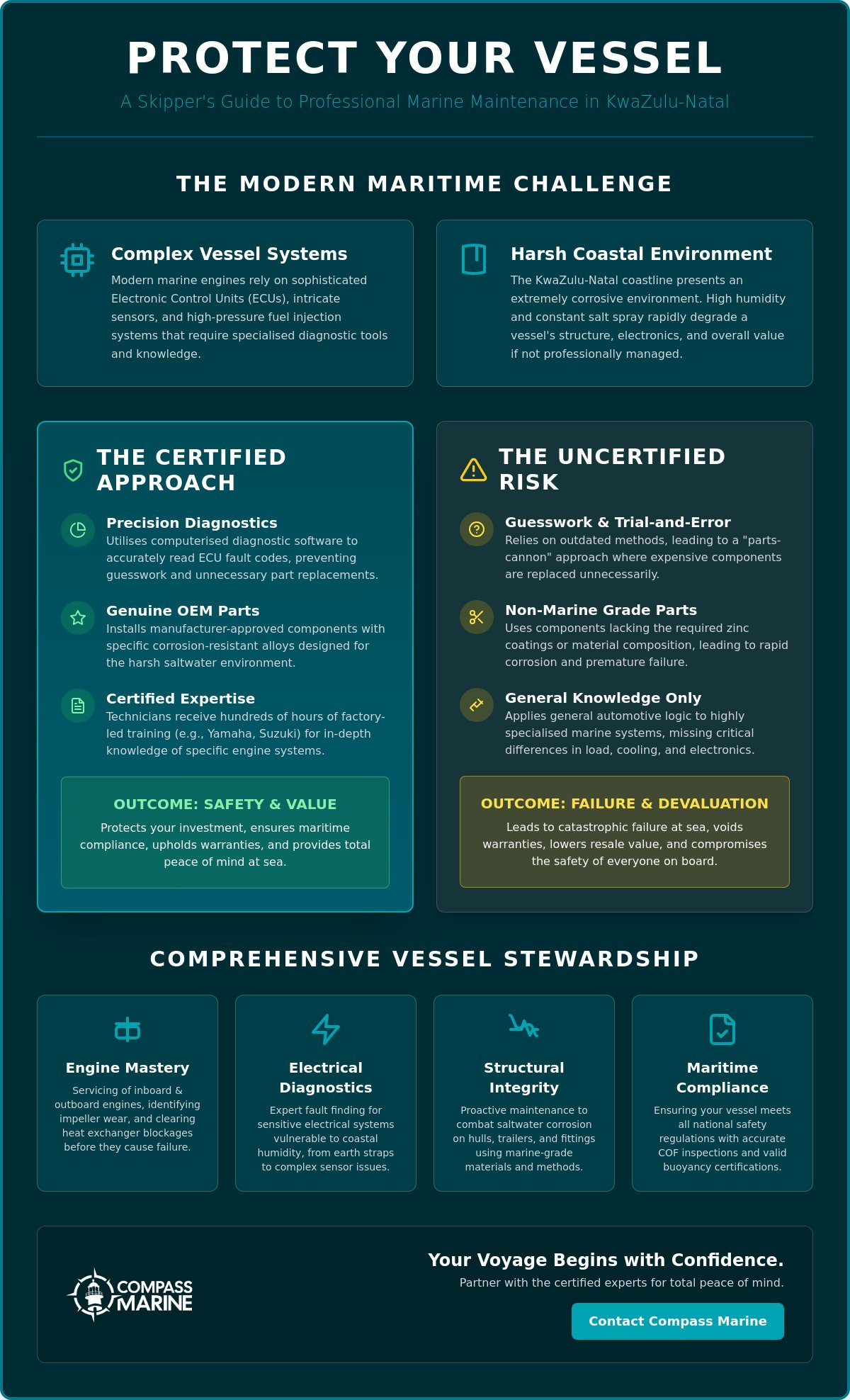
Owning a boat in Durban is a unique privilege, but it comes with substantial technical responsibilities. The days of simple carburettors and basic manual tuning are largely behind us. Today, modern vessel propulsion systems rely on sophisticated Electronic Control Units (ECUs) and intricate sensors to maintain peak performance. Relying on the Compass Marine boating experts ensures that these high-tech components are managed with the precision they require, rather than being treated with guesswork or outdated methods.
The South African coastline, particularly around KwaZulu-Natal, presents one of the most corrosive environments on the planet. High humidity levels and intense salt spray can degrade a vessel’s value and safety faster than most owners anticipate. Shifting your focus from reactive repairs to a proactive stewardship mindset is the only way to safeguard your investment. This approach isn’t just about fixing what’s broken; it’s about preserving the vessel’s integrity before the environment takes its toll, ensuring every voyage begins with total confidence.
The Anatomy of Marine Reliability
Marine engines operate under constant heavy load, unlike car engines that spend much of their time coasting at low RPM. This means mechanical fatigue happens differently. Regular servicing by the Compass Marine boating experts significantly lowers your total cost of ownership by identifying issues like impeller wear or heat exchanger blockages before they lead to a catastrophic engine failure at sea. You should remain vigilant for subtle signs of trouble, such as unusual vibrations, slight changes in exhaust colour, or a slow rise in operating temperature. These are often the first whispers of a looming problem that requires professional intervention.
The Risks of Uncertified Maintenance
Opting for uncertified “backyard” repairs might seem cost-effective initially, but the risks are substantial. Unqualified maintenance often involves using non-marine grade components that lack the necessary zinc coatings or corrosion resistance for saltwater environments. This can lead to rapid part failure and may even void your manufacturer warranties or insurance claims. Professional diagnostics use specialised software to pinpoint faults accurately, saving you hours of billable time compared to the trial-and-error methods used by unqualified hands. By choosing certified expertise, you ensure that every repair meets the rigorous standards required for safety on the open ocean.
Technical Mastery: The Value of Certified Marine Mechanics
A vessel is only as reliable as the hands that maintain it. For owners in Durban, the distinction between a general mechanic and certified Compass Marine boating experts becomes clear the moment a complex fault arises. Yamaha and Suzuki certifications aren’t merely badges; they represent hundreds of hours of factory-led training on specific engine geometries and electronic mapping. This technical depth allows for faster, more accurate fault finding that generalists simply cannot match, ensuring your time is spent on the water rather than in the workshop.
Longevity in the harsh South African maritime environment depends heavily on the use of genuine OEM parts. These components are designed with specific alloy compositions to resist the aggressive saltwater corrosion typical of our local coastline. For a deeper look at how these standards impact your vessel, you can read our guide on professional marine engine servicing. Modern fuel injection systems require micron-level precision and specific fuel-rail pressures to deliver the lean-burn efficiency and immediate throttle response that high-performance outboards are designed for.
Advanced Electrical Diagnostics and Fault Finding
Electrical systems are the most vulnerable components in high-humidity coastal areas like KwaZulu-Natal. We utilise computerised diagnostics to interface directly with your engine’s ECU, allowing us to view live data and historical fault codes. This precision prevents the “parts-cannon” approach, where expensive components are replaced unnecessarily in hopes of fixing a ghost in the machine. Expert fault finding identifies the root cause, whether it’s a corroded earth strap or a failing sensor, saving you significant costs over the life of your vessel. Maintaining these systems is a vital part of maritime compliance and protection, as electrical failure is a leading cause of on-water distress calls.
Inboard and Jet Ski Specialisations
Inboard engines and jet skis present their own sets of engineering challenges, from complex heat exchangers to high-RPM jet pumps. Jet skis are particularly susceptible to damage from sand and debris ingestion, which can quickly score an impeller or wear down a wear ring. We use specialised tools for jet pump servicing that ensure perfect tolerances, protecting these high-performance machines from premature wear. If you’re concerned about your engine’s current performance, it might be time to book a professional inspection with a technician who understands these nuances.
Beyond the Engine: Integrated Marine Technical Services
Mechanical reliability is only one half of the safety equation. A perfectly tuned engine cannot compensate for a compromised transom or a hull slowed by significant bio-fouling. The Compass Marine boating experts provide a holistic approach to vessel care, ensuring that structural integrity and technical integration keep pace with mechanical performance. This comprehensive oversight is why we often consult with certified marine mechanics to ensure that every upgrade, from new navigation arrays to structural reinforcements, meets global maritime standards.
Modern angling in KwaZulu-Natal also requires more than just a sturdy hull; it demands precision technology. Maximising the potential of Lowrance fish finders and integrated navigation systems requires expert installation to prevent electrical interference and ensure accurate transducer readings. When your electronics are calibrated correctly, they don’t just find fish; they provide essential data for safe passage through Durban’s busy harbour and unpredictable coastal waters. We ensure these systems are fused into your vessel’s architecture with the same rigour applied to our mechanical repairs.
Craftsmanship in Stainless Steel and Fabrication
In our local environment, anything less than Grade 316 stainless steel is a liability. We specialise in custom fabrication for T-tops, railings, and bespoke engine mountings that withstand the relentless salt spray of the Indian Ocean. Quality fabrication isn’t just about the grade of the metal; it’s about the integrity of the weld and the final polish. A professional finish removes microscopic pits where corrosion starts, preserving both the aesthetic appeal and the structural strength of your fittings for years to come.
Vessel Refurbishment and Aesthetic Care
Gelcoat is your boat’s first line of defence against water osmosis and UV degradation. Restoring a chalky or cracked finish is a technical necessity that prevents moisture from reaching the underlying fibreglass laminate. Similarly, we prioritise trailer refurbishment, as a seized bearing or a rusted frame can end a fishing trip before you even reach the slipway. Durban’s boat ramps are punishing on equipment. Ensuring your trailer is roadworthy is just as critical as ensuring your boat is seaworthy. Professional detailing and structural refurbishment don’t just make a boat look new; they actively preserve the resale value of pre-owned vessels by preventing the slow creep of environmental decay.
Ensuring Maritime Compliance and Long-Term Protection
Legal compliance in South African waters isn’t just about avoiding fines; it’s about ensuring your vessel is fundamentally safe for your crew and passengers. The Compass Marine boating experts understand that navigating the requirements for a Certificate of Fitness (COF) or a buoyancy certificate can be daunting for many owners. These documents are the legal backbone of your maritime activities, proving that your boat meets the specific safety category requirements, such as Cat C for coastal waters up to 15 nautical miles offshore.
SAMSA regulations mandate that every recreational vessel must undergo an annual inspection by an authorised surveyor to renew its Certificate of Fitness (COF), ensuring it remains compliant with national safety standards. Beyond the COF, a valid buoyancy certificate is a non-negotiable requirement that confirms your vessel has sufficient flotation to remain buoyant even when flooded. Without these current documents, your insurance is likely void, and your safety at sea is significantly compromised. We prioritise these standards to ensure that every vessel we service is not only high-performing but fully compliant with national maritime law.
Preparing for a COF Survey
- Step 1: Conduct a thorough pre-survey audit of all safety gear, paying close attention to the expiry dates on flares and the pressure gauges on fire extinguishers.
- Step 2: Ensure all engine and electrical systems are fully operational, as any failure during the official survey will result in a non-compliance finding and a required re-inspection.
- Step 3: Verify that hull markings, registration numbers, and the vessel’s name are clearly visible and meet SAMSA’s specific size and placement specifications.
- Step 4: Engage an expert to facilitate the final inspection, allowing a professional to identify and rectify potential issues before the surveyor arrives.
The Strategic Benefits of Secure Indoor Storage
While maintaining your boat’s legal status is vital, physical protection from the elements is equally important for long-term value. Intense UV rays and Durban’s high coastal humidity accelerate the degradation of gelcoat, upholstery, and delicate electronic sensors. For many owners, the most effective solution is found in our guide on secure indoor boat storage, which outlines how to shield your asset from environmental decay. Lock-up facilities also offer superior security compared to driveway storage, significantly reducing the risk of theft for high-value equipment like outboards and navigation arrays.
The off-season shouldn’t be a period of neglect. Instead, use this time for deep-cleaning and preventative repairs whilst the vessel is safely out of the water. If your annual inspection is approaching, contact us today to schedule your COF preparation and ensure your vessel meets every safety standard before your next launch.
Partnering with Compass Marine for Total Peace of Mind
Managing a vessel requires balancing multiple technical disciplines, from engine health to structural integrity. By choosing the Compass Marine boating experts, you gain the advantage of a “one-stop-shop” where mechanical, structural, and retail expertise live under a single roof. This integrated approach ensures that your boat isn’t just serviced in isolation; every repair and upgrade is considered as part of a total care plan. Building a documented service history with a single trusted partner is one of the most effective ways to maintain your vessel’s market value, as future buyers look for evidence of consistent, professional stewardship.
If you are considering entering the market or upgrading your current craft, our pre-owned boats for sale guide provides essential insights for navigating the local landscape. Whether you are buying or selling, having a technical partner who understands the history of a boat provides a level of security that generic listings cannot match. Our team acts as a guardian for your investment, ensuring that every technical challenge is met with a solution rooted in experience and integrity.
A Comprehensive Approach to Marine Stewardship
The Compass Marine team prioritises efficiency to ensure your time off the water is kept to an absolute minimum. We organise complex repairs by coordinating our certified mechanics and fabrication specialists, preventing the logistical headaches of moving your boat between different service providers. This oversight means a certified professional is watching every bolt and weld, providing the peace of mind that comes from knowing your vessel is seaworthy. In the technical world of modern boating, expert advice is often the most valuable tool in your arsenal, helping you avoid costly mistakes and unnecessary upgrades.
Chandlery and Product Excellence
Our marine store is more than just a retail space; it’s a curated selection of products we trust and use ourselves. Choosing the right safety equipment and boating accessories for South African waters requires local knowledge of SAMSA requirements and coastal conditions. As Lowrance agents, we don’t just sell fish finders; we help you understand the data they provide and how to get the most out of your high-tech navigation arrays. From expert-approved marine paints to specialised cleaning products for DIY maintenance, we ensure you have access to the same quality materials we use in our own workshop. When you’re ready to experience the difference that true technical mastery makes, contact us for an expert consultation and take the first step towards a more reliable maritime lifestyle.
Securing Your Future on the Water
True maritime safety is built on a foundation of technical precision and proactive care. Relying on certified Yamaha and Suzuki technicians ensures that modern engine complexities are handled with factory-standard accuracy. This professional oversight, combined with comprehensive SAMSA compliance support, removes the guesswork from vessel stewardship and ensures your craft is always legally and mechanically seaworthy. Decades of professional marine expertise allow us to identify subtle structural risks before they impact your safety or your boat’s resale value.
Maintaining a high-value asset in Durban’s corrosive environment doesn’t have to be a source of anxiety. When you partner with a team that understands the local harbour conditions and coastal challenges, you’re investing in years of reliable, stress-free voyages. It’s about more than just repairs; it’s about building a legacy of performance and protection for your vessel. Contact the Compass Marine boating experts today to secure your vessel’s performance and enjoy the Indian Ocean with total confidence. We look forward to seeing you at the slipway.
Frequently Asked Questions
How often should I service my outboard engine for saltwater use?
Outboard engines operated in saltwater should be serviced every 100 hours or at least once every 12 months, whichever comes first. Saltwater is highly corrosive, so even if you don’t reach the hour limit, the lubricants and impellers need annual replacement to prevent seizing or overheating. You should also ensure the engine is flushed with fresh water after every outing in Durban’s coastal waters to clear salt deposits from the cooling galleries.
What is the difference between a COF and a buoyancy certificate?
A Certificate of Fitness (COF) is an annual safety survey required by SAMSA, whilst a buoyancy certificate is a document proving your vessel has sufficient flotation material to stay afloat when flooded. You need a valid buoyancy certificate to obtain your annual COF. Whilst the COF expires every year, the buoyancy certificate usually remains valid for the life of the vessel unless the boat’s structure or flotation material is altered.
Why should I choose a certified Yamaha or Suzuki mechanic over a general repairer?
Choosing certified Yamaha or Suzuki mechanics ensures your engine is maintained using factory-authorised diagnostic software and genuine OEM parts. The Compass Marine boating experts undergo specific training to understand the exact tolerances and electronic mapping of these high-performance brands. General repairers often lack the specialised tools required to calibrate modern fuel injection systems, which can lead to poor fuel economy or engine damage.
Does Compass Marine offer custom stainless steel fabrication for all boat types?
Yes, we provide custom Grade 316 stainless steel fabrication for all types of vessels, including fishing boats, yachts, and jet skis. This high-grade material is essential for the KwaZulu-Natal environment because it provides the highest resistance to pitting and corrosion. We can design and fit anything from bespoke T-tops and rocket launchers to custom railings and engine mountings tailored to your specific hull.
What safety equipment is required for a Cat C vessel in South Africa?
Category C vessels, which operate up to 15 nautical miles offshore, must carry a specific list of SAMSA-approved safety gear. This includes a waterproof VHF radio, a full set of flares, a life jacket for every person on board, and at least two fire extinguishers. You must also carry a first aid kit, an anchor with sufficient chain and rope, and a suitable toolkit for emergency repairs to meet national maritime regulations.
How does indoor boat storage prevent mechanical and aesthetic degradation?
Indoor storage acts as a shield against the intense South African sun and the pervasive salt air that causes gelcoat oxidation and electrical corrosion. By removing the vessel from constant UV exposure, you prevent the fading and cracking of upholstery and the yellowing of clear plastics. It also provides a stable environment for the engine and electronics, significantly reducing the rate of mechanical degradation compared to driveway storage.
Can Compass Marine help with electrical fault diagnostics on older vessels?
Our technicians specialise in electrical fault diagnostics for both modern and older vessels using advanced testing equipment. Electrical issues are common in older boats due to the long-term effects of coastal humidity on wiring looms and terminal blocks. We can identify parasitic draws, failing sensors, or corroded earth points and provide full rewiring services to restore your vessel’s electronic reliability.
What should I look for when buying a pre-owned boat from a technical perspective?
Prioritise a documented service history and a professional engine compression test when evaluating a pre-owned vessel. Check the transom and deck for soft spots, which indicate structural rot, and inspect the hull for signs of osmosis or previous major repairs. It is also wise to consult the Compass Marine boating experts for a pre-purchase inspection to verify the health of the propulsion and electrical systems before you commit to a purchase.