Why does a brand-new bow rail start looking like a rusted antique after just one season in the Durban harbour? It’s a common frustration for boat owners across KwaZulu-Natal who find that “stainless” doesn’t always mean “corrosion-proof” in our aggressive saltwater environment. When you invest in marine stainless steel fabrication in Durban, you aren’t just paying for a specific shape; you’re paying for the chemical resistance and structural integrity required to withstand the Indian Ocean’s relentless spray.
We understand the disappointment of seeing tea-staining on fresh fittings or discovering a weld has cracked under the pressure of a heavy swell. You deserve hardware that maintains its high-shine finish and keeps your crew safe. This article provides a professional evaluation checklist to help you distinguish between average metalwork and true maritime craftsmanship. We’ll examine the critical importance of material grades, the signs of a structurally sound weld, and the finishing techniques that ensure your custom fittings actually increase your vessel’s resale value.
Key Takeaways
- Grade 316 (A4) stainless steel is the non-negotiable standard for Durban’s high-salinity environment to prevent premature pitting and tea-staining.
- High-quality TIG welds and post-weld passivation are essential to prevent structural failure and ensure the longevity of your deck hardware.
- Professional marine stainless steel fabrication Durban provides custom-fit solutions that enhance vessel safety, resale value, and structural integrity.
- Simple maintenance routines, including fresh water rinsing and seasonal waxing, can extend the life of your stainless fittings by decades.
- All structural fabrication must align with local buoyancy and safety certificate requirements to ensure your vessel remains fully compliant.
Understanding Marine Grade Metals: The 316 vs 304 Debate
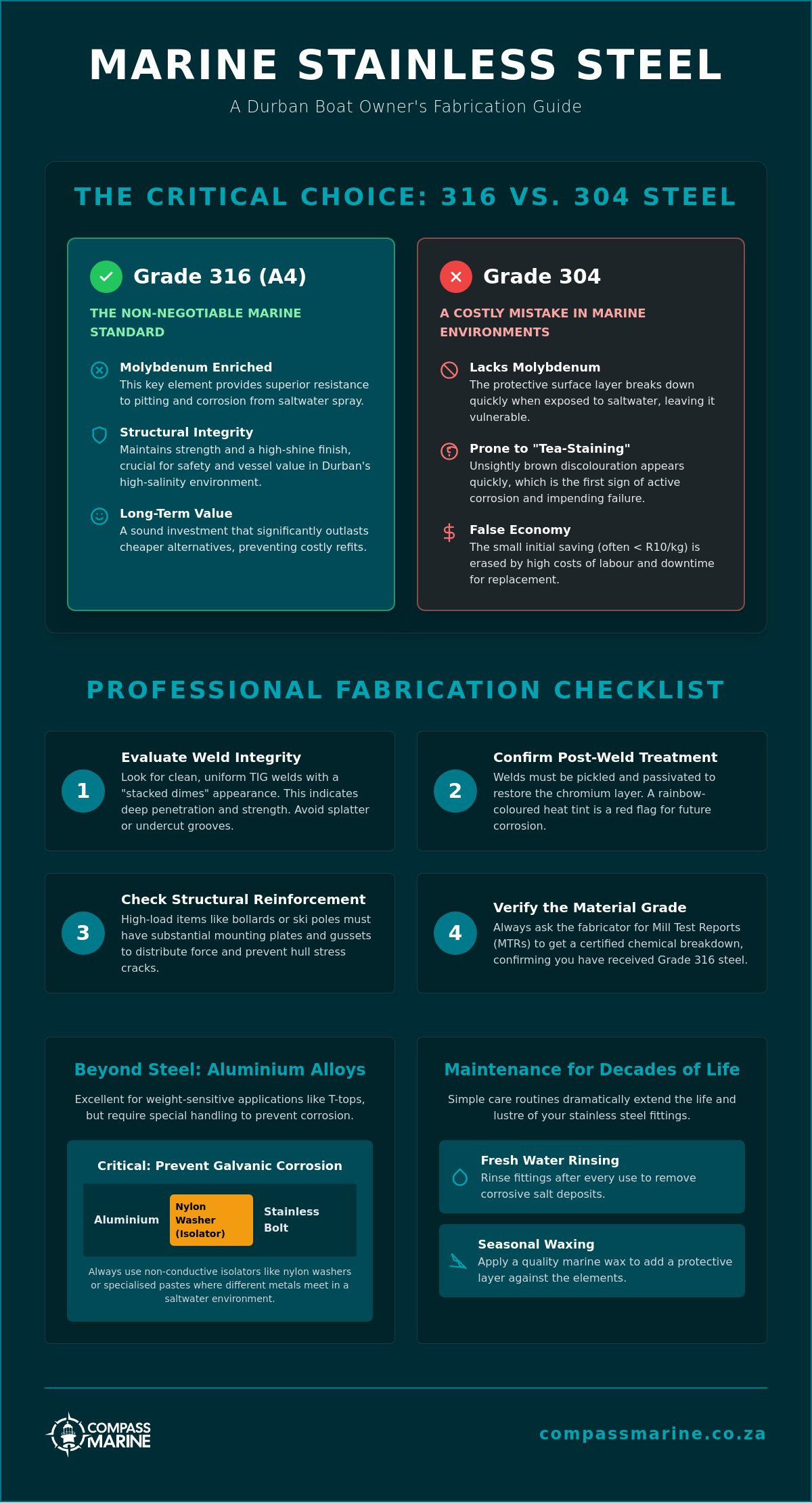
Selecting the wrong metal for your boat is an expensive mistake that usually reveals itself within weeks of launching. In the context of marine stainless steel fabrication Durban experts consistently recommend Grade 316, also known as A4 stainless steel. This alloy is designed specifically to handle the aggressive chloride levels found in the Indian Ocean. The defining characteristic of Marine Grade Stainless Steel is the addition of Molybdenum, a chemical element that significantly enhances resistance to pitting and crevice corrosion. Without this addition, the protective chromium oxide layer on the metal surface breaks down when exposed to salt spray.
Tea-staining is a common sight in Durban’s marinas, appearing as unsightly brown discolouration that looks like rust. This phenomenon occurs when lower grades of steel cannot handle the local coastal humidity and salt concentration. Whilst tea-staining is often cosmetic initially, it indicates that the metal is actively corroding. If left unchecked, this leads to structural failure. You can verify your material grade by requesting Mill Test Reports (MTRs) from your fabricator, which provide a certified chemical breakdown of the batch used for your project.
Why Grade 304 is a False Economy
Using Grade 304 might seem like a way to save costs initially, but it is a choice better suited for kitchen sinks or freshwater dams. In a saltwater environment, 304 stainless steel begins to pit almost immediately. Based on current market data, the price difference between scrap Grade 316 and Grade 304 is often less than R10 per kilogram, yet the lifespan of 316 is significantly longer. Replacing corroded 304 fittings every two years costs far more in labour and downtime than doing the job correctly the first time. Grade 316 is the marine industry benchmark for corrosion resistance because of its superior chemical stability in high-salinity environments.
Specialised Marine Alloys and Aluminium
Not every project requires stainless steel. Aluminium alloys, such as 5083 or 6061, are excellent choices for weight-sensitive applications like T-tops or custom tuna towers. However, aluminium requires careful handling to prevent galvanic corrosion. This happens when different metals touch in the presence of saltwater, causing the softer metal to dissolve. We use nylon washers or specialised isolating pastes to ensure your aluminium and stainless components never directly interact. Choosing the correct gauge is also vital; structural supports need thicker wall dimensions to prevent fatigue cracking, whilst aesthetic rails can use lighter gauges to maintain the boat’s sleek lines.
The Professional Marine Stainless Steel Fabrication Checklist
Once you’ve confirmed the grade of steel, the next step is scrutinising the workmanship. High-quality marine stainless steel fabrication Durban relies on precise execution. A primary indicator of a skilled fabricator is the appearance of the welds. You should look for a “stacked dimes” effect, where the weld beads are uniform and tightly spaced. This isn’t just for aesthetics; it signifies consistent heat control and deep penetration, ensuring the joint won’t fail under the vibration and pounding of a choppy KZN sea.
Welding naturally depletes the chromium in the steel, leaving it vulnerable to rust. To fix this, a professional must perform pickling and passivation. Pickling removes the heat-tinted oxide layer, whilst passivation uses a mild oxidant to restore the protective chromium-rich surface. These best practices for stainless steel fabrication are non-negotiable for items exposed to salt spray. If you see rainbow-coloured heat tint left on a finished product, it’s a sign the metal hasn’t been properly treated and will likely fail within months.
Check high-load items like bollards or ski poles for proper reinforcement. They should have substantial mounting plates and gussets to distribute the load across the hull. If you’re looking for high-quality stainless steel products for your deck, ensure they include these structural details to prevent stress cracks in your fibreglass.
Evaluating Weld Integrity and Aesthetics
TIG (Tungsten Inert Gas) welding is the gold standard for marine work. Unlike MIG welding, which can be prone to “cold start” issues or splatter, TIG provides a clean, concentrated arc. Watch out for “undercut,” which looks like a small groove at the edge of the weld; this weakens the metal. For hollow structures like T-tops or pulpits, ask if the fabricator used “back-purging.” This involves filling the tube with argon gas during welding to prevent “sugaring” or internal oxidation, which can cause the rail to rot from the inside out where you can’t see it.
The Mirror Finish: More Than Just Good Looks
Whilst a brushed or satin finish might look modern, a mirror-polished finish is technically superior for saltwater use. A rough surface provides microscopic “pockets” where salt crystals can settle and begin the corrosion process. A mirror finish minimises this surface area, making the metal easier to clean and harder for salt to grip. Whether achieved through mechanical polishing or electropolishing, the final result should feel perfectly smooth. Run a piece of cloth over the joints; if it snags, the finish isn’t up to marine standards and will trap salt and moisture.
Custom Fabrication vs Ready-Made Marine Fittings
Ready-made fittings are often marketed as a quick, cost-effective fix, but they rarely account for the unique geometry of your vessel. When you opt for marine stainless steel fabrication Durban specialists can design components that follow the specific lines of your hull, ensuring a seamless aesthetic and structural fit. Generic imports frequently compromise on wall thickness or use inferior alloys that fail to meet the Grade 316 standards required for KZN waters. Whilst the initial price tag of a mass-produced rail might be lower, the longevity and safety of a custom-fit 316 component provide far better value over the vessel’s lifecycle.
Custom work is also a core element of professional boat detailing and structural refurbishment. It allows you to replace outdated, pitted hardware with modern, high-strength alternatives that rejuvenate the boat’s appearance. Another advantage is the ability to plan for future upgrades. For example, a custom T-top can be designed with internal cable runs to simplify your marine electronics installation, keeping wiring protected from the elements and out of sight.
Planning Your Custom Project
Precision is the foundation of any successful build. We always recommend creating physical templates on the boat before cutting any metal. This process ensures that rod holders, light brackets, and antenna mounts are positioned exactly where you need them for your specific fishing or cruising style. You should also consult with a technician to discuss structural load distribution. A heavy radar arch or a tall ski pole exerts significant leverage on the deck. Ensure your mounting points are reinforced with appropriate backing plates to handle these forces without damaging your hull. This is particularly important if your vessel has already experienced any hull softening or moisture ingress — issues that may also require professional boat transom repair to fully restore the structural foundation before new hardware is installed.
Refurbishing Existing Stainless Steel
Not every piece of hardware needs to be scrapped. If your railings are structurally sound but have lost their shine, professional polishing can often restore the original lustre. However, if you find deep pitting or cracks near the base of the welds, replacement is the safer option. Professional refurbishment can extend the life of stainless fittings by decades, provided the base material is high-quality Grade 316. Restoring your existing hardware is often a sensible first step during a vessel’s mid-life refit, especially for rare or discontinued boat models where replacements are impossible to find. A comprehensive refit at this stage also presents an ideal opportunity to address your hull’s protective coating, as selecting the correct marine paint for fiberglass boats can significantly extend the life of your hull alongside your newly refurbished metalwork.
Maintaining Your Investment: Post-Fabrication Care
Even the finest marine stainless steel fabrication Durban workshops produce requires ongoing care. Saltwater is a relentless solvent. When it evaporates, it leaves behind concentrated chloride crystals that can penetrate even the most resilient finishes. A quick wash-down with fresh water after every launch is your primary defence against the elements. This prevents salt from drying and bonding to the surface, which is the leading cause of premature tea-staining.
Beyond rinsing, you should implement a seasonal ‘wax and protect’ routine. Applying a high-quality marine-grade wax or a specialised polymer sealant creates an additional barrier. This makes future cleaning easier and helps prevent the fine pitting that often starts in the humid Durban climate. Regularly inspect your hardware for early signs of crevice corrosion, particularly in areas where water might pool or where two components meet.
Cleaning Dos and Don’ts
One of the most common mistakes boat owners make is using steel wool or carbon steel brushes to scrub away stains. This is a critical error. These tools leave behind microscopic particles of carbon steel that will rust almost immediately, a process known as cross-contamination. Always use soft-bristle nylon brushes and non-acidic cleaning agents. If you spot minor tea-staining, treat it early with a dedicated stainless steel restorer. This prevents surface discolouration from turning into deep structural pitting that can compromise the safety of your rails.
Fastener Maintenance
Fasteners are often the first place corrosion takes hold. Crevice corrosion occurs in tight spaces, like the threads of a bolt, where oxygen cannot reach to replenish the metal’s protective layer. Regularly check for loose bolts; these not only compromise structural safety but also allow saltwater to seep into your deck’s core. When installing or servicing fittings, always use Tef-Gel or a similar anti-seize compound to prevent galling and galvanic corrosion. Ensure every screw and bolt is also Grade 316. Mixing grades will lead to rapid failure of the lower-quality component.
If your deck hardware has already begun to show signs of severe pitting or structural weakness, consider our refurbishment of boats and trailers service to safely restore or replace your critical fittings. If saltwater ingress has also compromised the structural core of your hull, it is worth investigating whether you need boat transom repair to address any underlying rot or delamination before fitting new hardware.
Why Compass Marine for Stainless Steel Fabrication in Durban?
Choosing a partner for your vessel’s metalwork requires more than just finding someone who can operate a welder. At Compass Marine, we view every project through the lens of total vessel health and long-term reliability. Our approach to marine stainless steel fabrication Durban boat owners trust is built on the understanding that a new fitting must work in harmony with your boat’s mechanical systems, electrical layout, and legal compliance. We don’t just build rails; we provide a “safe pair of hands” to ensure your investment is protected from the unique challenges of the KwaZulu-Natal coastline.
One critical area where we provide a distinct advantage is ensuring that custom work aligns with South African maritime regulations. Adding significant weight through custom-built T-tops, radar arches, or heavy-duty boarding platforms can alter your vessel’s weight distribution. We possess the technical expertise to ensure that these structural additions continue to meet boat buoyancy certificate requirements, keeping your vessel legal and safe on the water. This integration of fabrication with our broader marine technical services means you won’t have to deal with multiple contractors to keep your boat compliant.
The Compass Marine Technical Advantage
Our workshop is specifically designed for the precision required in maritime environments. We use professional TIG welding equipment to achieve the “stacked dimes” finish discussed earlier, followed by a methodical polishing process that restores the metal’s natural resistance to salt. A major benefit of working with us is the synergy between our mechanics and fabricators. We ensure that a new custom fuel tank or a set of rod holders never compromises engine access or interferes with complex wiring routes. Our on-site marine store also stocks the correct Grade 316 fasteners and specialised Tef-Gel compounds needed to finish every job to a professional standard.
Your Partner in Vessel Refurbishment
Whether you’re preparing for a seasonal COF inspection or undertaking a complete vessel restoration, we manage the entire lifecycle of your project. We’ve spent years customising vessels for local conditions, from creating ergonomic fishing platforms for North Coast anglers to installing safety railings for family cruisers. We never compromise on materials; Grade 316 stainless steel is our absolute standard for every marine project we undertake. This commitment to quality ensures that your custom fittings won’t just look good during the first month, but will continue to add value to your boat for years to come.
Ready to upgrade your vessel with hardware that stands up to the Indian Ocean? Contact Compass Marine for a custom fabrication quote and let our team design a solution tailored to your specific boating needs.
Building for Longevity in the Indian Ocean
Your boat’s hardware shouldn’t be an afterthought. Choosing the right materials and insisting on professional weld standards ensures your vessel remains safe, compliant, and visually stunning for years. By prioritising Grade 316 stainless steel and following a methodical maintenance routine, you protect your investment from the aggressive salt spray and humidity that define the KZN coastline. Investing in high-quality marine stainless steel fabrication Durban ensures your vessel is prepared for the unique challenges of the Indian Ocean whilst maintaining its structural peace of mind.
At Compass Marine, we combine technical mastery with a deep understanding of the maritime lifestyle. Our specialists in saltwater-ready Grade 316 fabrication work alongside certified Yamaha and Suzuki technicians to deliver integrated solutions that never compromise your boat’s performance. Whether you need a custom-built T-top or a simple rail refurbishment, our full-service marine chandlery on-site provides the high-quality 316 fasteners required for a professional finish. We take pride in being a “safe pair of hands” for your vessel’s most critical structural upgrades.
Ready to upgrade your deck hardware? Request a custom fabrication quote from our expert team today. We look forward to helping you prepare your vessel for many successful seasons on the water.
Frequently Asked Questions
Why is 316 stainless steel the standard for boats in KwaZulu-Natal?
Grade 316 is the only viable choice because it contains molybdenum, a chemical element that resists the aggressive chloride pitting common in the Indian Ocean. Whilst Grade 304 might survive in freshwater dams, Durban’s high-salinity air and coastal humidity will cause it to corrode almost immediately. Choosing the correct grade during your marine stainless steel fabrication Durban project ensures your fittings remain structurally sound and free from deep-seated rust for many years.
How can I identify if a weld on my railing is structurally unsafe?
Look for “undercutting,” which appears as a small groove or thinning of the metal right at the edge of the weld bead. You should also check for tiny pinholes, known as porosity, which suggest that gas was trapped during the welding process and has weakened the joint. If a weld looks messy or inconsistent rather than having a smooth, “stacked dimes” appearance, it may fail under the heavy vibrations and structural loads encountered in rougher sea conditions.
Is it possible to remove tea-staining once it has appeared?
Yes, light tea-staining can usually be removed with specialised marine-grade phosphoric acid cleaners or metal restorers. It is vital to avoid household bleach or abrasive steel wool, as these will destroy the protective oxide layer and cause even faster corrosion. Once the stains are gone, the metal must be thoroughly rinsed and protected with a high-quality marine wax to seal the surface against Durban’s salt spray.
Why should I choose custom work over ready-made fittings for my vessel?
Custom fabrication ensures that the hardware follows the specific lines of your boat, providing a professional finish that off-the-shelf parts cannot match. Ready-made fittings often require additional holes or awkward spacers that can lead to deck leaks and core rot over time. By opting for a custom solution, you ensure that mounting plates are sized correctly to distribute structural loads, which prevents the fibreglass from cracking under the pressure of heavy use.
Can Compass Marine assist with repairing bent or cracked hardware?
We provide comprehensive refurbishment services for stainless steel railings, bollards, and T-tops that have been damaged or weathered. If a rail is bent but the metal hasn’t reached its fatigue point, we can often straighten and re-polish it to its original condition. However, if we find structural cracks near the welds or severe internal rot, we will advise on a full replacement to ensure the safety of your crew and the integrity of your vessel.