A single undetected hairline crack in a stainless steel fitting or a minor salt-crust buildup in your cooling system can be the difference between a successful day off the Durban coast and an expensive tow back to the harbour. You’ve likely experienced the frustration of an intermittent electrical fault or the creeping worry of saltwater corrosion quietly affecting your engine’s longevity. Maintaining a vessel in KwaZulu-Natal requires more than just basic upkeep; it demands professional marine technical services that treat your investment with the precision it deserves.
We understand that the complexity of maritime safety regulations and the technical demands of modern outboards can feel overwhelming. You want a sea-ready vessel that performs efficiently whilst staying fully compliant for insurance and safety audits. This guide provides the essential technical standards for marine engine maintenance, structural fabrication, and maritime safety. We will explore how to identify early warning signs, optimise fuel efficiency, and ensure your boat meets every regulatory requirement for total peace of mind on the water.
Key Takeaways
- Understand why professional marine technical services require a multi-disciplinary approach to ensure your vessel remains sea-ready and reliable.
- Learn how certified Yamaha and Suzuki mechanics protect your engine warranty whilst diagnosing complex electrical faults in modern fuel-injected systems.
- Discover the importance of custom stainless steel fabrication and structural repairs in defending your boat against Durban’s aggressive saltwater corrosion.
- Navigate the essential legal requirements for South African maritime compliance, including the Certificate of Fitness (COF) and buoyancy certification.
- See how integrating expert electronics installation with high-quality hardware from a specialist chandlery creates a more efficient and safer boating experience.
Understanding the Scope of Professional Marine Technical Services
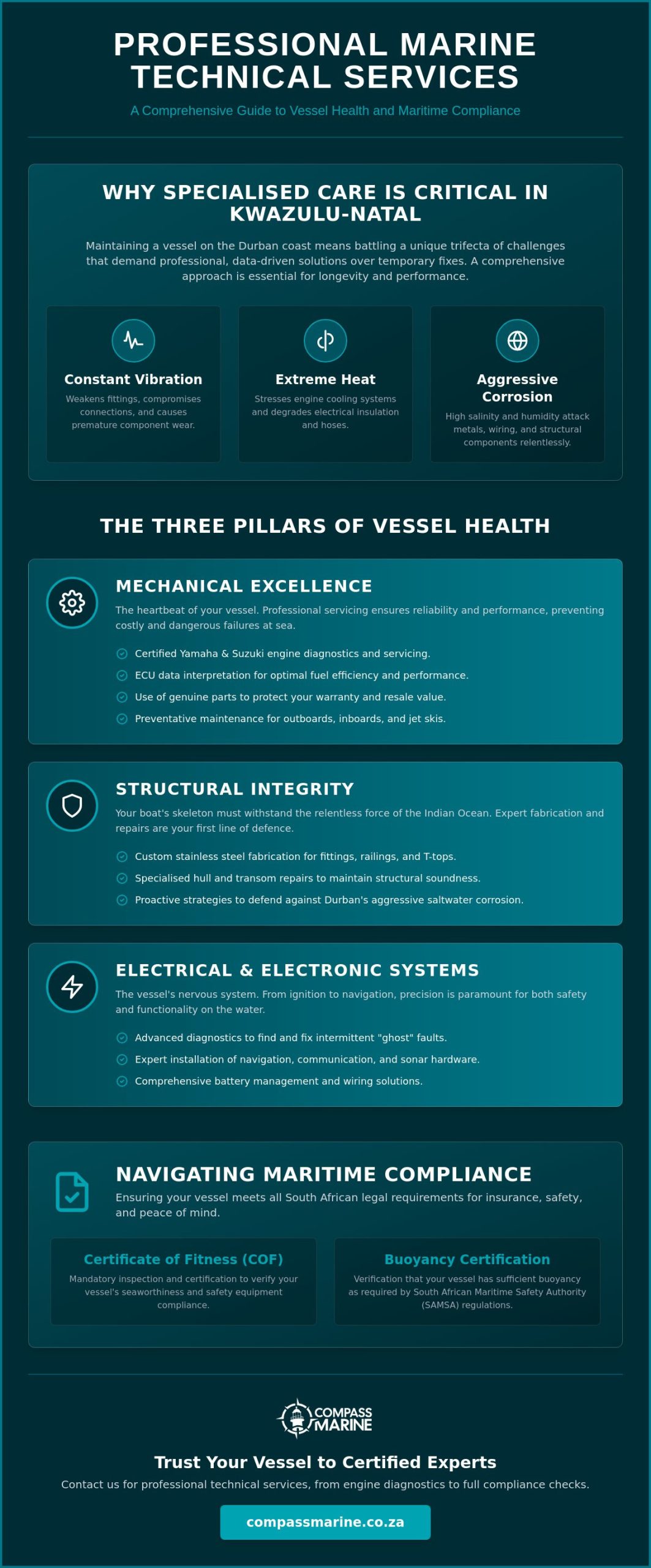
Professional marine technical services represent much more than a simple call-out for a broken motor. It’s a comprehensive, multi-disciplinary discipline that treats a vessel as a single, integrated system where mechanical power, structural integrity, and electronic precision must work in perfect harmony. Unlike basic repairs that focus on immediate symptoms, technical services address the underlying causes of failure. This is particularly vital in KwaZulu-Natal, where our intense coastal humidity and the high salinity of the Indian Ocean create a relentless environment for high-value maritime assets.
Maintaining a vessel to the standards recognised by professional marine engineering organizations ensures that every intervention is based on data rather than guesswork. When you entrust your boat to a “safe pair of hands,” you’re investing in a methodology that prioritises longevity and performance over quick, temporary fixes. Specialised technical knowledge is required because the maritime environment presents a unique trifecta of challenges: constant vibration, extreme heat, and aggressive galvanic corrosion.
The Three Pillars of Vessel Health
We categorise professional care into three distinct but overlapping areas to ensure nothing is overlooked. First is the mechanical system, which includes the engines, gearboxes, and fuel delivery components. Second is the structural skeleton, focusing on the hull, transom, and custom stainless steel fabrication that must withstand the pounding of our local surf. Finally, the electrical and electronic pillar covers everything from basic wiring and battery management to advanced diagnostics and navigation hardware. If one pillar is weak, the entire vessel’s reliability is compromised.
Evaluating Technical Competence
True competence is found in the details of the workshop and the credentials of the staff. A professional technical service provider doesn’t rely on trial-and-error “parts swapping” to find a fault. Instead, they use advanced diagnostic software and factory-prescribed protocols. This is why using a certified Yamaha or Suzuki mechanic is non-negotiable for modern fuel-injected engines. These technicians have the training to interpret complex data, ensuring your engine runs at peak fuel efficiency whilst protecting your manufacturer’s warranty. A clean, organised workshop environment is often the first sign that your boat is being handled with the precision required for maritime safety.
Mechanical Excellence: Certified Engine Diagnostics and Servicing
Mechanical power is the heartbeat of any vessel. In the challenging waters of the Indian Ocean, relying on amateur repairs is a risk no Durban boater should take. Professional marine technical services prioritise mechanical excellence by employing certified Yamaha and Suzuki mechanics who understand the specific needs of modern, high-performance engines. These technicians don’t just change filters; they interpret complex data from the Electronic Control Unit (ECU) to ensure your fuel-to-air ratios are perfect and your timing is precise. This level of technical mastery ensures that your engine performs reliably when you are navigating a busy harbour mouth or heading out for a deep-sea fishing trip.
The return on investment for preventative maintenance is undeniable. A seized engine or a failed gearbox at sea is a dangerous and expensive scenario that usually dwarfs the cost of an annual service. By using genuine parts and adhering to factory-specified intervals, you ensure your vessel remains sea-ready whilst protecting its resale value for years to come. Professional mechanical care also ensures your vessel meets the rigorous safety standards often referenced in maritime compliance regulations, keeping both your passengers and your financial investment secure.
Outboard and Inboard Specialisations
Modern outboards are essentially floating computers. Diagnostic tools are used to scan for “ghost” faults; these are errors that may not trigger a warning light but could lead to an intermittent stall at the worst possible moment. For inboard owners, the focus often shifts to the cooling system components. Over time, salt and mineral deposits restrict flow in heat exchangers; professional descaling is required to prevent catastrophic overheating. Even jet skis require specialised technical attention, particularly regarding wear ring clearances and impeller tuning to maintain the thrust needed for Durban’s demanding surf conditions.
Preventing Saltwater Degradation
Corrosion is a constant threat in KwaZulu-Natal. The chemistry of galvanic corrosion means that without properly functioning sacrificial anodes, the saltwater will literally eat away at your engine’s aluminium components. Internal flushing systems are your first line of defence, but they must be used correctly with the right pressure to be effective. We also focus heavily on fuel system integrity. Ethanol-blended fuels can attract moisture in our humid climate, leading to phase separation and clogged injectors. For a deeper dive into these processes, read our Professional Marine Engine Servicing: The Complete Guide to Reliability. If you suspect your performance is dropping, booking a professional outboard engine service is the most effective way to restore efficiency and ensure your boat remains in peak condition. You may also benefit from exploring boat performance upgrades that address propeller cavitation, hole-shot response, and fuel consumption through a methodical technical approach.
Structural Integrity and Custom Stainless Steel Fabrication
Whilst the engine provides the power, the hull and its fittings form the essential skeleton of your vessel. In the high-energy surf and humid climate of KwaZulu-Natal, structural integrity is constantly under siege from mechanical stress and oxidation. Comprehensive marine technical services must include a deep understanding of metallurgy and composite materials to ensure your boat remains safe and sea-ready. Addressing structural fatigue early, such as soft spots in the deck or hairline cracks in the transom, prevents minor issues from becoming catastrophic failures during a challenging launch.
A vessel’s structural health is often compromised by “invisible” factors. For example, a transom that has absorbed water over several seasons won’t just be heavier; it will lose the rigidity required to support the torque of a modern outboard. Professional technicians use moisture meters and percussion testing to identify these issues before they lead to structural delamination. By integrating structural repairs with mechanical upkeep, you ensure that the entire vessel can handle the physical demands of offshore angling and commercial operations alike.
Marine Grade Metalwork
Custom fabrication isn’t just about aesthetics; it’s about engineering solutions that survive the Indian Ocean. We exclusively use 316-grade stainless steel for all custom fittings because of its superior resistance to pitting and crevice corrosion compared to lower grades. Whether we are fabricating T-tops, railings, or custom rod holders, every weld must meet strict technical specifications to handle the leverage and vibration of offshore use. Organisations like the Marine Technology Society advocate for these high standards in marine technology to ensure long-term durability and safety. For a more detailed look at our metalwork standards, see our guide on Marine Stainless Steel Fabrication Durban: A Guide to Quality and Longevity.
Refurbishment and Restoration
Over time, even the best-built boats face structural challenges like Glass Reinforced Plastic (GRP) osmosis. This “hull rot” occurs when moisture penetrates the gelcoat, leading to blistering that compromises the hull’s strength. A professional refurbishment project involves stripping back affected layers, drying the hull, and applying high-grade marine paint or anti-fouling. In Durban harbour, where marine growth is aggressive, a technical approach to anti-fouling is essential to maintain hull speed and fuel efficiency.
Vessel restoration also extends to the trailer, which is often the most neglected part of the boating setup. In South Africa, ensuring your trailer meets national roadworthiness standards is vital for both safety and insurance compliance. Technical checks must focus on axle corrosion, bearing health, and the integrity of the braking system. A well-maintained trailer ensures that your journey to the slipway is as stress-free as your time on the water.
Navigating Maritime Compliance: COFs and Buoyancy Certificates
Compliance is the non-negotiable side of boat ownership. In South Africa, every power-driven vessel must possess a valid Certificate of Fitness (COF) to operate legally on our waters. This document proves that your vessel has passed a rigorous safety survey and contains the prescribed safety equipment for its designated category. For those launching from Durban or Richards Bay, Cat C is often the standard. This category requires specific gear for coastal waters up to 15 nautical miles offshore, including a waterproof VHF radio and a full set of distress signals. Engaging professional marine technical services ensures that your vessel isn’t just legally compliant, but genuinely safe for your crew and passengers.
A professional workshop acts as a bridge between the boat owner and the surveyor. We prepare the vessel by conducting a pre-survey inspection, identifying potential failure points that an owner might overlook. This proactive approach prevents the frustration and additional costs of a failed survey. From testing the emergency steering to ensuring the navigation lights are correctly wired, technical preparation is the key to a stress-free compliance process. Surveyors respect vessels that show evidence of professional maintenance, as it demonstrates a commitment to maritime safety and technical excellence.
The COF Survey Process
The survey is a thorough examination of your boat’s safety equipment and structural condition. You’ll need to present a valid buoyancy certificate, proof of your radio licence, and a complete kit of safety gear including lifejackets, flares, and fire extinguishers. Common failures often stem from expired pyrotechnics, outdated fire extinguishers, or bilge pumps that lack the required flow rate. For a comprehensive breakdown of the requirements, consult The Ultimate Guide to COF Certificates for Boats in South Africa (2026). Ensuring these items are checked before the surveyor arrives is the most efficient way to maintain your vessel’s legal status.
Buoyancy and Flotation Standards
Buoyancy is a critical technical requirement that ensures your vessel remains afloat even when swamped. The national standard requires specific volumes of flotation material, typically calculated based on the weight of the hull, engines, and maximum passenger load. Whether your boat uses high-density foam injection or sealed air bottles, the buoyancy must be certified by a competent person to be valid for insurance. If you’ve recently completed structural work, such as the transom repairs or deck refurbishments discussed in the previous section, your buoyancy certificate must be updated. This ensures the flotation remains sufficient for the modified weight and displacement of the vessel.
If your annual survey is approaching, we can help you prepare with a professional COF inspection and buoyancy certification to ensure your vessel passes the first time.
The Integrated Approach: From Technical Store to Secure Storage
A truly comprehensive approach to marine technical services extends far beyond the workshop floor. It involves a seamless integration between the hardware you buy, the electronics you rely on, and how you protect your vessel when it isn’t in use. Sourcing the correct marine-grade components from a specialist technical chandlery is the first step in avoiding the “false economy” of using inferior parts that fail prematurely in Durban’s salt-heavy air. By choosing a partner that understands the entire lifecycle of boat ownership, you ensure that every upgrade and maintenance task works toward a single goal: unwavering reliability.
Managing a high-value maritime asset requires a steady hand and a long-term perspective. When your mechanical servicing, structural repairs, and electronics installations are handled under one roof, you eliminate the risk of conflicting technical advice. This integrated model ensures that your electrical system can handle the load of new navigation hardware, and your hull is structurally prepared for the custom stainless steel fittings you require. It’s about building a relationship with a guardian of your investment who knows your vessel’s history from the engine’s first hour to its latest safety survey. A structured plan for maximising boat performance upgrades ensures that each hardware refinement and mechanical tuning decision contributes to measurable gains in efficiency and compliance.
Marine Electronics and Hardware
Installing advanced electronics like Lowrance fish finders involves more than just mounting a screen on the console. It requires a deep understanding of electrical diagnostics to ensure interference-free readings. A poorly placed transducer or a sub-optimal wiring route can lead to “noise” on your display, making it difficult to track fish or navigate safely. Professional marine electronics installation ensures that your navigation systems are correctly configured and integrated with your engine data, providing you with a clear, accurate picture of your vessel’s performance at all times.
Preserving Technical Gains through Storage
The Indian Ocean environment is relentless even when your boat is on its trailer. High UV levels and coastal humidity can degrade gelcoats, upholstery, and exposed wiring in a matter of months. Secure indoor boat storage provides a controlled environment that preserves the technical gains made during your annual service. It prevents the “creeping” corrosion that occurs when salt air sits in the engine bay over the off-season, ensuring your vessel is ready to launch the moment the weather clears.
Beyond physical protection, professional storage solutions facilitate better battery health and fuel stability. We recommend keeping batteries on a managed charging cycle and using fuel stabilisers to prevent the degradation of modern fuels. For a detailed look at how to protect your vessel between trips, read The Ultimate Guide to Secure Indoor Boat Storage: Protecting Your Maritime Investment. By combining expert care with proper protection, you ensure your boat remains a source of leisure rather than a technical burden.
Securing the Future of Your Maritime Investment
Professional marine technical services are the foundation of a safe, high-performing vessel. By integrating certified mechanical diagnostics with structural precision and strict regulatory compliance, you transform boat ownership from a source of technical concern into one of pure leisure. We have explored how the Indian Ocean environment demands a proactive approach to everything from engine cooling systems and fuel stability to custom stainless steel fabrication and hull integrity.
Choosing a dedicated partner means your boat is handled by a team that understands the specific Durban coastal conditions. Whether it’s ensuring your buoyancy certification is current or keeping your outboard in peak condition, a methodical approach ensures you’re always sea-ready. Our commitment to technical mastery and quality craftsmanship provides the peace of mind that your investment is in a safe pair of hands.
With our certified Yamaha and Suzuki technicians, comprehensive SAMSA compliance support, and secure indoor storage facilities, we offer a total care solution for every mariner. Book your comprehensive marine technical service with Compass Marine today and experience the confidence of a professionally maintained vessel. We look forward to seeing you at the harbour for your next successful launch.
Frequently Asked Questions
What is included in a standard marine technical service?
A standard service includes a comprehensive inspection of mechanical, structural, and electrical systems to ensure total vessel reliability. This goes beyond a simple oil change to include diagnostic scans of the Electronic Control Unit, checking for hull osmosis, and inspecting the integrity of all stainless steel fittings. It’s a holistic approach that ensures every component of the boat functions as an integrated unit for maximum safety during offshore launches.
How often should my outboard engine undergo professional diagnostics?
You should have professional diagnostics performed on your outboard engine at least once a year or every 100 hours of operation. Modern fuel-injected engines from brands like Yamaha and Suzuki store critical performance data that only certified technicians can interpret. Regular scans can detect “soft” faults or cooling issues before they lead to a breakdown at sea, saving you from expensive reactive repairs and potential safety risks.
Why do I need a buoyancy certificate if my boat is already floating?
A buoyancy certificate is a legal requirement in South Africa that proves your vessel will remain afloat even if it’s completely swamped or capsized. It isn’t about how the boat sits in the water during normal use, but how it behaves in an emergency situation. This certification is essential for your annual COF survey and is a critical document for insurance claims, as it verifies the boat meets national flotation standards.
Can I install my own marine electronics like a fish finder?
Whilst you can physically mount the hardware, professional installation is recommended to prevent electrical interference and ensure accurate readings. Incorrectly routed cables or poorly placed transducers can cause “noise” on the display, which compromises the effectiveness of units like Lowrance fish finders. A technician ensures the unit is correctly fused and integrated with your vessel’s power management system for long-term reliability and interference-free performance. For a full overview of best practices, consult our marine electronics installation comprehensive reference guide for 2026.
What are the technical requirements for a Cat C safety rating?
A Cat C rating requires specific safety equipment for vessels operating up to 15 nautical miles offshore. This includes a waterproof VHF radio, a valid buoyancy certificate, distress flares, and lifejackets for all passengers on board. The technical standard also demands that all equipment is within its expiry date and that the vessel has passed a formal survey conducted by an authorised SAMSA representative or safety officer.
How does custom stainless steel fabrication improve boat value?
Custom stainless steel fabrication improves boat value by adding durable, high-quality fittings that are specifically engineered for your vessel’s layout. Using 316-grade stainless steel ensures that items like T-tops, rod holders, and railings remain free from pitting and corrosion in our humid climate. These bespoke additions enhance the boat’s functionality and aesthetic appeal, making it far more attractive to potential buyers in the pre-owned market.
What should I check before booking a COF survey?
You should check that all your safety equipment is present and that pyrotechnics, such as flares, are within their expiry dates. Ensure your fire extinguishers are serviced and that your navigation lights and bilge pumps are fully operational. It’s also vital to verify that your buoyancy certificate is valid and that your trailer’s lights and braking systems are working correctly to avoid a survey failure and a re-inspection fee.
Is indoor boat storage necessary for technical preservation?
Indoor boat storage is highly beneficial for preserving the technical integrity of your vessel by protecting it from UV degradation and salt-laden air. Constant exposure to the elements can cause gelcoat oxidation and damage to delicate electronics. By keeping your boat in a secure, covered facility, you significantly reduce the rate of corrosion and wear, ensuring your marine technical services gains are maintained between fishing seasons.