Would you trust a backyard mechanic with your life when you’re twenty nautical miles offshore in a shifting South African swell? For many mariners, the true cost of cut-price boat repairs in Durban only becomes clear when the engine cuts out or the hull begins to weep in heavy seas. You already know that your vessel is a high-value asset that demands technical mastery, yet finding a partner who balances mechanical skill with a deep understanding of local coastal conditions can be a challenge.
This guide provides the professional clarity you need to maintain peak vessel performance while ensuring your boat remains fully compliant with the latest South African maritime regulations. We’ve designed this resource to help you move from a state of concern regarding structural integrity to a state of total confidence on the water. You’ll learn the essential differences between routine maintenance and certified mechanical service, alongside a practical breakdown of SAMSA requirements and the updated 2026 standards for buoyancy and Certificates of Fitness. By the end, you’ll have a clear roadmap for protecting your investment and securing the peace of mind that only comes from expert craftsmanship.
Key Takeaways
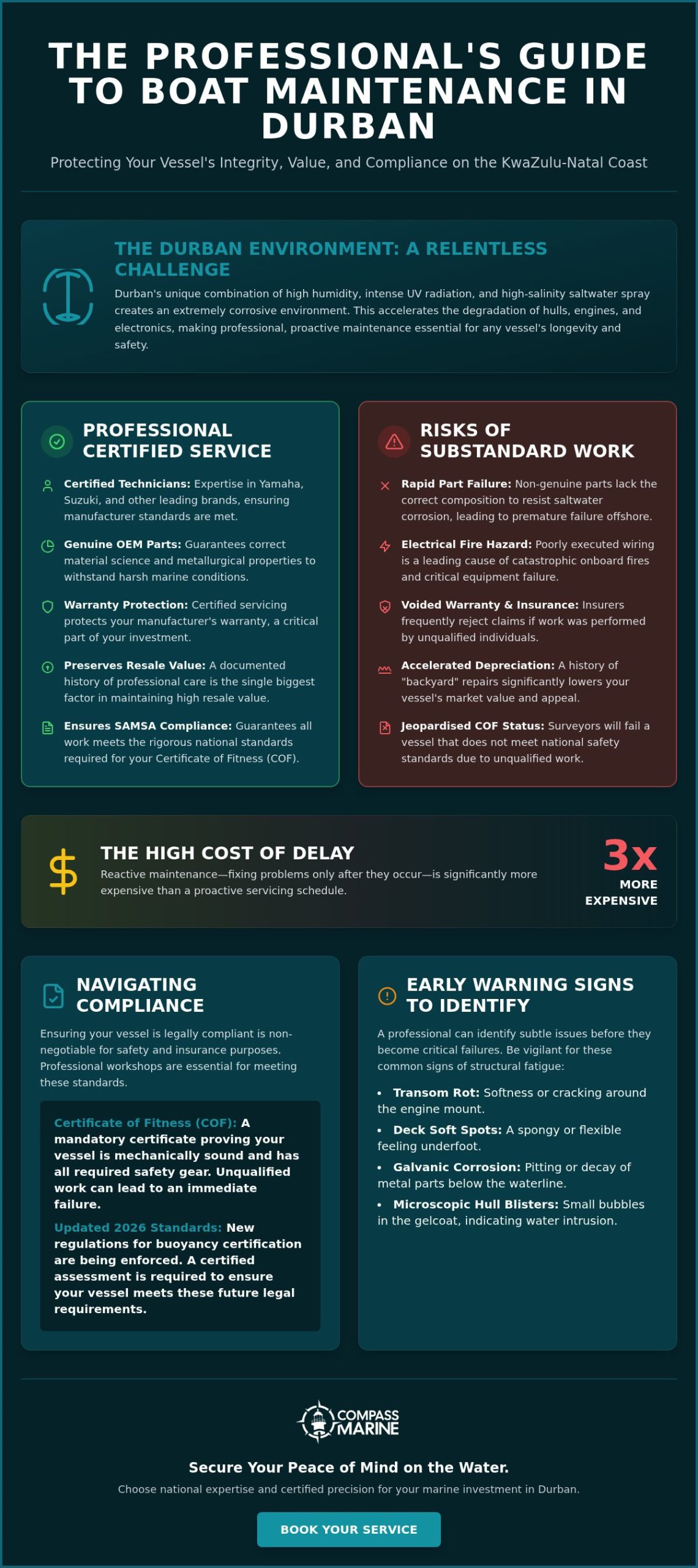
- Professional boat repairs in Durban are essential for mitigating the rapid effects of saltwater corrosion and coastal humidity on your hull and engines.
- Learn how to identify early warning signs of structural fatigue, such as transom rot or deck soft spots, before they become costly safety risks.
- Gain a clear understanding of the 2026 standards for Certificate of Fitness (COF) and buoyancy certification to ensure your vessel remains fully compliant with South African law.
- Discover why utilising certified Yamaha or Suzuki mechanics for engine servicing protects your manufacturer warranty and guarantees technical precision.
- Establish a proactive maintenance schedule to avoid the anxiety of mid-sea engine failure whilst preserving the long-term resale value of your boat.
The Importance of Professional Boat Repairs in Durban for Vessel Longevity
Durban’s subtropical climate and high salinity levels create a relentless environment for any vessel. Constant exposure to saltwater spray and intense UV radiation accelerates the degradation of every boat building material, from gelcoats to aluminium alloys. Saltwater spray acts as a catalyst for decay. Choosing professional boat repairs in Durban isn’t just about fixing what is broken; it’s about counteracting these environmental pressures before they compromise your vessel’s structural integrity.
Many mariners fall into the trap of reactive maintenance, only seeking assistance when a component fails. This approach is often three times more expensive than proactive servicing. Relying on professional boat repairs in Durban ensures that your maintenance schedule is managed by experts who understand the specific stresses of the KwaZulu-Natal coastline. A professional workshop identifies early warning signs like galvanic corrosion or microscopic hull blisters that a layperson might overlook. Beyond the mechanical benefits, a documented history of professional care is the single most important factor in preserving your boat’s resale value in the South African market.
The Risks of Substandard Marine Work
Using uncertified mechanics or “backyard” services introduces significant risks that extend far beyond a simple breakdown. Non-genuine parts often lack the necessary metallurgical properties to withstand the Indian Ocean’s conditions, leading to rapid failure. Poorly executed electrical wiring is particularly dangerous; it is a leading cause of onboard fires and can disable critical bilge pumps during an emergency. Insurance providers frequently reject claims if they discover that structural or mechanical work was performed by unqualified individuals. This also jeopardises your Certificate of Fitness (COF) status, as surveyors require proof of compliance with national safety standards.
Defining National Standards for Marine Excellence
High-calibre marine work requires more than just a toolbox. Accredited workshops invest in specialised diagnostic equipment and test tanks that allow engines to be run under load, simulating real-world conditions. This ensures that a repair is verified before you leave the harbour. Professional technicians stay abreast of evolving maritime technology and manufacturer-specific requirements for brands like Yamaha and Suzuki. By choosing a facility that adheres to these rigorous standards, you ensure that your vessel remains a safe, reliable platform for your offshore excursions.
Mechanical Precision: Marine Engine Servicing and Technical Repairs
Precision engineering demands a certified approach. Whilst a generic mechanic might understand the basics of internal combustion, a certified Yamaha or Suzuki technician uses specialised tools to ensure your outboard operates within its designed parameters. This technical mastery is the foundation of reliable boat repairs in Durban, where the combination of heat and humidity punishes mechanical components. Maintaining a modern marine engine isn’t a job for the hobbyist; it requires a professional who can interpret complex ECU data and maintain manufacturer standards to protect your warranty and investment.
Durban’s warm, nutrient-rich coastal waters can lead to rapid salt crystallisation within cooling passages. Organising regular service intervals is the only way to prevent the overheating issues that frequently lead to mid-ocean engine failure. Using genuine OEM parts isn’t just about brand loyalty; it’s about material science. Non-genuine impellers or gaskets often lack the specific rubber compounds required to resist the chemical breakdown caused by modern fuels and coastal conditions. A valid Certificate of Fitness (CoF) depends on more than just safety gear; it requires a vessel that is mechanically sound and environmentally compliant.
Advanced Diagnostics and Electrical Troubleshooting
Modern fuel-injected motors rely on sophisticated electronics that require professional marine engine servicing to remain reliable. Certified workshops use proprietary software to read engine behaviour, fault history, and sensor data. This diagnostic capability allows technicians to address complex wiring issues and marine battery health before they manifest as a failure at sea. Salt air is a conductor of electricity, and even a minor breach in a wire’s insulation can lead to catastrophic electrical shorts or “ghost” faults that are impossible to find without the right equipment.
Specialised Jet Ski and Inboard Servicing
High-performance jet ski engines operate at extreme RPMs and have unique mechanical requirements, particularly regarding their internal cooling and jet propulsion systems. Regular inspection of the wear ring and impeller is vital to maintain thrust and fuel efficiency. For inboard motors, maintenance focuses on cooling systems, oil changes, and the precision alignment of drive shafts. Ensuring peak performance through accurate propeller tuning and shaft alignment reduces vibration, which protects your transmission and hull from unnecessary stress. If you’re concerned about your vessel’s current mechanical state, consulting a professional marine workshop for a comprehensive health check is a proactive step toward safer boating.
Structural Excellence: Boat Refurbishment and Stainless Steel Fabrication
Structural integrity is the silent guardian of your safety at sea. Whilst engine reliability often receives the most attention, the physical condition of your hull and deck determines your vessel’s ultimate lifespan. In the context of boat repairs in Durban, structural work frequently involves addressing the long-term effects of moisture ingress and UV damage on composite materials. Identifying signs of deck fatigue or “soft spots” early can prevent a complete structural failure, especially in older vessels where timber cores might have been used in the transom or floorboards.
Professional refurbishment goes beyond cosmetic fixes. It involves a methodical approach to restoring the original strength of the vessel. Organisations like the South African Boat Builders Export Council (SABBEX) help maintain high standards across the local industry, ensuring that repairs meet rigorous quality benchmarks. Whether you are dealing with hull osmosis (osmotic blistering) or significant fiberglass damage from a collision, the restoration process must use high-quality resins and cloths to ensure a permanent bond that can withstand the heavy South African swells.
Hull and Deck Restoration Techniques
Restoring a fiberglass hull requires technical precision to ensure a seamless finish that doesn’t just look good but performs under pressure. Professional workshops use advanced grinding and laminating techniques to address structural weaknesses in the transom and floorboards. Once the structural work is complete, applying high-quality marine paint and anti-fouling is essential for protecting fiberglass hulls from water absorption and marine growth. Correct colour matching is vital during this process, as it ensures that repairs are indistinguishable from the original gelcoat, preserving the vessel’s aesthetic value and market appeal.
Stainless Steel Fabrication and Hardware
Durban’s corrosive air makes the choice of metal fittings a critical safety decision. Only marine-grade 316 stainless steel offers the necessary resistance to pitting and tea-staining in our local waters. Custom stainless steel fabrication allows for the creation of bespoke marine fittings, such as rod holders, boarding ladders, and custom T-tops tailored to your specific fishing style. Upgrading your marine hardware isn’t just a luxury; it’s a practical improvement that enhances vessel functionality and safety whilst ensuring that every safety rail and cleat can withstand the high loads encountered during offshore excursions.
Navigating Compliance: The COF and Buoyancy Certification Process
Operating a vessel in South African waters requires strict adherence to the Merchant Shipping (National Small Vessel Safety) Regulations. The Certificate of Fitness (COF) is your primary legal proof that your boat meets these national safety standards. For mariners seeking boat repairs in Durban, compliance should never be an afterthought. A professional workshop ensures that every structural modification or mechanical fix aligns with the rigorous requirements set by the South African Maritime Safety Authority (SAMSA).
Buoyancy certificates are equally critical. They verify that your vessel possesses sufficient flotation to remain buoyant even when swamped. This is a non-negotiable factor for marine insurance; if a claim arises and your buoyancy is found to be non-compliant or the certificate has expired, insurers have grounds to reject the claim entirely. Professional boat repairs in Durban provide the necessary technical verification that your foam or bottle buoyancy remains effective, especially as materials degrade over time. As of June 2026, mariners should be mindful of the proposed two-year grace period for certain technical provisions under the newly updated safety regulations.
Step-by-Step Guide to Achieving COF Compliance
Achieving compliance is a methodical process that begins well before the surveyor arrives. A professional workshop facilitates this by conducting a comprehensive pre-survey check of all required safety equipment. This includes verifying the expiry dates on flares and fire extinguishers, testing bilge pumps, and inspecting the trailer’s roadworthiness. Once the vessel is prepared, a certified surveyor audits the mechanical and structural integrity. Any failures identified during this audit must be addressed immediately by qualified technicians. Only after these technical hurdles are cleared is the final COF issued, ensuring your documentation is current for another year of safe operation.
Buoyancy Standards and Cat C Requirements
Vessels classified as Cat C are required to carry specific safety gear designed for offshore use, including specialised lifejackets, waterproof torches, and a set of emergency flares. The buoyancy requirements for these vessels are calculated based on the total displacement and the combined weight of the hull, engines, and maximum crew capacity. Ensuring your vessel meets these evolving standards is essential for both legal operation and crew safety. If your certification is nearing its expiry, you can book a COF inspection and buoyancy test with our certified team to ensure your vessel remains fully compliant.
Choosing Compass Marine: National Expertise for Your Boating Investment
Compass Marine serves as a dedicated partner for the KwaZulu-Natal boating community. With decades of institutional knowledge, we provide a stable hand for owners of high-value maritime assets. Our facility is designed as a one-stop solution, integrating technical mastery with a fully stocked chandlery and secure marine storage. Whether you require complex boat repairs in Durban or are looking to upgrade your onboard technology, our team approach ensures that your vessel receives comprehensive care under one roof. This integrated model reduces the administrative burden on boat owners, allowing for a seamless transition between mechanical servicing and structural maintenance.
Integration of advanced electronics like Lowrance fish finders and digital helm features is a hallmark of our service. We don’t just install hardware; we ensure your electrical systems are balanced and your safety gear is mission-ready. This proactive approach reduces the risk of technical failure during offshore excursions, allowing you to focus on the maritime lifestyle with total peace of mind. By combining mechanical expertise with the latest maritime technology, we help you achieve a vessel that is both high-performing and fully compliant with modern safety standards.
A Comprehensive Marine Partner
Our on-site marine store provides immediate access to premium products, from marine paint to stainless steel fittings. This convenience eliminates the delays often associated with sourcing specialised hardware, ensuring your repairs are completed efficiently. For those looking to enter the market or upgrade their current vessel, we offer expert advice on pre-owned boats for sale and trade-ins. We maintain a commitment to transparent pricing and technical excellence, ensuring that every mariner, from the novice to the seasoned pro, receives a professional consultation based on integrity. Our technicians are always available to explain the technical benefits of specific products, helping you make informed decisions for your vessel.
Secure Storage and Long-Term Care
Durban’s coastal humidity and salt air can be as damaging as the sea itself. Our secure indoor boat storage facility provides a controlled environment that shields your vessel from UV degradation and corrosion whilst it is off the water. This is particularly beneficial for high-performance jet skis and cabin boats that require lock-up security for both the hull and expensive onboard electronics. We offer more than just a space; we provide long-term care that includes routine battery maintenance and engine flushing. This ensures your vessel remains sea-ready at a moment’s notice, preserving the structural integrity and mechanical reliability we have discussed throughout this guide. Choosing Compass Marine for your boat repairs in Durban means choosing a guardian for your investment, ensuring your vessel is protected through every stage of its lifecycle.
Securing Your Future on the Indian Ocean
Maintaining a vessel in KwaZulu-Natal requires a meticulous balance of technical precision and regulatory diligence. We’ve explored how professional boat repairs in Durban counteract the aggressive effects of saltwater corrosion and why manufacturer-certified mechanical servicing is the only reliable way to ensure mid-sea performance. From structural refurbishment using 316-grade stainless steel to navigating the updated 2026 COF standards, every technical decision you make impacts the safety of your crew and the longevity of your investment.
Choosing a partner with deep institutional knowledge allows you to focus on the enjoyment of the maritime lifestyle whilst we handle the complexities of compliance and upkeep. With our team of certified Yamaha and Suzuki mechanics and SAMSA-compliant buoyancy experts, your boat remains in a safe pair of hands. Our secure indoor storage facilities in KZN provide the final layer of protection, keeping your vessel shielded from the elements until your next launch. Book your professional boat repair or service with Compass Marine today to ensure your vessel is restored to peak performance. We look forward to helping you make your time on the water easier, safer, and more enjoyable.
Frequently Asked Questions
How often should I service my outboard motor for saltwater use?
You should service your outboard motor every 100 hours of operation or at least once a year, whichever comes first. In Durban’s high-salinity environment, we recommend more frequent inspections of the water pump impeller and sacrificial anodes. Saltwater accelerates the buildup of crystals in cooling passages, so a professional service ensures these are cleared before they cause overheating or permanent engine damage.
What is the difference between a COF and a buoyancy certificate?
A Certificate of Fitness (COF) is an annual safety audit, whilst a buoyancy certificate verifies the vessel’s physical ability to remain afloat when flooded. The COF focuses on safety equipment and general seaworthiness. Conversely, the buoyancy certificate is a structural document usually valid for five to ten years, depending on the material used during the initial build or refurbishment.
Can you repair structural damage to a fiberglass boat hull?
We can certainly repair structural damage to fiberglass hulls using professional lamination and refurbishment techniques. Our process involves removing compromised material and rebuilding the area with high-quality resins and fiberglass cloth to restore the original structural integrity. This is essential for addressing hull osmosis or collision damage, ensuring the vessel remains safe for the demanding offshore conditions found along the KwaZulu-Natal coast.
Why should I choose a certified Yamaha or Suzuki mechanic?
Choosing a certified Yamaha or Suzuki mechanic ensures that your engine is serviced using manufacturer-specific diagnostic software and genuine OEM parts. This technical precision is vital for maintaining your warranty and ensuring the long-term reliability of fuel-injected systems. Uncertified repairs often lead to recurring faults and can significantly reduce the resale value of your vessel when it’s time to trade in.
What safety equipment is required for a Cat C vessel in South Africa?
A Cat C vessel requires a comprehensive range of safety gear designed for operation up to 15 nautical miles offshore. This includes a set of emergency flares, a waterproof torch, a fire extinguisher, and SANS-approved lifejackets for every person on board. You’ll also need a capsize bottle, a first aid kit, and an anchor with a suitable length of chain and rope to meet national standards.
Is indoor boat storage better than keeping my boat on a trailer at home?
Indoor boat storage is significantly better than home storage for protecting your vessel from Durban’s intense UV radiation and coastal humidity. Storing your boat in a secure, climate-controlled environment prevents the gelcoat from fading and stops the rapid corrosion of electrical components. It also offers superior security for high-value assets like fish finders and outboard motors, which are often vulnerable when kept on a driveway.
How much do boat repairs typically cost in South Africa?
A common industry guideline suggests budgeting approximately 10% of your vessel’s total value for annual maintenance and boat repairs in Durban. For example, a boat valued at R100,000 typically requires about R10,000 per year in professional upkeep. Actual costs vary based on the engine’s condition and any structural work required, but preventative care consistently reduces the likelihood of expensive, emergency mechanical failures at sea.
Do you provide on-site diagnostics for marine electrical faults?
We provide comprehensive fault diagnostics for marine electrical systems to identify issues like parasitic battery drain or wiring shorts. Our technicians use specialised tools to trace faults in complex looms, which is essential for modern vessels with integrated electronics. Addressing these electrical concerns early prevents the failure of critical safety equipment such as bilge pumps and navigation lights whilst you are out on the water.