What if the pristine hull you’re eyeing among the used jet skis for sale is actually a mechanical nightmare in disguise? It’s a valid concern for any boater in KwaZulu-Natal. You want to spend your weekends carving through the swell off Durban’s coast or enjoying a family day on the dam, not staring at a seized engine in your driveway. We know that the anxiety of buying a “lemon” or failing to meet SAMSA safety standards can take the joy out of finding a bargain.
You can secure a reliable PWC and protect your investment by following a professional inspection routine. This guide provides an expert-led mechanical and compliance checklist designed to help you master the technical nuances of pre-owned watercraft. We will walk you through the critical warning signs of saltwater corrosion, how to verify engine integrity, and the essential steps to ensure your new vessel is fully legal for South African waters. By the end of this article, you will have the confidence to distinguish a well-maintained machine from a costly mistake.
- Prioritise a documented maintenance history over low engine hours to ensure mechanical longevity in the Indian Ocean’s corrosive environment.
- Conduct a professional mechanical audit of the impeller, wear ring, and engine compression before finalising the purchase of used jet skis for sale.
- Verify that the Hull Identification Number matches all SAMSA documentation, including a valid buoyancy certificate and Category C safety equipment.
- Inspect the trailer’s structural integrity, focusing on wheel bearings and leaf springs that are frequently compromised by saltwater exposure.
- Secure your maritime investment with immediate post-purchase servicing and protected indoor storage to prevent UV damage and hull oxidation.
Navigating the Market for Used Jet Skis for Sale
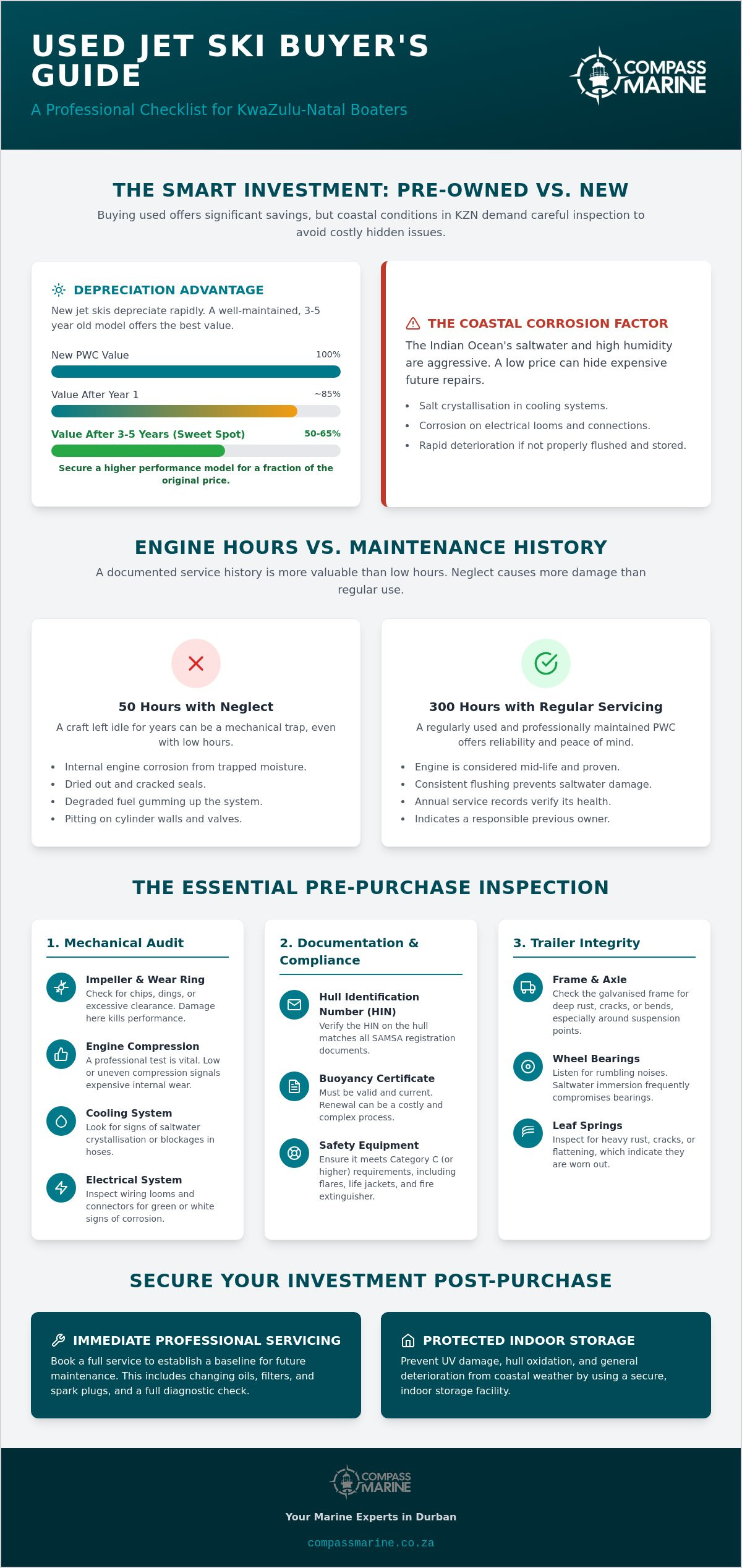
Buying a Personal watercraft (PWC) from the pre-owned market is a savvy move for any Durban enthusiast. New models experience a steep depreciation curve, often losing 12% to 15% of their value in the first year alone. By targeting used jet skis for sale that are three to five years old, you can typically secure a craft for approximately 50% to 65% of its original retail price. This allows you to step up to a higher-performance model or a luxury touring edition that might have been out of reach at brand-new prices; the savings are substantial if you choose wisely.
However, the coastal conditions in KwaZulu-Natal demand a more cautious approach than inland markets. Our high humidity and the aggressive nature of the Indian Ocean mean that a poorly maintained craft can deteriorate rapidly. A low asking price often masks thousands of Rands in upcoming maintenance. Saltwater crystallisation in the cooling system or corrosion on electrical looms can turn a “bargain” into a permanent resident of a repair shop. Buying from a reputable marine specialist provides a layer of protection and technical verification that unverified private sellers simply cannot offer.
This emphasis on professional verification is a hallmark of quality pre-owned markets worldwide, similar to how leading automotive specialists like Carz World Pte Ltd maintain high standards for their vehicle inventory.
The Value Proposition of Pre-owned PWC
A well-chosen used jet ski still has the majority of its service life ahead of it. Most modern four-stroke engines are engineered for hundreds of hours of reliable operation if they’ve been flushed correctly after every launch. When you evaluate the total value, look beyond the hull. A package that includes a galvanised trailer in good condition, a fitted cover, and valid safety gear can save you a significant amount of capital. These extras are essential for the Durban lifestyle but are often overlooked during the initial price comparison. We recommend looking for units that include a comprehensive service history to ensure the previous owner prioritised longevity over a quick sale.
Common Pitfalls for First-Time Buyers
The biggest mistake is assuming that low engine hours equate to a perfect machine. In reality, a craft that’s sat idle for two years without proper winterisation or storage prep often suffers more than one used regularly and serviced annually. Seals dry out, fuel degrades, and internal components can pit from moisture trapped in the cylinders. Additionally, bringing a non-compliant vessel up to South African maritime standards can be expensive. If the buoyancy certificate has expired or the trailer requires a full refurbishment to pass roadworthy, those costs must be factored into your final offer. Don’t let the excitement of finding used jet skis for sale blind you to the practical realities of maritime compliance and mechanical health.
Identifying the Right Model and Engine Type
Selecting the ideal craft from the available used jet skis for sale requires a clear understanding of how different engine technologies and hull designs perform in KwaZulu-Natal’s diverse waters. If you intend to launch from the Durban harbour for offshore fishing, your requirements will differ significantly from someone looking to cruise on the calmer waters of Midmar Dam. The choice between 2-stroke and 4-stroke engines is your first major decision. While older 2-stroke models are lighter and simpler to repair, modern 4-stroke engines have become the industry standard for their superior fuel efficiency, quieter operation, and significantly lower emissions. For most recreational users, the long-term reliability of a 4-stroke justifies the slightly higher initial purchase price.
Manufacturer-specific requirements also play a role in your choice. Yamaha models are renowned for their robust naturally aspirated engines, whilst Suzuki-powered craft often benefit from advanced fuel injection systems derived from their outboard expertise. Before making an offer, you should consult the owner’s manual for the specific service intervals of that model. A detailed used PWC buyer checklist is indispensable for spotting subtle signs of wear that are unique to these high-performance machines. Having a certified Yamaha mechanic perform a diagnostic test can reveal hidden fault codes or temperature warnings that a simple visual check might miss.
Engine Hours vs Maintenance Consistency
The number on the hour meter is often less important than the quality of the time spent on the water. In the marine world, 300 hours on a well-maintained 4-stroke engine is considered mid-life, yet 50 hours of neglect can be terminal. If a craft has sat idle in a coastal garage without being flushed or fogged, salt air can cause internal corrosion on the cylinder walls and valves. We often find that a jet ski used regularly and serviced every 50 hours or annually is in far better mechanical health than a “low hour” unit that has been ignored for two seasons. Consistent usage keeps seals lubricated and prevents gaskets from drying out and failing.
Hull and Deck Material Considerations
Durban’s heavy swell puts immense pressure on a jet ski’s structural integrity. When inspecting used jet skis for sale, you must look closely for “spidering” or fine stress cracks in the gelcoat, particularly around the footwells and the bow. While small cosmetic cracks are common, deep fissures can indicate a history of hard landings or hull breaches. Check the underside of the hull for deep gouges that penetrate the fibreglass matting; these allow water to wick into the laminate, leading to delamination over time. Ensure the seat upholstery is still supple, as sun-bleached, cracked vinyl is a sign the craft has been stored outdoors without a cover, exposing the electronics to KZN’s harsh UV rays. When upgrading your vessel’s fittings and hardware, investing in marine stainless steel fabrication Durban specialists can ensure that any custom components withstand the relentless humidity and salinity of the Indian Ocean coastline.
The Essential Mechanical Inspection Checklist
A thorough physical examination is the only way to verify the true health of used jet skis for sale in the local market. You should begin by opening the seat and inspecting the engine bay for salt crystallisation. In Durban’s humid coastal air, even a few months of neglect can lead to white, crusty deposits on the cylinder head and electrical connectors. These deposits are a clear warning that the previous owner failed to flush the craft correctly after launching. Referencing J.D. Power’s used jet ski buying checklist can help you maintain a methodical approach during this phase, ensuring no component is overlooked.
The condition of the engine oil tells a vital story about the craft’s history. Remove the dipstick and check for clarity and scent. Clear, amber-coloured oil suggests recent maintenance, whilst black, thick oil indicates long-term neglect. If the oil appears “milky” or has the consistency of a milkshake, it is a sign of water ingress, which often leads to catastrophic engine failure. Before you commit to any used jet skis for sale, ensure the cooling system and exhaust are free from obstructions. A blocked cooling line can cause an engine to overheat within minutes, especially when operating in the warm waters of the Indian Ocean.
Assessing the Engine and Driveline
Mechanical integrity relies on more than just a clean engine bay. You should inspect the engine mounts for cracks and check the drive shaft alignment; excessive vibration during a test run often points to misaligned components. We strongly advise performing a compression test on each cylinder. This test reveals the internal health of the engine and ensures the piston rings and valves are sealing correctly. Consistent readings across all cylinders provide the peace of mind that the engine still has significant service life remaining.
Inspecting the Pump and Impeller
The jet pump is the heart of a PWC’s propulsion system. You need to look into the intake grate to inspect the impeller blades for nicks, bends, or stone damage. Even a small dent can cause cavitation, which reduces top speed and increases fuel consumption. Check the clearance between the impeller and the wear ring; if the gap is wider than a millimetre, the pump will lose efficiency. Ensure the ride plate and intake grate are securely fastened and free from corrosion that could affect the craft’s handling.
Electrical Systems and Diagnostics
Modern personal watercraft are sophisticated machines with complex wiring looms. You should test every dashboard gauge and verify that the start, stop, and safety lanyard functions work perfectly. Open the fuse box to look for signs of overheating or bypassed circuits, as electrical “short-cuts” are common in poorly maintained vessels. Because modern fuel-injected models rely heavily on electronic sensors, professional marine engine diagnostics are vital. These scans can reveal hidden fault codes, historical overheat warnings, and the true engine hours logged in the ECU.
Documentation, Compliance, and Trailer Safety
Verifying the legal standing of a vessel is just as critical as checking its engine. Many private listings for used jet skis for sale claim that “papers are in order,” but you must verify this yourself to avoid future legal headaches. The Hull Identification Number (HIN) is your first point of verification. Located on the transom, this unique code must match the registration documents and the buoyancy certificate exactly; any discrepancy suggests a history of hull swaps or administrative errors that will haunt you at the insurance office. If the seller cannot produce original, matching documentation, the risk of the craft being stolen or uninsurable is too high to ignore.
Safety equipment is another area where costs can quickly escalate. For those launching in Durban, a Category C rating is standard for operating up to 15 nautical miles from shore. You need to ensure that the flares, fire extinguishers, and first aid kits included with the sale are within their expiry dates. Buying used jet skis for sale that lack a current safety kit means you will immediately need to spend thousands of Rands to make the craft seaworthy. Always ask the seller to demonstrate that the bilge pump and navigation lights are functional, as these are mandatory requirements for your annual inspection.
SAMSA Compliance and Buoyancy
In South Africa, you cannot legally operate a PWC without a valid Certificate of Fitness (COF). Understanding the COF certificate for boats requirements is essential for every new owner. This document proves that the vessel has been inspected and meets national safety standards. Equally important is the buoyancy certificate, which must be issued by an approved authority. Insurance companies in KwaZulu-Natal will rarely pay out a claim if the buoyancy is outdated or the certificate is missing. We recommend checking that the buoyancy foam or bottles are correctly documented and that the certificate clearly states the craft’s maximum weight capacity.
Trailer Condition and Legalities
The trailer is the most neglected component of a pre-owned PWC package. Because trailers spend their lives being submerged in Durban’s corrosive saltwater, the axle, leaf springs, and wheel bearings are prone to rapid failure. Look for heavy flaking rust or structural cracks in the galvanised frame. A trailer that isn’t roadworthy is a liability that can lead to fines or accidents on the way to the slipway. Ensure the licence disc is current and that the VIN plate on the trailer matches the registration papers. If the winch strap is frayed or the lights are flickering, these are signs of poor maintenance. If you are uncertain about the legal status of a craft, we can provide a professional COF inspection and buoyancy certification to give you total peace of mind.
Securing Your Investment with Professional Care
Once you have navigated the legalities and finalised the purchase of one of the available used jet skis for sale, the priority shifts to long-term preservation. In Durban, owning a personal watercraft is a constant battle against the elements. Coastal humidity and salt air are relentless; without a proactive maintenance strategy, your new asset will degrade much faster than you might expect. Professional care is the only way to ensure that your weekend leisure time isn’t interrupted by preventable mechanical failures. Compass Marine supports pre-owned buyers by providing the technical mastery needed to handle these challenges, moving you from a state of concern to a state of total confidence.
The First Service: Establishing a Baseline
We strongly recommend that every new owner schedules a comprehensive professional service immediately after the transaction is complete. This initial visit allows our technicians to strip away the uncertainty of the previous owner’s maintenance history. Even if the seller provided a stack of invoices, replacing vital fluids, filters, and spark plugs ensures you are starting from a clean slate. By following a rigorous outboard engine inspection checklist, we can identify minor faults, such as weeping cooling hoses or slightly corroded electrical grounds, before they lead to a breakdown at sea. Establishing this mechanical baseline is the most effective way to guarantee the reliability of your craft for the seasons ahead.
Protection and Storage Solutions
The harsh UV rays and salt-laden air of KwaZulu-Natal can cause significant damage to a jet ski’s exterior and internal electronics. Leaving your PWC on a trailer in an open driveway leads to hull oxidation and brittle upholstery within a surprisingly short time frame. Utilising secure indoor boat storage is the most effective method for preserving both the aesthetic appeal and the resale value of your vessel. Indoor facilities shield the craft from the corrosive night air and the “baking” effect of the Durban sun. Additionally, for owners who don’t ride year-round, professional winterisation services, including fuel system stabilisation and internal engine fogging, provide the peace of mind that your jet ski will fire up perfectly when the next summer season arrives.
Take Command of Your Maritime Purchase
Finding the right balance between value and reliability is the key to enjoying your time on the Indian Ocean. You now have the tools to evaluate used jet skis for sale with a critical eye, from inspecting the pump and impeller for cavitation damage to verifying that all SAMSA documentation and buoyancy certificates are current. A low asking price is never a substitute for a transparent service history and structural integrity. By following a methodical inspection process, you protect your capital and your safety.
Our team of certified Yamaha and Suzuki mechanics is here to ensure your investment remains a source of joy rather than a mechanical burden. We specialise in complex electrical diagnostics and comprehensive mechanical repairs, whilst our secure indoor storage facilities protect your craft from the corrosive Durban environment. Prioritising professional verification allows you to launch with the peace of mind that your vessel is both safe and compliant for the season ahead.
Book a professional pre-purchase inspection or service with Compass Marine today to secure the longevity of your watercraft. We look forward to seeing you out on the water.
Frequently Asked Questions
Do I need a special licence to operate a jet ski in South Africa?
Yes, you must hold a valid National Certificate of Competence, commonly known as a Skipper’s Licence, to operate any of the used jet skis for sale on the coastal or inland waters of South Africa. For the Durban coastline, a Category E or Category C licence is required depending on how far offshore you intend to travel. You must be at least 16 years old to operate a PWC legally, and the vessel itself must be registered with a unique number displayed on the hull.
Can I use a jet ski for offshore fishing in Durban?
Absolutely, provided the craft is surveyed and equipped for Category C operation. This allows you to travel up to 15 nautical miles from the shore, which is ideal for reaching the popular fishing reefs off the KwaZulu-Natal coast. Anglers should look for 4-stroke used jet skis for sale as they offer the stability and fuel efficiency required for long days at sea, along with the ability to troll at low speeds without the engine stuttering.
How often should I flush my jet ski when riding in saltwater?
You must flush the engine’s cooling system with fresh water after every single launch in the Indian Ocean. Saltwater is highly corrosive and will begin to form crystals inside the engine’s cooling jackets if left to dry. Using a salt-neutralising additive during the flushing process is a practical way to ensure that the internal components remain free from build-up and operate at the correct temperature.
Will my insurance cover me if my buoyancy certificate has expired?
Most marine insurance providers in South Africa will reject a claim if the vessel’s buoyancy certificate or COF is not current. Whilst a buoyancy certificate typically remains valid for the life of the craft, it must be presented during your annual safety survey. Keeping these documents organised is essential for protecting your investment and ensuring that you are fully covered in the event of an accident or theft.
What are the most critical trailer checks for coastal boaters?
You should prioritise the condition of the wheel bearings and the leaf springs, as these are the components most affected by Durban’s saltwater. We recommend jacking up the trailer and spinning the wheels before any long trip; a grinding or rumbling sound is a clear sign that the bearings need immediate replacement. Ensuring the winch strap is free from UV damage and that the licence disc is current will help you avoid fines and keep your craft secure during transit.