A failed boat survey for COF is rarely the result of a single major catastrophe; it’s almost always the small, overlooked details that keep a vessel grounded. You might feel a familiar sense of anxiety as the expiry date on your current certificate approaches, wondering if your flares are still compliant or if your mechanical condition will meet the surveyor’s standards. It’s a common concern amongst even the most seasoned mariners who find the shifting SAMSA categories and technical requirements confusing to navigate alone.
We understand that your vessel is a significant investment, and ensuring its safety shouldn’t feel like an insurmountable legal hurdle. This comprehensive guide will show you how to master maritime safety requirements and provide a clear, step-by-step path to passing your annual survey on the first attempt. We’ll explore everything from essential safety gear and buoyancy certificates to the mechanical checks that guarantee total peace of mind. By the end, you’ll have a professional’s perspective on maintaining a legally compliant and seaworthy craft that’s ready for any adventure.
Key Takeaways
- Understand the essential role of the annual Certificate of Fitness (COF) and how SAMSA-appointed safety officers evaluate your vessel’s seaworthiness.
- Learn how to identify your specific SAMSA vessel category to ensure your safety equipment perfectly matches your intended area of operation.
- Perform a rigorous pre-inspection of your hull, transom, and outboards to ensure your boat survey for cof isn’t derailed by preventable mechanical or structural issues.
- Discover the most efficient way to organise your documentation and safety gear to facilitate a professional and stress-free inspection process.
- Recognise how partnering with a professional marine centre can identify hidden faults and streamline your entire compliance journey for total peace of mind.
The Essentials of a Boat Survey for COF Compliance
A Certificate of Fitness (COF) is the definitive legal requirement for any power-driven vessel operating in South African waters. It functions as a mandatory annual safety document, proving that your boat has undergone a rigorous inspection and meets the necessary standards for its specific class. For the responsible mariner, this document is far more than a bureaucratic hurdle. It represents a professional seal of approval that confirms your craft is prepared to handle the unpredictable nature of the marine environment.
Surveys are conducted by highly trained safety officers to ensure that minimum safety standards are consistently met across the fleet. Under current maritime regulations, a certificate remains valid for exactly 12 months from the date of issuance. This requires a proactive approach to renewal, as allowing your certification to lapse can have severe consequences. Beyond the risk of heavy fines from authorities, an expired COF typically voids marine insurance policies. Should an incident occur whilst your documentation is out of date, you may find yourself personally liable for significant costs and damages.
When is a New Survey Required?
Whilst annual renewals are the most frequent reason for a boat survey for cof, specific life events for your vessel will also trigger the need for an inspection. A new survey is legally required immediately upon the change of ownership. Even if the vessel was surveyed recently by the seller, the law requires the new owner to secure a fresh certificate in their name. Additionally, significant structural modifications or the installation of new engines necessitate a re-survey. These changes can alter the weight distribution and buoyancy of the craft, making a professional reassessment essential for continued safety. Preparing for a boat survey for cof in these instances ensures your modifications meet the required legal standards.
The Role of the Safety Officer
Safety officers act as authorised representatives of the South African Maritime Safety Authority (SAMSA). Their primary goal is to verify that the vessel is seaworthy and correctly equipped for its designated operational category. By providing an unbiased assessment of your boat’s safety status, these surveyors help maintain high standards amongst the boating community. They check everything from the integrity of the hull to the expiry dates on your flares, ensuring that no detail is overlooked before you head out to sea.
Decoding SAMSA Vessel Categories and Safety Requirements
Vessel categories are the foundation of maritime safety in South Africa. They aren’t merely suggestions; they are legally binding tiers that dictate where you can travel and what equipment you must carry. The South African Maritime Safety Authority (SAMSA) organises these categories based on the distance a boat operates from the shore or within protected waters. Understanding these distinctions is the first step in preparing for a successful boat survey for cof. If you present a vessel for a Category C survey but only carry Category E safety gear, the inspection will halt immediately, requiring you to reschedule once the correct inventory is secured.
Offshore vs. Inland Categories
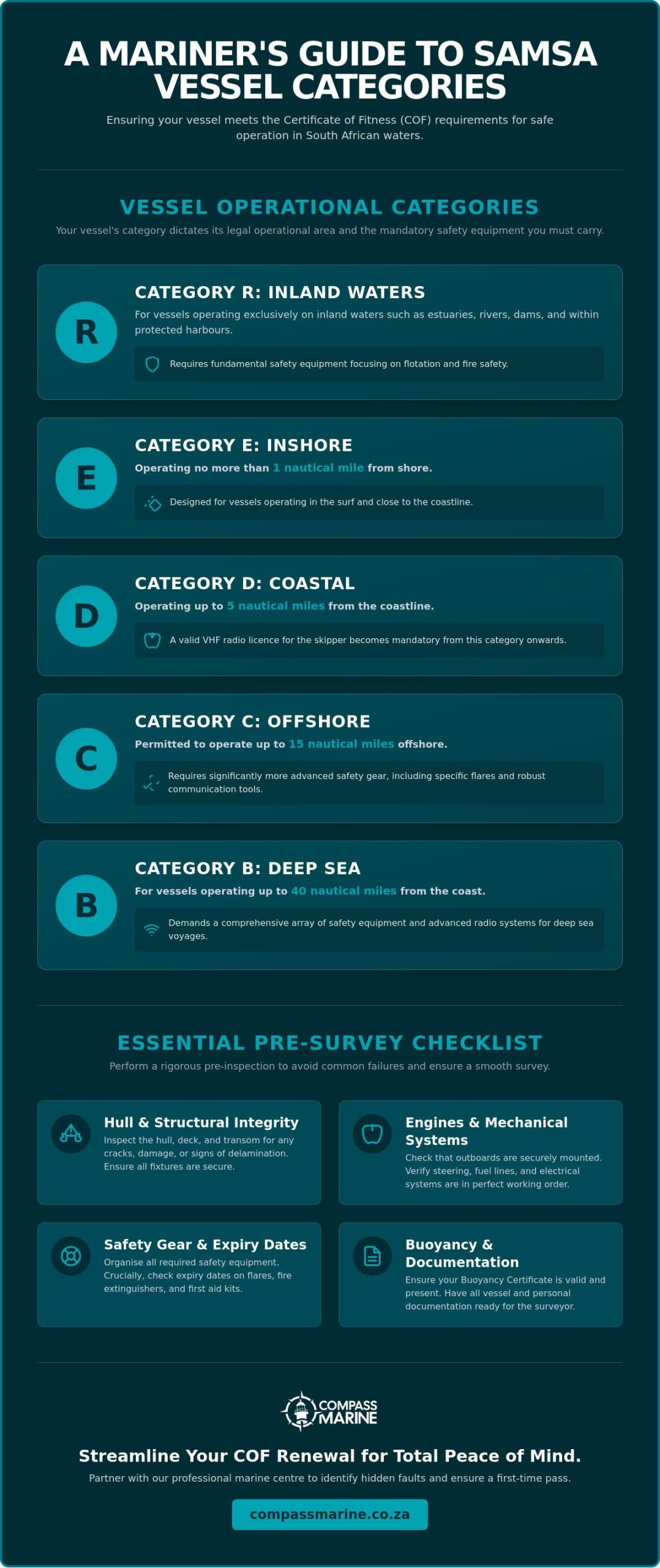
The most common categories for recreational and light commercial use are those operating close to the coastline or on inland bodies of water. Category R is reserved for vessels operating exclusively on inland waters, estuaries, and within the confines of protected harbours. These boats require the least amount of specialised equipment, focusing primarily on basic flotation and fire safety. Category E vessels move into the surf, operating no more than 1 nautical mile from the shore. Once you venture further, Category D allows for operation up to 5 nautical miles from the coastline. It’s mandatory for a skipper to hold a valid VHF radio licence for any vessel operating in Category D and above.
Deep Sea Compliance (Categories C and B)
As the distance from the safety of the shore increases, so does the complexity of the required safety array. Category C vessels are permitted to operate up to 15 nautical miles offshore. This jump requires significantly more advanced marine safety gear, including specific types of flares and more robust communication tools. For those heading even further into the blue, Category B covers vessels operating up to 40 nautical miles from the coast. This necessitates comprehensive radio equipment and often more stringent buoyancy requirements to ensure the vessel remains a safe platform in heavy swells. If you find the technical specifications for these categories daunting, engaging with a professional marine centre can help you audit your current inventory against the official checklists.
The equipment gap between a Category R vessel and a Category C craft is vast. A lake boat doesn’t require the same long-range signalling devices or heavy-duty anchoring systems as a deep-sea fishing boat. However, the integrity of the survey process remains the same. Every item on the checklist must be present, in good working order, and within its service date. Ensuring your boat is surveyed for the correct category prevents frustrating legal issues during routine water-side inspections by authorities who will verify your COF against your actual location at sea. Following the specific “Safety Survey” checklist for your category is the only way to ensure a first-time pass during your boat survey for cof. For a comprehensive breakdown of every requirement across all categories, our ultimate guide to COF certificates for boats in South Africa provides an in-depth reference to help you prepare with confidence.
A Comprehensive Pre-Survey Checklist: Mechanical and Structural Integrity
Whilst many owners focus primarily on their safety gear inventory, a surveyor’s first priority is often the physical integrity of the vessel itself. A boat survey for cof involves a thorough examination of the hull, transom, and deck to identify signs of stress, fatigue, or structural failure. If your deck feels soft underfoot or your transom shows hairline fractures around the engine mountings, these are significant red flags that could lead to an immediate failure. A seaworthy vessel must be structurally sound before any safety equipment can be considered effective.
Mechanical reliability is a fundamental safety factor. You simply aren’t safe at sea if your propulsion or steering systems are compromised. Steering must be fluid and responsive; we recommend checking for any leaks in hydraulic lines or fraying in mechanical cables well before the inspector arrives. Similarly, your fuel system must be beyond reproach. Surveyors look for secure, marine-grade hoses and proper ventilation systems that prevent the buildup of dangerous fumes, which is a critical step in mitigating fire hazards on the water.
Engine and Electrical Readiness
Electrical failure remains a leading cause of maritime incidents. You should verify that your battery is firmly secured in a dedicated battery box and that the terminals are clean and tight to prevent sparking. During the inspection, the officer will test your navigation lights and bilge pumps to ensure they are fully operational whilst on the water. For those operating Yamaha or Suzuki outboards, having documented proof of recent marine engine servicing provides the surveyor with confidence in your vessel’s mechanical health and reliability.
Buoyancy and Structural Soundness
A valid buoyancy certificate is a non-negotiable requirement for a successful boat survey for cof. This document is the only legal proof that your vessel will remain afloat even if it’s completely swamped by a wave. Beyond the paperwork, you must physically inspect the transom for any signs of movement or soft spots. It’s equally vital to ensure all drainage bungs are present and that their seals are in good condition to prevent water ingress. For owners looking for a deeper dive into specific standards, the SA Sailing vessel safety requirements offer an excellent benchmark for what constitutes a truly seaworthy craft. Taking the time to address these structural details ensures your vessel is a safe platform for your family and passengers.
Organising Your Documentation and Safety Equipment for Inspection
Efficiency is the hallmark of a seasoned mariner. When the surveyor arrives for your boat survey for cof, having your materials meticulously organised demonstrates a commitment to safety that sets a positive tone for the entire inspection. You shouldn’t leave the officer waiting whilst you rummage through lockers for misplaced items. Instead, gather all physical documents into a single waterproof folder and lay out your gear clearly. This simple act of preparation protects your paperwork from sea spray and ensures a professional, methodical handover that respects everyone’s time.
The Mandatory Document Pack
Your document pack must be comprehensive and current. You are required to present your original Skipper’s Licence (SADSAA or SAMSA issued) along with a clear copy of your ID. You will also need the previous year’s COF certificate and the original buoyancy certificate for the vessel. For those operating in Category D or higher, a valid ICASA radio licence is an absolute necessity. A common stumbling block for many owners is the “Owner’s Declaration.” This is a formal statement where you confirm that the vessel has been properly maintained and that no major structural modifications have occurred since the last survey. Having this signed and ready prevents the most frequent administrative delays encountered during a boat survey for cof. If you’re unsure about the precise documentation requirements for your vessel class, our detailed resource on the COF certificate requirements for boats outlines exactly what you need to present at every stage of the process.
Safety Gear Layout and Verification
Transparency is key during the physical inspection. We recommend laying out all safety equipment on the deck or a clean surface nearby so the officer can verify your inventory at a glance. Every piece of safety gear, from your oars to your life jackets, must be clearly marked with the vessel’s unique survey number using a permanent marker. This ensures that gear isn’t swapped between vessels and remains dedicated to your craft’s safety profile.
- Pyrotechnics and Fire Safety: Check the expiry dates on all flares and fire extinguishers well before the appointment. If an item is even one day past its date, it constitutes an immediate failure.
- Life Jackets: These must be SAMSA-approved and appropriate for the specific number of persons the vessel is certified to carry.
- Ground Tackle: Verify that your anchor, chain, and rope meet the specific weight and length requirements for your category.
- Emergency Essentials: Include your tool kit, a fully stocked first aid kit, and a waterproof torch with fresh spare batteries in your layout.
If you discover that any of your gear is outdated or missing during your pre-survey audit, you can find a full range of SAMSA-approved marine safety gear and boating accessories at our marine store. Taking the time to verify these details ensures your vessel remains a “safe pair of hands” for your passengers and meets every legal requirement with ease.
Streamlining Your COF Renewal with Professional Marine Support
Managing the requirements for a boat survey for cof can be a complex undertaking for any vessel owner. Partnering with a professional marine centre transforms this annual necessity from a source of anxiety into a streamlined, efficient process. By leveraging expert support, you ensure that your high-value asset is handled with the care it deserves. A comprehensive pre-survey inspection by a dedicated partner can identify hidden faults or minor technical discrepancies that might otherwise result in a failed attempt. This proactive approach saves time and ensures your vessel remains legally compliant without the frustration of repeated inspections.
Access to a full-service chandlery is another significant advantage of professional support. If your pre-survey audit reveals expired flares or a missing fire extinguisher, these items can be replaced immediately on-site. You won’t have to spend hours sourcing compliant gear from multiple vendors. Having a “safe pair of hands” to manage these details allows you to focus on the enjoyment of the maritime lifestyle whilst we handle the technical rigour of regulatory compliance.
The Value of Expert Technical Preparation
Reliability on the water begins with mechanical excellence. Our certified mechanics possess the institutional knowledge required to ensure your engines meet the stringent reliability standards expected during a safety check. Whether it involves routine outboard maintenance or addressing complex electrical fault diagnostics, professional oversight guarantees that your propulsion systems are beyond reproach. Additionally, any necessary stainless steel fabrication or fittings repairs can be completed on-site to address structural concerns before the surveyor steps on board. For those utilising secure indoor boat storage, the convenience is even greater. Storage clients often benefit from a concierge style service where the vessel is meticulously prepped and organised whilst in our care, ensuring it is ready for the safety officer at a moment’s notice.
Booking Your Survey Appointment
Timing is critical when maintaining your vessel’s legal standing. We recommend that you schedule your boat survey for cof at least two weeks before your current certificate is due to expire. This window allows for any last-minute adjustments or gear replacements should the surveyor identify a minor issue that needs rectification. Before the appointment, ensure the vessel is clean and all compartments, including the bilge and battery boxes, are easily accessible for the safety officer’s inspection. A well-presented boat reflects an owner who takes safety seriously. Contact Compass Marine today to organise your COF survey and benefit from our professional vessel preparation services. Let our team act as your steady hand in maritime compliance, giving you the peace of mind to enjoy the water with total confidence.
Secure Your Maritime Compliance with Confidence
Successfully navigating a boat survey for cof requires more than just a cursory glance at your equipment. It demands a thorough understanding of your SAMSA vessel category and a commitment to maintaining both structural integrity and mechanical reliability. By auditing your safety gear and ensuring your documentation is meticulously organised, you transform a potentially stressful inspection into a routine validation of your seaworthiness. This methodical approach ensures that your vessel remains a safe platform for all your maritime adventures.
You don’t have to manage these technical complexities alone. At Compass Marine, we act as a safe pair of hands for your investment, offering certified Yamaha and Suzuki mechanics alongside a fully stocked range of SAMSA-compliant safety gear. We provide expert assistance with buoyancy certificates and COF documentation to ensure your vessel meets every regulatory standard with ease. Book your COF Survey and Professional Vessel Prep with Compass Marine today to benefit from our deep institutional knowledge and dedicated professional care.
With the right preparation and expert support, you can head out onto the water with the absolute peace of mind that your craft is legally compliant and safe for every passenger on board. We look forward to helping you maintain your vessel in peak condition for the season ahead.
Frequently Asked Questions
How long is a COF certificate valid for in South Africa?
A COF certificate is valid for exactly 12 months from the date of a successful survey. This is a shift from the older calendar-year system. It’s essential to plan your boat survey for cof well in advance of the expiry date to ensure your vessel remains legally compliant and your marine insurance stays active throughout the season.
Can I do my own boat survey for COF?
No, you cannot conduct your own survey for legal certification. All surveys must be carried out by a SAMSA-appointed safety officer or an inspector from an authorised agency such as South African Sailing. These professionals provide the unbiased assessment required to verify that your vessel meets national safety standards for its specific category.
What happens if my boat fails the COF survey?
If your vessel fails to meet the required standards, the safety officer will provide a list of specific faults that must be rectified. You’ll need to address these issues, which might include replacing expired gear or fixing mechanical faults, before scheduling a follow-up inspection. A certificate will only be issued once every item on the checklist is fully compliant.
Do I need a buoyancy certificate every year for my COF?
You don’t need to obtain a new buoyancy certificate every year, but you must present the original document at every annual survey. The buoyancy certificate remains valid for the life of the vessel provided no major structural modifications or repairs have been made. It acts as a prerequisite for the issuance of your Certificate of Fitness.
What is the difference between a COF and a buoyancy certificate?
The COF is an annual safety inspection that focuses on your current equipment and mechanical readiness. In contrast, a buoyancy certificate is a structural document that proves your boat has sufficient flotation to remain on the surface if swamped. Whilst the COF expires every 12 months, the buoyancy certificate is usually a permanent record of the vessel’s physical construction.
Is a radio licence mandatory for all boat surveys?
A radio licence is not mandatory for all surveys, as it depends entirely on your vessel’s category of operation. It is a legal requirement for vessels in Categories D, C, B, and A. If you’re operating a Category R or E craft, you generally don’t need an ICASA radio licence unless you have voluntarily fitted a VHF radio to the vessel.
How much does a boat survey for COF typically cost?
The cost of a boat survey for cof varies depending on whether you use a SAMSA official or a commercial surveyor. There are prescribed government fees for the certificate itself, whilst commercial providers charge a professional service fee for the inspection. You should also factor in the potential costs of replacing expired safety equipment or performing mechanical repairs required to pass the survey.
What safety equipment is required for a Category E vessel?
Category E vessels require a specific array of safety gear designed for operation within 1 nautical mile of the shore. This includes SAMSA-approved life jackets for every person on board, a suitable anchor with chain and rope, and a fire extinguisher. You’ll also need a set of pyrotechnics, including handheld flares and smoke signals, all of which must be within their valid service dates.