What if the sluggish response you feel at the throttle isn’t a sign of an ageing engine, but simply a lack of technical synergy? For many boaters in KwaZulu-Natal, investing in boat performance upgrades is the difference between a frustrating outing and a seamless day at sea. You’ve likely felt that nagging concern when an electrical glitch disrupts your diagnostics or when your vessel burns through far more litres of fuel than necessary during a run out of Durban Harbour. Accepting poor hole-shot performance or propeller cavitation as “normal” often leads to unnecessary wear and increased operating costs.
We agree that your time on the water should be defined by confidence, not mechanical guesswork. This resource guide demonstrates how professional mechanical tuning and hardware refinements can significantly enhance your vessel’s efficiency and reliability. You’ll discover how a methodical approach to technical upgrades ensures your boat remains compliant with national standards whilst delivering a smoother, more responsive ride. We will preview the critical engine adjustments, propeller matching, and electrical fault-finding techniques that turn a standard boat into a peak-performing maritime asset.
Key Takeaways
- Learn to balance power and fuel economy by viewing performance as a holistic combination of mechanical synergy and handling characteristics.
- Discover how certified engine tuning and precise electrical diagnostics can eliminate glitches and restore reliable output.
- Understand the critical role of propeller pitch and professional repairs in reducing vibration and preventing unnecessary fuel waste.
- Identify the most effective boat performance upgrades for your specific vessel, from offshore fishing boats to leisure cruisers.
- Explore how modern electronics and custom stainless steel fabrication work together to improve navigation and reduce hydrodynamic drag.
Understanding Boat Performance Upgrades: Beyond Top-End Speed
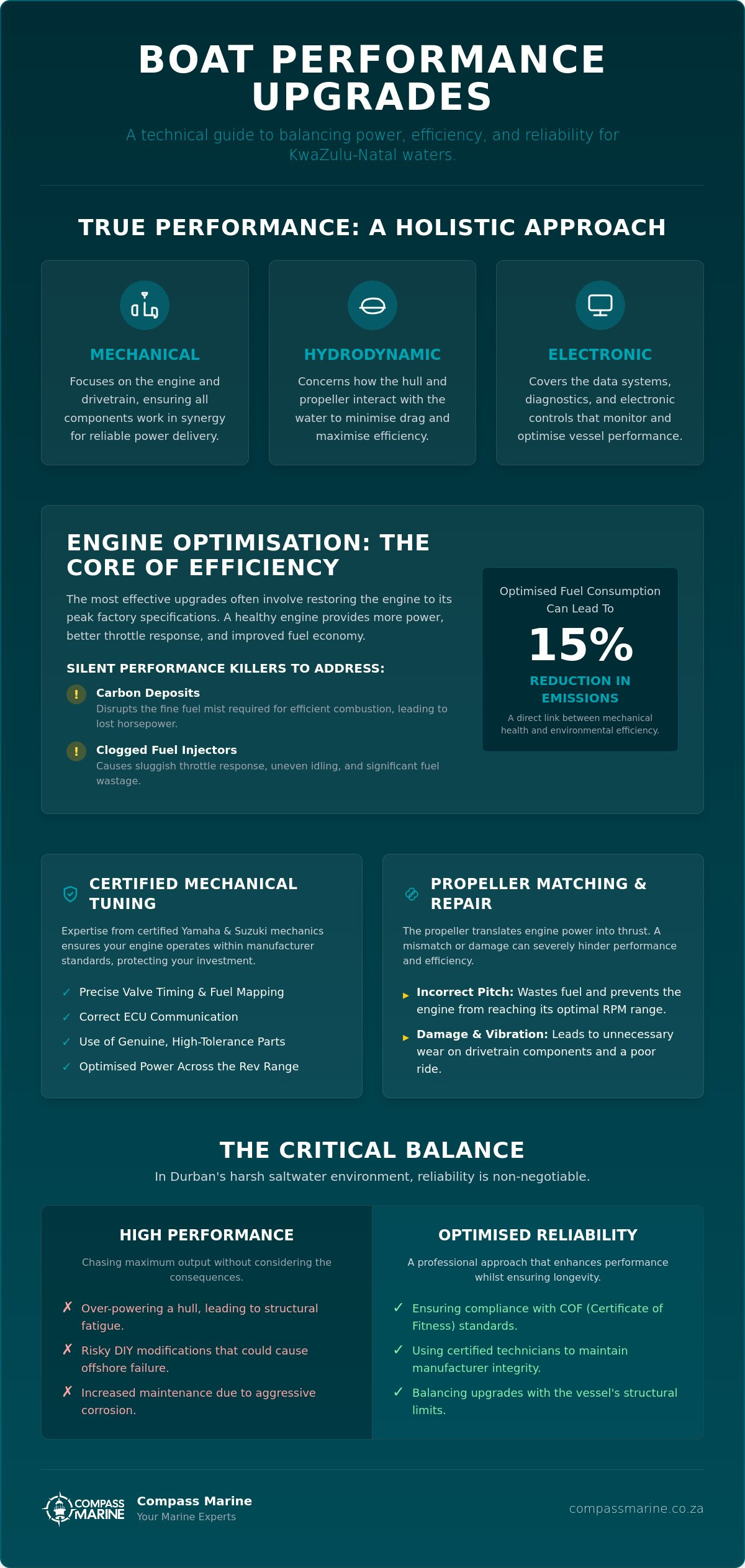
Performance is often misunderstood as a simple quest for top-end speed. In reality, true performance is the delicate equilibrium between raw power, fuel economy, and predictable handling characteristics. When considering boat performance upgrades, you must look at your vessel as a single, integrated system rather than a collection of independent parts. Adopting a “more is better” philosophy, such as over-powering a hull without considering structural limits, often leads to premature engine fatigue and increased vibration. It’s a common mistake that turns a high-value asset into a liability.
We categorise vessel optimisation into three essential pillars: Mechanical, Hydrodynamic, and Electronic. The mechanical pillar focuses on the engine and drivetrain. The hydrodynamic pillar involves how the hull interacts with the water. Finally, the electronic pillar covers the data systems that monitor and optimise output. Neglecting any one of these pillars results in a boat that might be fast on a flat dam but struggles against the swell and coastal humidity of the KwaZulu-Natal coastline. A holistic approach ensures that every Rand spent on technical services translates into a tangible improvement on the water.
The Synergy of Marine Systems
Your engine’s internal health dictates the success of every external modification. If your outboard isn’t reaching its peak RPM range due to poor fuel delivery or worn components, a new stainless steel propeller won’t fix the underlying sluggishness. There’s also a vital relationship between hull weight distribution and engine trim efficiency. Understanding Planing Hulls is crucial here; if your boat cannot lift onto the plane efficiently because it’s stern-heavy or under-powered, you’ll waste litres of fuel pushing a wall of water. Professional diagnostics should always be your first step to establish a baseline before changing any hardware.
Performance vs. Reliability: Finding the Balance
In the harsh saltwater environments of Durban, reliability is non-negotiable. Any technical enhancement must be weighed against its impact on the longevity of your components. High-performance parts often require more frequent maintenance to combat the aggressive corrosion found in our local waters. It’s also vital that any boat performance upgrades you choose don’t compromise your ability to secure a COF (Certificate of Fitness). Certified mechanics, specifically those trained for Yamaha and Suzuki systems, ensure that your tuning remains within manufacturer standards. This protection of your investment is what separates a professional upgrade from a risky DIY modification that could lead to a breakdown kilometres from the harbour.
Engine Optimisation: The Core of Vessel Efficiency
The engine is the heart of any vessel. For many owners in KwaZulu-Natal, the most effective boat performance upgrades don’t involve adding new hardware, but rather restoring the engine to its peak factory specifications. Regular servicing is not merely a maintenance task; it is a strategic performance enhancement. When an engine runs at its optimal thermal and mechanical state, it consumes fewer litres of fuel and provides a more linear power delivery. This is especially critical in our local waters, where high humidity and saltwater can quickly degrade fuel quality and lead to internal carbon build-up.
Carbon deposits and clogged fuel injectors are silent performance killers. They disrupt the fine mist required for efficient combustion, leading to sluggish throttle response and uneven idling. By prioritising a professional fuel system clean, you can often recover lost horsepower and improve your fuel burn rate by a noticeable margin. Industry data suggests that optimised marine fuel consumption can reduce a vessel’s emissions by approximately 15%, highlighting the direct link between mechanical health and efficiency.
Certified Mechanical Tuning for Outboards and Inboards
Achieving a perfect balance of power requires the expertise of a certified Yamaha or Suzuki mechanic. These professionals understand the nuances of precise valve timing and fuel mapping. By ensuring the engine’s electronic control unit (ECU) is communicating correctly with the mechanical components, they can optimise power delivery across the entire rev range. Using genuine parts is essential to maintain technical integrity. Non-standard components often fail to meet the tight tolerances required for high-speed operation, which can lead to mechanical failure during long offshore trips.
Diagnostic-Led Performance Improvements
Modern engines rely heavily on a network of sensors to monitor everything from oxygen levels to water temperature. Even a minor sensor error can cause the ECU to limit output to protect the engine. Utilising professional marine technical services allows for a deep dive into these digital systems to unlock hidden performance.
Advanced diagnostics help identify sensor glitches or cooling system inefficiencies before they cause a breakdown. For instance, monitoring operating temperatures is vital to prevent “heat soak,” where the engine loses power due to excessive heat. This technical precision is what allows a vessel to reach the performance levels described in studies of Advanced Propulsor Hydrodynamics, where engine output must perfectly match the propulsive needs of the hull. Ensuring your engine is in top condition is the foundation of a reliable vessel. If you haven’t had a professional check recently, booking a comprehensive outboard engine service is the best place to start.
Marine Propeller Repair and Pitch Selection
The propeller is the final link in your vessel’s power delivery chain. Whilst many owners focus on engine horsepower, a damaged or poorly matched propeller can waste a significant portion of that energy. Even a minor ding or a slightly bent blade, often caused by submerged debris in Durban Harbour, can lead to excessive vibration and fuel waste. These imperfections disrupt the smooth flow of water, causing the engine to work harder than necessary to maintain speed. Over time, this unnecessary strain can lead to premature wear on gearbox seals and shaft bearings.
Identifying the need for professional attention is straightforward if you know what to look for. Common warning signs include cavitation burns; small pits or “burn marks” on the blade surface caused by collapsing air bubbles; and a noticeable drop in your maximum RPM. If your boat feels sluggish or struggles to reach the speeds it once did, the propeller is often the culprit. Investing in targeted boat performance upgrades through propeller refurbishment is frequently more cost-effective than a total replacement.
The ROI of Professional Propeller Refurbishment
There is a common misconception that a damaged propeller must always be replaced. In many cases, professional refurbishment can restore a blade to its factory-perfect state for a fraction of the cost of a new unit. The technical process involves several precise steps:
- Re-pitching: Adjusting the blade angle to better suit your boat’s typical load.
- Balancing: Eliminating vibrations that can damage your drivetrain.
- Custom Cupping: Adding a small inward curve to the trailing edge to improve “hole-shot” and grip in heavy seas.
A well-timed refurbishment improves your boat’s ability to get on the plane quickly, which is essential when navigating the Durban swell. During regular marine engine servicing, a technician can often spot the subtle signs of propeller-related strain, such as unusual wear patterns on the skeg or mounting hardware.
Choosing the Right Pitch for Your Usage
Selecting the correct pitch is a trade-off between acceleration and top-end speed. A lower pitch acts like a lower gear in a car, providing the torque needed for heavy loads or pulling skiers. A higher pitch allows for higher top speeds but requires more effort from the engine to get moving. You can use your tachometer to check this; if your engine cannot reach its rated wide-open-throttle (WOT) RPM, your pitch is likely too high.
The material also matters. Aluminium propellers are cost-effective and act as a “sacrificial” part that breaks before damaging the gearbox. Stainless steel propellers are far more rigid and efficient, offering a significant boost in boat performance upgrades for high-speed vessels. However, their durability means they transfer more impact energy to the shaft if you hit an object, making professional pitch selection and balancing even more critical for long-term gearbox health.
Technical Enhancements: Electronics and Custom Fabrication
Vessel optimisation extends far beyond the engine bay and propeller shaft. Modern boat performance upgrades increasingly focus on the technical integration of electronics and the structural refinement of the deck. High-quality navigation tools and bespoke fabrication allow you to shave kilograms off your total weight whilst gaining precise control over your fuel consumption. In the high-corrosion environment of the KwaZulu-Natal coast, these technical choices are as much about longevity as they are about speed.
Professional marine electronics installation is the foundation of this technical layer. Without correct shielding and dedicated wiring, high-draw fish finders and GPS units can suffer from electromagnetic interference. This often results in “ghost” readings or diagnostic glitches that can compromise your safety offshore. A robust electrical system ensures that your engine data remains accurate, providing a clear picture of how your boat is performing in real-time.
Custom Marine Stainless Steel for Performance
Weight distribution and aerodynamics play a significant role in how a hull handles the Durban swell. Custom stainless steel fabrication allows for the replacement of bulky, standard fittings with streamlined, bespoke alternatives. Fabricating lightweight T-tops and railings can reduce windage and lower the vessel’s centre of gravity, contributing to a more stable ride at high speeds. We prioritise high-grade stainless steel to ensure these components withstand constant exposure to saltwater without compromising their structural integrity or aesthetic appeal. Selecting the correct hardware is equally important; using 316 stainless steel fasteners in Durban ensures that every fitting and connection point resists the relentless corrosion of the Indian Ocean environment.
Smart Navigation and Fuel Management
Leveraging Lowrance fish finders and GPS units goes far beyond identifying structure. By integrating engine data through NMEA 2000 networks, you can monitor your fuel burn rate with extreme precision. This allows you to adjust your trim and throttle to find the exact “sweet spot” where your kilometres-per-litre ratio is at its most efficient. Accurate depth and current data also enable more efficient passage making, helping you navigate coastal currents that would otherwise increase your fuel costs. If you are looking to refine your vessel’s layout or electrical reliability, our team offers expert stainless steel fabrication and fittings to enhance your time on the water.
Developing Your Boat Performance Upgrade Strategy
Every successful technical project begins with a clear, prioritised roadmap. Your strategy for boat performance upgrades should be dictated by your primary use case and the specific demands of the KwaZulu-Natal coastline. A Durban-based angler prioritises mid-range torque and offshore reliability to handle the backline safely, whereas a leisure cruiser owner might focus on fuel efficiency for long trips toward the South Coast. Staging these upgrades allows you to manage your budget whilst seeing immediate improvements in handling or economy before moving to the next phase of work.
Older vessels require a particularly methodical approach. Before investing in high-end electronics or custom stainless steel, you must ensure the structural integrity of the hull and the health of the fuel system. A professional refurbishment plan identifies which components are nearing the end of their service life, preventing a situation where a new performance part is compromised by an old, failing sub-system. This logical progression ensures that every Rand spent contributes to a safer, more capable vessel. Part of this process includes auditing your hardware from deck fittings to mounting bolts; specifying the correct marine-grade 316 stainless steel fasteners throughout your vessel prevents seized components and structural failures that can undermine even the most comprehensive upgrade plan.
The Total Vessel Refurbishment Approach
Performance isn’t just about what happens in the water; it’s about the entire ownership experience. A neglected trailer is a common performance killer that many owners ignore. Seized rollers or corroded axles make launching and retrieving a chore, and an unbalanced trailer can even cause structural stress to the hull during transport. Combining mechanical repairs with professional hull detailing and trailer refurbishment creates a comprehensive overhaul that protects your investment. This holistic approach also extends to your deck equipment and rigging; selecting the right mooring and anchoring lines from a trusted supplier like Southern Ropes Durban ensures that your vessel’s lines are matched to their specific job and can handle the surge loads common in local harbour conditions. Consulting with a seasoned maritime expert helps you create a long-term maintenance roadmap, ensuring your upgrades are balanced and technically sound.
For boat owners looking to manage the financial side of these extensive upgrades or new vessel acquisitions, Motorlend provides specialised finance brokerage for leisure equipment and commercial assets.
Final Performance Checks and Compliance
In South Africa, any significant modification must respect national safety standards. Increasing engine horsepower or adding heavy custom fabrication can alter your vessel’s displacement and stability. This makes updating your buoyancy certificates essential to remain compliant with South African Maritime Safety Authority (SAMSA) regulations. Furthermore, ensuring all boat performance upgrades meet the requirements for a COF (Certificate of Fitness) protects your insurance standing and ensures you are legally cleared to launch from Durban Harbour or other local slipways.
Once the technical work is complete, a post-upgrade sea trial with a certified technician is non-negotiable. This is a controlled evaluation of how the new systems interact under real-world loads. We monitor operating temperatures, check for harmonic vibrations, and verify that the engine reaches its rated RPM with the new propeller configuration. Performance is a journey of precision, not a single purchase. It requires technical mastery to ensure your vessel performs at its peak whilst remaining a safe, reliable partner for your offshore adventures. If you are ready to begin your vessel’s transformation, our team is available to assist with comprehensive boat repairs in Durban to ensure your strategy is executed to the highest professional standards.
Achieving Peak Performance on the Water
Optimising a vessel is a meticulous process that balances mechanical integrity with hydrodynamic efficiency. You’ve seen how professional engine tuning and precise propeller matching can transform your experience at sea, reducing fuel consumption whilst improving handling in the challenging Durban swell. By integrating modern electronics and custom fabrication, you ensure your boat is not just faster, but more reliable and compliant with all national safety standards. These boat performance upgrades represent a significant investment in the longevity and enjoyment of your maritime lifestyle, allowing you to fully appreciate world-class boating environments similar to those found at the Water Street Inn.
Our team brings decades of experience in maritime technical services to every project we undertake. With certified Yamaha and Suzuki technicians on-site and a comprehensive marine store and chandlery, we provide the technical mastery needed to handle complex vessel overhauls. Whether you’re preparing for a competitive fishing season or a quiet cruise along the KwaZulu-Natal coast, we’re here to act as your dedicated technical partner and a safe pair of hands for your investment.
Consult our certified mechanics for a bespoke performance assessment and take the first step towards a more efficient and capable vessel. We look forward to helping you reach your boat’s true potential and ensuring your time on the water is both safe and rewarding.
Frequently Asked Questions
Will boat performance upgrades void my engine warranty?
Most manufacturer warranties are strictly conditional on the use of genuine parts and authorised service centres. If you opt for non-approved aftermarket modifications or DIY tuning, you risk voiding your engine warranty immediately. Performance enhancements carried out by a certified Yamaha or Suzuki mechanic using approved technical procedures typically maintain your coverage whilst improving output. Always consult your specific engine manual and warranty documentation before proceeding with any major boat performance upgrades.
How much fuel can I actually save with marine propeller repair?
A damaged or fouled propeller can increase your fuel consumption by 10% to 15% due to reduced hydrodynamic efficiency. Professional refurbishment restores the blade’s original geometry, which eliminates the drag and cavitation that force your engine to burn more litres of fuel to maintain speed. Whilst exact savings depend on the extent of the initial damage, most boat owners notice an immediate improvement in their fuel burn rate and overall range after a professional repair.
Do I need a new COF after upgrading my outboard engine?
You must update your Certificate of Fitness (COF) if your boat performance upgrades involve a change in engine horsepower or weight that exceeds the original vessel specifications. SAMSA regulations require that your COF accurately reflects the current configuration of your boat to ensure safety and legal compliance. It’s also vital to check if your buoyancy certificate remains valid. A heavier engine can significantly alter the vessel’s displacement and stability in the water.
Can a fish finder really help improve my boat performance?
Modern fish finders serve as sophisticated data hubs that provide real-time feedback on your vessel’s efficiency. When integrated with an NMEA 2000 network, these units allow you to monitor fuel flow and engine load with extreme precision. This data enables you to adjust your trim and throttle to find the most efficient cruising speed for local conditions. Accurate GPS route planning also helps you avoid unnecessary kilometres; it’s a direct way to lower your operating costs.
Is stainless steel always better than aluminium for propellers?
Stainless steel is superior for high-performance applications because it’s more rigid and resists flexing under heavy loads. This results in better acceleration and higher top speeds compared to aluminium alternatives. However, aluminium propellers are often preferred for use in shallow or rocky waters. They’re designed to break upon impact, which protects your expensive gearbox from structural damage. The choice between materials should always be based on your specific vessel type and environment.
How often should I have my marine electronics and wiring inspected?
We recommend a professional inspection of your marine electronics and wiring at least once every twelve months. In the high-humidity and saltwater environment of Durban, corrosion can bridge electrical contacts and degrade wire insulation surprisingly quickly. Regular checks help identify green crust on terminals or brittle wiring before they lead to a complete system failure offshore. Keeping your electrical diagnostics current is essential for maintaining the reliability of modern, sensor-heavy engine systems.