
What if the right boat-care product isn’t the strongest cleaner, but the one suited to the task and surface? If you’re searching for quality marine supplies from Compass Marine, first identify what needs attention. Routine washing, salt deposits, a specific stain and surface finishing each call for different care.
Cleaning, polishing and detailing are not interchangeable. To avoid choosing a product that may mark or damage a boat’s finish, identify the material and the problem, then check the current manufacturer label for intended use, surface compatibility and directions.
This guide compares marine cleaning and detailing categories by task and surface. It also explains what to check before choosing a product or asking a marine supplier about current availability and suitability.
Key Takeaways
- Choose a product category for the job at hand, rather than assuming one product suits every task.
- Identify the boat’s surface and finish, then check the current label for compatibility and directions.
- Prepare the area, follow product-specific instructions and prevent wash water or residue from running into the water.
- Before travelling or ordering, confirm the exact product name, intended surface and current availability with a marine supplier.
- Keep routine washing separate from polishing or detailing so you can choose the right level of care.
Star brite boat cleaning products: what should a roundup help you compare?
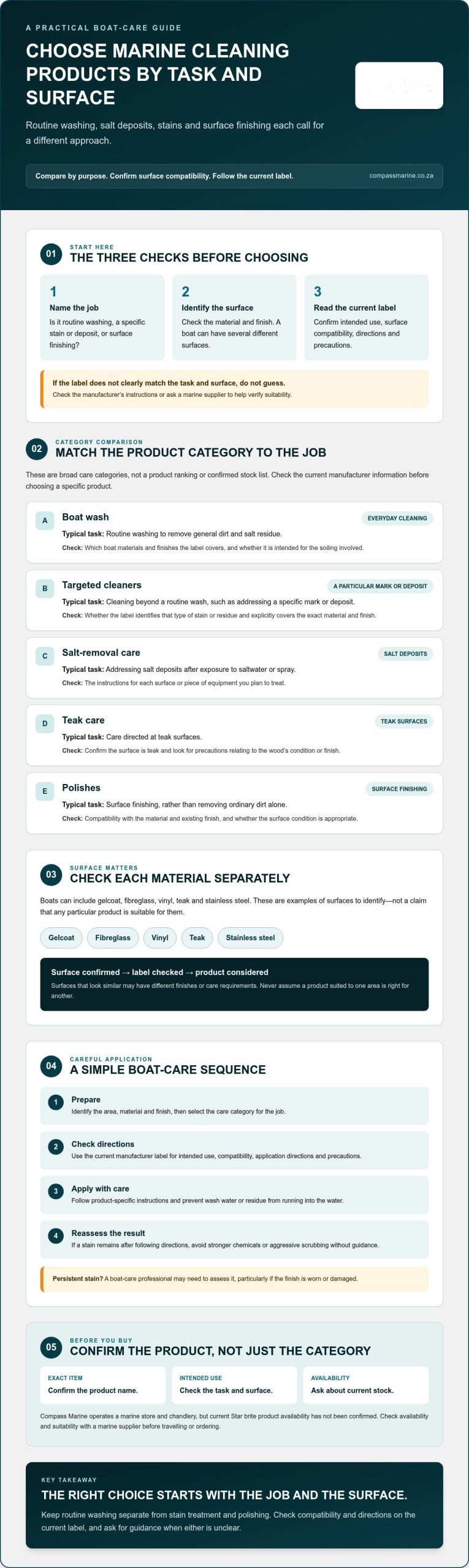
A useful roundup compares products by task and surface, rather than declaring one option the best for every boat. This guide covers broad care categories, not a ranking or a confirmed stock list. Before buying, check the current product label for its intended use, suitable surfaces and directions.
A marine cleaning category describes a type of boat-care task, such as routine washing or surface finishing. The distinction helps you narrow your search: a product intended to remove everyday grime may not be designed to treat a stain, restore gloss or maintain a finish.
Which boat-care tasks belong in a product comparison?
Start with the result you need. Routine washing removes general dirt and salt residue; stain treatment addresses specific marks; polishing is intended to improve a surface’s appearance; and ongoing surface care helps maintain the finish between more intensive jobs. These tasks aren’t interchangeable. A polish isn’t simply a stronger wash, and a cleaner shouldn’t be assumed to protect a surface.
For each category, compare the stated purpose, the surfaces it is intended for and any application precautions. If the label doesn’t clearly match your task, don’t guess. Ask a marine supplier to help verify the current manufacturer directions before you purchase or apply the product.
Why does surface compatibility matter?
A boat may have several materials and finishes, including gelcoat, fibreglass, vinyl, teak and stainless steel. These are examples to check, not a claim that any particular product is suitable for them. Even surfaces that look similar may have different finishes or care requirements, so a product that’s appropriate in one area may not be right elsewhere.
Identify the surface as accurately as you can, then look for explicit compatibility guidance on the label. If it’s unclear, consult the manufacturer’s instructions or ask a supplier before use. That check is useful when maintaining a boat used for recreational boating, where routine cleaning is part of responsible ownership.
A practical comparison should answer three questions: what job needs doing, which surface is involved, and what does the manufacturer say about using the product there? Keep those answers in view as you compare categories. Compass Marine operates a marine store and chandlery, but its current Star brite product availability hasn’t been confirmed. Ask about availability and suitability rather than assuming a particular item is stocked.
Compare Star brite product categories by cleaning task for Star brite Durban searches
Compare marine-care categories by the result you need, then check the label for surface suitability and directions. Categories covered here include boat wash, cleaners, polishes, teak care and salt-removal care. This is a category-level comparison, not a ranking or confirmation of Compass Marine’s current stock. Check current manufacturer information before choosing a specific product.
| Category | Typical task | Surface checks | Questions to confirm |
|---|---|---|---|
| Boat wash | Routine washing to remove general dirt and salt residue. | Check which boat materials and finishes the label covers. | Is it intended for the type of soiling and surface involved? |
| Cleaners | Targeted cleaning beyond a routine wash, such as addressing a particular deposit or mark. | Confirm the exact material and finish. Don’t assume a cleaner suits every area. | Does the label identify this kind of stain or residue? |
| Salt-removal care | Addressing salt deposits after exposure to saltwater or spray. | Check the instructions for the specific surfaces and equipment you plan to treat. | Which areas are included in the stated intended use? |
| Teak care | Care directed at teak surfaces. | Confirm the surface is teak and follow the stated application directions. | Are there precautions for the condition or finish of the wood? |
| Polishes | Surface finishing, rather than removing ordinary dirt alone. | Check compatibility with the material and existing finish. | Is the surface condition appropriate for this type of product? |
How do washing and stain-removal options differ?
A wash is for general cleaning; stain treatment is intended to address a specific mark or deposit. Read the label to see what type of soiling the product is intended for and which materials it covers. If a mark remains after you follow the directions, don’t switch to a stronger chemical or aggressive scrubbing without guidance. A persistent stain may need assessment by a boat-care professional, particularly if the finish is worn or damaged.
When should boat owners consider polish or detailing products?
Polishing is a separate finishing task, not a substitute for removing dirt or residue. The surface’s condition, material and existing finish all affect what may be appropriate, so check the current product directions before use. Ask a marine supplier to confirm the exact category, availability and label guidance rather than assuming a particular item is in stock. Compass Marine operates a marine store and chandlery, and you can ask about marine product suitability.
For wider market context, the NMMA publishes information about the recreational boating industry. Industry data can’t identify the right cleaner for an individual boat, so base your choice on the task, surface and current manufacturer instructions.
How to choose a Star brite product for your boat’s surfaces
A cleaner that works for one part of a boat may be unsuitable for another. Gelcoat, painted finishes, vinyl upholstery, teak and stainless steel each have different characteristics. Previous treatments or wear can also affect how a surface responds. Suitability depends on the specific product, material and condition of the boat, so don’t choose by brand name alone.
Always check the current product label for surface compatibility and instructions. The right choice depends on both the material and the condition of the finish.
What should you check before using a cleaner?
Use boat documentation or manufacturer guidance to identify the material and finish, especially if you’re unsure whether a surface is painted, coated or previously treated. Then follow this selection sequence:
- Identify the surface. Be specific about the area you plan to clean, rather than treating the whole boat as one material.
- Define the task. Decide whether you’re removing routine dirt, treating a mark or caring for a finish.
- Read the current label. Check intended surfaces, application directions, dilution instructions if given, and any stated precautions.
- Consider the condition. Worn, damaged or previously treated surfaces may need a different approach from an intact finish.
If you can’t identify the material or don’t know what treatment has already been applied, pause and seek advice from the boat or product manufacturer, or a qualified boat-care professional. Guessing can make a poor result harder to diagnose.
How can you reduce the risk of a poor result?
Follow the manufacturer’s directions for the exact product you have. Products in the same category may have different application methods, dilution instructions or precautions. If the label recommends testing an inconspicuous area, follow its instructions. A spot test doesn’t replace checking surface compatibility.
Stop if the surface changes unexpectedly, for example, if it shows discolouration, a change in sheen or an unusual texture. Don’t keep applying the product or add another chemical to try to correct it. Seek qualified advice before continuing, particularly if the finish is valuable or already deteriorating.
Using only the amount and method directed also helps keep runoff controlled. The US EPA’s Clean Boating Act page explains US requirements for discharges from recreational vessels; it isn’t South African regulatory guidance. For Star brite Durban enquiries, have the surface type and cleaning task ready when asking a marine supplier to verify current directions and suitability.
A careful boat-cleaning routine: preparation, application and follow-up
A controlled routine helps you clean effectively without exposing a boat’s finish, fittings or nearby equipment to unnecessary risk. Product labels take priority because directions can differ between cleaners. Don’t transfer a method from one product to another or improvise with chemicals.
What should you prepare before cleaning?
Choose a suitable time and working area. Avoid conditions that conflict with the label, such as direct heat or wind that could affect application or carry spray onto nearby surfaces. Keep wash water and residue controlled, and take care not to let products run into the surrounding water.
- Check the surface and task. Confirm which area needs attention and identify its material or finish. If you’re unsure, consult the boat documentation or manufacturer guidance before choosing a product.
- Remove loose dirt carefully. Use a method appropriate for the surface. Avoid abrasive tools or forceful scrubbing unless the relevant instructions confirm they’re suitable.
- Read the label before opening the container. Check the intended use, application method, dilution directions if provided, precautions and any stated protective measures. Prepare only as directed.
- Protect nearby equipment. Move or cover items where appropriate. Keep containers closed, clearly labelled and secured so they can’t tip or spill onboard.
Never mix cleaning products or combine them with other chemicals. If you’re uncertain about safe handling, follow the product’s safety information and seek advice rather than testing a mixture. While you’re reviewing onboard systems, it’s also worth checking that your bilge pumps Durban boaters rely on are functioning correctly, as a blocked intake or faulty float switch can go unnoticed until it matters most. If your maintenance checklist also includes sealing deck fittings or joints, review the Sikaflex marine sealant Durban selection guide to understand how to match the right sealant to the joint’s purpose and materials before applying anything.
What should you check after cleaning?
Follow the label’s instructions for removal or rinsing, then inspect the treated area for residue, discolouration or an unexpected change in sheen or texture. If the surface reacts unexpectedly, stop. Don’t apply another product to try to correct it. Persistent staining, a damaged finish, or an unknown material or previous treatment calls for professional assessment before further cleaning.
Store any remaining product as directed on its label, with the original identification intact and away from materials the manufacturer says are incompatible. Don’t leave containers loose where they may move, leak or be exposed to unsuitable conditions.
Cleaning before indoor storage can help you spot residue or surface concerns before putting the boat away. It also gives you a chance to follow up on areas that need attention. For guidance on preparing your boat for storage, explore Compass Marine’s secure indoor boat storage information. If you’re searching for Star brite Durban and aren’t sure how to approach a particular surface, contact Compass Marine to ask about suitable marine products and support.
Choosing a marine supplier and confirming Star brite availability
Before travelling to a marine supplier or placing an order, confirm both current availability and suitability for your boat. Product ranges and stock can change, and a familiar brand name alone doesn’t confirm that a particular cleaner is right for your surface or task.
What should you ask before buying?
Have the exact product name to hand if you’re considering a specific item. If you’re unsure of the name, describe the cleaning task and ask the supplier to confirm the product identity and whether it’s currently available. Then check the intended use against the current manufacturer directions.
- Does the label cover my cleaning task? Explain whether you’re washing general dirt, addressing a particular stain or caring for a finish.
- Is it intended for this surface? Name the material and finish as accurately as possible, rather than relying on a broad description such as “boat hull”.
- Could the boat’s condition affect the choice? Mention any worn finish, previous treatment or uncertainty about the material. These details may change the recommendation.
- Can I check the current directions? Ask to verify the latest manufacturer instructions, including application and precautions, before use.
If the surface or its previous treatment is unknown, don’t rely on a guess. Consult the boat or product manufacturer, or seek advice from someone experienced in boat care. A supplier can help you check product information, but the label remains the reference for its intended use.
When can Compass Marine help with boat care?
Compass Marine operates a marine store and chandlery, and offers boat refurbishment, mechanical repairs and secure indoor boat storage. Its current Star brite stock hasn’t been confirmed, so contact the business to ask about availability rather than assuming a particular product is on the shelf. If your concern goes beyond choosing a cleaner, explain the surface and the condition you’ve noticed to find out whether one of these services is relevant.
A clear enquiry saves time: share the product name, the task, the surface and any known previous treatment. This gives the supplier useful context to check current availability and help you locate the manufacturer’s directions. If you’re comparing Star brite options, use those details to assess suitability rather than seeking a universal recommendation.
Contact Compass Marine to ask about product availability and marine services.
Choose your next boat-care step with confidence
The right choice starts with the job. Routine washing, treating a mark and caring for a surface finish each call for a different product category. Identify the material and condition of the surface, then check the current label for intended use, compatibility and precautions. This helps you avoid treating every part of the boat as if it needs the same care.
If you’re searching for Star brite Durban, confirm the exact product and current availability before travelling or ordering. Don’t assume a product is suitable simply because it carries a familiar brand name, and seek advice if the finish or its previous treatment is uncertain.
Compass Marine operates a marine store and chandlery, and offers boat refurbishment, mechanical repairs and secure indoor boat storage. Contact Compass Marine to ask about current product availability and relevant marine services. With the right information and a careful approach, you can choose your next step with greater confidence.
Frequently Asked Questions
Which Star brite product should I use to clean my boat?
The right product depends on the cleaning task, the boat’s surface and the current manufacturer directions. If you’re searching for Star brite Durban, first identify the material and decide whether you need routine washing, stain treatment or surface finishing. Read the product label to confirm its intended use and compatibility. If you’re unsure what caused a stain or how the finish was treated, ask a marine supplier to help check suitability before buying.
Can Star brite products be used on every boat surface?
No. Don’t assume one product suits every boat surface. Compatibility depends on the specific formulation, material and finish, and a boat may have several different surfaces close together. Check the current product label and relevant boat-maker guidance before applying anything. If you can’t identify the surface, or it’s already worn or damaged, pause and seek professional advice rather than testing a product across a larger area.
How do I choose between a boat cleaner and a polish?
A cleaner is intended to remove dirt or residue, whilst a polish is for a separate surface-finishing task. They aren’t interchangeable, and neither should be chosen by category alone. Consider the boat’s surface and condition, then check the label for intended use and compatibility. If dirt remains after cleaning as directed, don’t assume polishing is the next step. First confirm that the finish is suitable for polishing.
Is it safe to use a boat cleaner on gelcoat or fibreglass?
Suitability can’t be assumed from the words gelcoat or fibreglass alone. Check the exact product label and relevant boat-manufacturer guidance to confirm that use on the surface is stated as suitable. The condition of the finish also matters. If it’s worn, damaged or has been treated with an unknown product, get advice from a marine professional before applying a cleaner or attempting a test.
Can I mix different boat-cleaning products?
Don’t mix cleaning products unless their manufacturers explicitly instruct you to do so. Different formulations can have different directions and precautions, so combining them or improvising a dilution may create avoidable risks for you and the boat’s surfaces. Use each product only as labelled, and store it securely in its original, clearly identified container. If instructions are unclear, ask the product manufacturer or supplier before use.
Does Compass Marine stock Star brite products?
Compass Marine’s current Star brite stock hasn’t been verified, so contact the business to confirm availability before travelling or ordering. Compass Marine operates a marine store and chandlery, but that doesn’t confirm a particular brand or product is currently stocked. For a Star brite Durban enquiry, provide the exact product name and intended task so the team can check availability and discuss relevant marine services without assuming a specific item is available.