Why does a “stainless” rail start bleeding tea-coloured rust onto your pristine gelcoat just months after a supposed upgrade? It’s a common frustration for boat owners in KwaZulu-Natal, where the combination of high humidity and intense salt spray makes professional marine stainless steel fabrication durban a necessity rather than a luxury. If you’ve ever struggled with “universal” hardware that doesn’t quite line up or T-tops that vibrate under pressure, you’ve seen firsthand how standard fittings fail to meet the demands of the Indian Ocean.
We believe that your vessel deserves better than off-the-shelf compromises. High-quality fabrication is about more than just a polished finish; it’s a structural insurance policy for your asset. This guide will show you how custom-fabricated Grade 316 fittings prevent structural fatigue and why professional refurbishment is the most effective way to protect your boat’s resale value and your safety on the water.
Key Takeaways
- Understand why Grade 316 stainless steel is the non-negotiable standard for Durban’s coastal conditions and how its composition resists chloride pitting.
- Discover the structural advantages of custom-engineered hardware over mass-produced fittings that often fail to distribute loads correctly across your hull.
- Learn how professional marine stainless steel fabrication durban acts as a vital insurance policy for your vessel’s long-term safety and resale value.
- Identify the key stages of a successful refurbishment, ensuring new fittings integrate perfectly with your boat’s existing mechanical and electrical systems.
- Recognise the subtle warning signs of “tea staining” and structural fatigue before they lead to permanent gelcoat damage or safety risks on the water.
The Role of Marine Stainless Steel Fabrication in Vessel Integrity
Vessel integrity depends entirely on the quality of the hardware holding your boat together. Marine fabrication is the specialised engineering of metal components designed to survive the relentless assault of saltwater and high humidity. In Durban, where the Indian Ocean’s spray is particularly aggressive, standard mild steel or low-grade stainless steels fail rapidly. They often develop deep structural pitting within months. Professional marine stainless steel fabrication durban ensures that your bow rails, T-tops, and engine mounts remain structurally sound. This provides a critical safety net during heavy offshore transit when hardware failure simply isn’t an option.
Why Specialised Marine Engineering Matters
The salt-heavy air in KwaZulu-Natal creates a unique metallurgical challenge known as stress-corrosion cracking. This occurs when tensile stress and a corrosive environment combine to create microscopic fractures in the metal. If your hardware is welded using incorrect techniques or contaminated equipment, these cracks can lead to sudden, catastrophic failure. Specialised marine stainless steel fabrication durban relies on specific TIG welding processes and high-purity shielding gases to prevent “tea-staining.” This unsightly brown discolouration is often the first sign of surface degradation. General welders often lack the dedicated clean-room environments required to keep Marine grade stainless steel free from carbon steel cross-contamination.
Common Stainless Steel Components on Modern Boats
Every fitting on your boat serves a practical purpose, from the cleats and bollards that secure you in the harbour to the fuel tanks tucked away in the hull. High-quality fabrication covers a wide range of essential hardware:
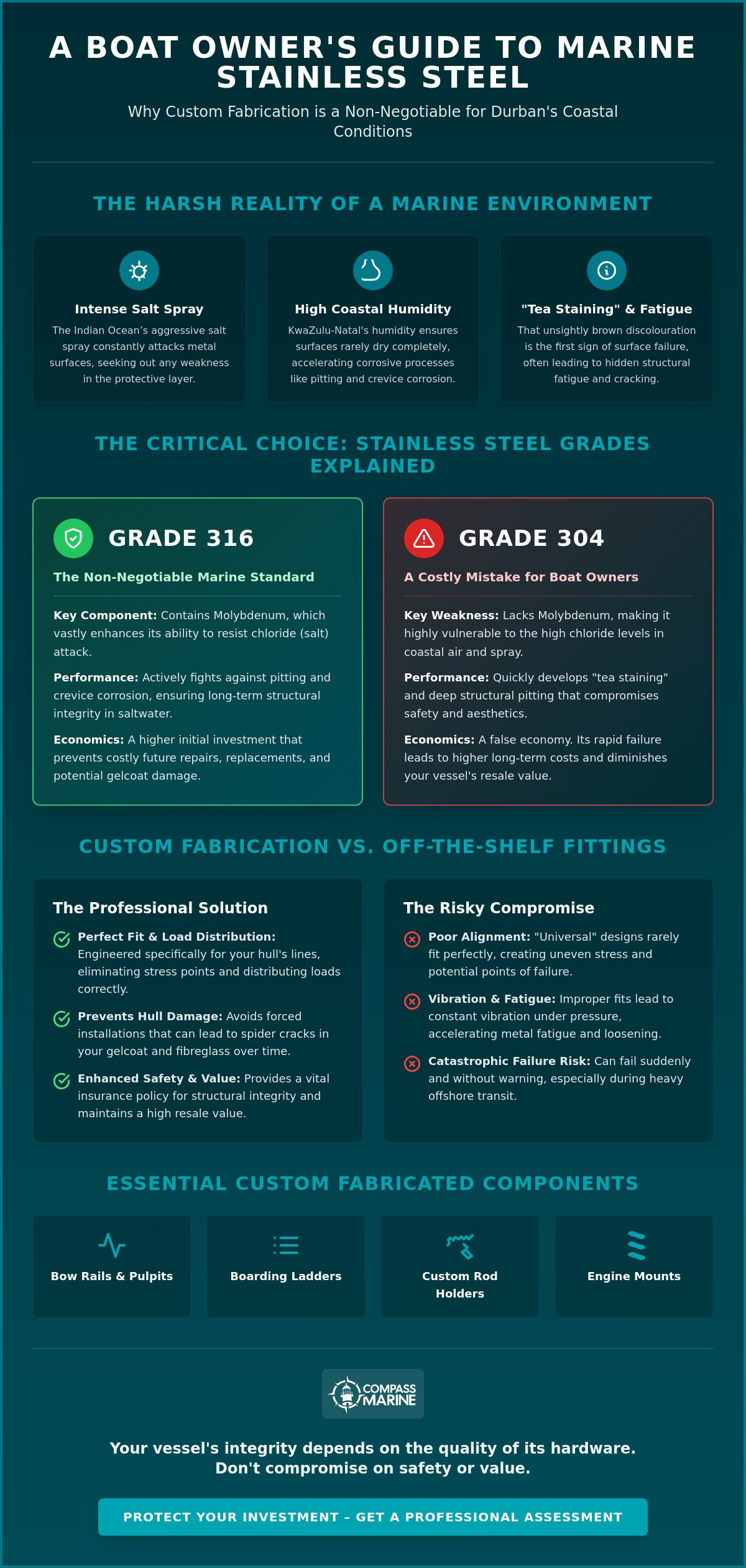
- Boarding Ladders: These are custom-fitted to your transom to ensure safe and easy access from the water.
- Rod Holders: For serious anglers in KZN, custom-angled holders are essential for managing heavy tackle during a strike.
- Bow Rails and Pulpits: These provide the primary safety barrier for passengers moving around the deck.
- Custom Engine Mounts: These must handle the immense torque of modern outboards whilst resisting vibration-induced fatigue.
Beyond the functional benefits, a high-polish finish serves an important aesthetic purpose. It keeps your vessel looking well-maintained and helps preserve its resale value in the local pre-owned boat market. Precision-made fittings that match your hull’s specific lines also eliminate the need for forced installations, which can stress the fibreglass and lead to spider-cracks over time.
The Science of Saltwater Resistance: Grade 316 vs Grade 304
The term “stainless” is often misunderstood by boat owners. It suggests a metal that is impervious to all forms of degradation, regardless of the environment. In reality, stainless steel is a broad family of alloys with varying degrees of resistance. For those seeking professional marine stainless steel fabrication durban, the choice between Grade 304 and Grade 316 is the difference between a fitting that lasts decades and one that fails in months. Grade 304 is the standard “18/8” stainless used in kitchens; it’s strong and corrosion-resistant in mild conditions. However, the high chloride levels in our coastal spray quickly penetrate its protective layer, leading to rapid tea-staining and structural loss.
Grade 316 is distinguished by the addition of molybdenum. This element significantly enhances the metal’s ability to resist pitting and crevice corrosion. Whilst Grade 316 carries a higher initial cost than 304, its lifespan in a saltwater environment is vastly superior. Choosing a lower grade for your vessel’s structural fittings is a false economy, especially when considering the harsh conditions that necessitate expert marine stainless steel fabrication durban. The eventual cost of removal, repair, and replacement far outweighs the initial investment in genuine marine-grade materials. If you are unsure about the current state of your hardware, a professional assessment of your stainless steel fabrication and fittings can identify which components are at risk.
Understanding Pitting and Crevice Corrosion
Pitting is a particularly dangerous form of corrosion because it’s localised. It creates tiny, deep holes that can compromise the structural integrity of a rail or mount whilst the surrounding surface looks perfectly fine. This happens when the protective chromium oxide layer breaks down in the presence of chlorides. Crevice corrosion is similar but occurs in shielded areas where saltwater becomes stagnant, such as under washers or inside bolt threads. Grade 316 stainless steel contains 2-3% molybdenum, providing essential resistance to chloride-induced pitting in saltwater.
Surface Finishes and Their Impact on Longevity
The way a metal surface is finished directly affects how well it resists the ocean’s salt. Brushed or satin finishes might look modern, but they contain microscopic grooves that trap salt crystals and moisture. A mirror-polished finish is the gold standard for marine applications. By removing surface irregularities, we reduce the number of sites where corrosion can begin. This high-lustre finish isn’t just for show; it’s a functional barrier. Following the fabrication process, we also prioritise passivation. This chemical treatment removes free iron from the surface and accelerates the reformation of the protective chromium oxide layer, ensuring your new hardware is “sealed” against the elements from day one. Before commissioning any new hardware, it is worth consulting our marine stainless steel fabrication Durban quality checklist to verify that your fabricator meets the critical standards for material grade, weld integrity, and finishing technique.
Custom Fabrication vs Off-the-Shelf Marine Fittings
Mass-produced marine hardware often relies on a “one-size-fits-all” philosophy that rarely translates to a perfect fit on a real-world hull. Whilst off-the-shelf cleats or rails might seem convenient, they frequently require forced installation, which puts unnecessary stress on your gelcoat and fibreglass. In contrast, marine stainless steel fabrication durban allows for hardware that’s engineered specifically for your vessel’s unique geometry. This ensures that structural loads are distributed across reinforced sections of the deck or transom, preventing the spider-cracking and hardware loosening common with universal fittings.
Custom solutions also offer significant weight-saving advantages. By using high-strength, thin-wall stainless steel or marine-grade aluminium, we can create robust structures like T-tops or radar arches without adding excessive top-side weight. This is particularly important for maintaining your boat’s centre of gravity and overall stability in the swells of the Indian Ocean. Beyond standard fittings, custom work solves unique challenges, such as designing specialised transducer mounts for high-speed sonar or extending swim platforms to accommodate specific diving or fishing requirements.
When to Choose Custom Fabrication
If your vessel has an unusual transom angle or a non-standard deck layout, off-the-shelf parts will likely fail to align correctly. Custom fabrication is also the preferred choice for heavy-duty commercial craft or charter boats that face daily wear and tear. Although the initial cost is higher, a custom fitting designed for longevity can easily last 20 years, whereas “universal” hardware often requires replacement every three years due to fatigue or corrosion. It’s also vital to work with certified mechanics who understand how new stainless structures might affect engine access or weight distribution during a refurbishment.
The Design and Measurement Process
The secret to a flawless finish lies in precise on-vessel measurements. Ordering from a template or a catalogue cannot account for the subtle variations in a hand-laid hull. Our process involves taking exact dimensions directly from your boat to ensure every bolt hole aligns perfectly. For complex structures, we often use a “tack-welding” phase, where the component is temporarily assembled on the vessel to verify the fit before final shop fabrication and mirror polishing. To prevent the silent threat of electrolysis, we always utilise nylon washers or insulating compounds like Tef-Gel between different metal types, such as when mounting stainless fittings to aluminium hulls or outboard brackets.
Integrating Fabrication into Boat Refurbishment Services
A comprehensive vessel refurbishment is about more than just a fresh coat of anti-foul or new upholstery. It’s a structural reset. For many older boats in KwaZulu-Natal, the original hardware has often reached the end of its fatigue life, especially if it was manufactured from lower-grade materials. Professional marine stainless steel fabrication durban is a core pillar of this process. By replacing brittle aluminium T-tops or tea-stained bow rails with custom-engineered 316 stainless steel, we don’t just restore safety; we modernise the entire profile of the vessel. This makes an older hull look current whilst significantly increasing its market value.
The role of fabrication extends beyond the deck. Saltwater immersion is a trailer killer, and during a full refurbishment, the metalwork on your trailer requires as much attention as the boat itself. Replacing rusted winch posts, rollers, and structural brackets with custom stainless components ensures your transport system is as reliable as your vessel. If you’re planning a major project, our team provides expert refurbishment of boats and trailers to ensure every component is fit for the Indian Ocean.
The Refurbishment Workflow
Restoring structural integrity follows a methodical process to ensure no hidden defects remain. We follow these essential steps during a hardware overhaul:
- Step 1: Audit. We conduct a thorough audit of all deck hardware, looking for “bleeding” rust or any movement that suggests loose mounting points.
- Step 2: Core Assessment. We assess the integrity of the deck core beneath the fittings to ensure the fibreglass hasn’t been softened by years of water ingress.
- Step 3: Fabrication. We replace fatigued aluminium or low-grade steel with custom-measured 316 stainless components, ensuring a perfect fit without stressing the hull.
- Step 4: Re-sealing. We re-install all hardware using marine-grade sealants and backing plates to distribute loads and prevent future leaks.
Stainless Steel Maintenance for Owners
Even the best marine stainless steel fabrication durban requires a basic maintenance routine to stay in peak condition. The coastal humidity in Durban is relentless, so we recommend a fresh water rinse after every launch to remove salt crystals. Periodically applying a specialised polishing paste will help maintain the protective oxide layer and keep that mirror finish bright.
Keep a close eye on your fittings for warning signs like brown streaks “bleeding” from bolt holes or a rough, sandpaper-like texture on the rails. These are early indicators that the surface needs attention before deep pitting begins. We recommend a professional hardware inspection during your annual COF surveys to ensure your vessel remains compliant and safe for offshore transit.
Expert Marine Technical Services: The Compass Marine Approach
At Compass Marine, we view every vessel as a high-value asset that requires a holistic approach to maintenance. Choosing professional marine stainless steel fabrication durban is only one part of the equation. By housing fabrication, mechanical repairs, and engine servicing under one roof, we eliminate the communication gaps that often lead to technical errors. Our team ensures that every new rail or mount is designed with mechanical access in mind. This prevents frustrating situations where a beautiful new T-top blocks access to vital engine components or fuel filters. Understanding the full scope of professional marine technical services — from structural fabrication to engine maintenance and regulatory compliance — is essential for any boat owner who wants to keep their vessel sea-ready and legally compliant in KwaZulu-Natal.
Our commitment to your safety extends to full regulatory compliance. We don’t just build hardware; we ensure it meets the rigorous standards required for your COF and buoyancy certificates. This integrated approach means your vessel is structurally sound, mechanically reliable, and legally compliant before it ever touches the water. We take pride in being a “safe pair of hands” for boat owners in KwaZulu-Natal, providing a steady, professional service that covers the entire lifecycle of your boat.
Comprehensive Technical Expertise
Our certified Yamaha and Suzuki mechanics work directly with our fabrication team. This collaboration is essential when designing custom engine mounts or reinforcing transoms for high-performance outboards. We handle everything from complex electrical fault diagnostics to the final polish on a custom boarding ladder. If you want to see the results of this integrated care, we invite you to browse our pre-owned boats for sale. These vessels represent the high standard of refurbishment we bring to every project, showing how custom metalwork and mechanical excellence work in tandem.
Securing Your Investment
Quality stainless steel work is a direct investment in your boat’s future resale value. Buyers in the Durban market prioritise vessels with well-maintained, high-grade fittings because they know the metallurgy and engineering are correct for our harsh conditions. To further protect these assets, we offer secure indoor boat storage. This environment shields your newly fabricated hardware from the corrosive night air of the KZN coast whilst your vessel is not in use, significantly extending the time between polishing cycles.
Whether you need a single custom rod holder or a complete structural overhaul, we’re here to help. Contact us today for a professional consultation on your next fabrication or refurbishment project, and let’s ensure your vessel is ready for the challenges of the Indian Ocean.
Protecting Your Maritime Investment with Precision Engineering
Selecting the right materials and craftsmanship is the ultimate safeguard for your vessel’s structural integrity. We have explored how Grade 316 stainless steel provides the necessary resistance to the Indian Ocean’s aggressive salt spray, and why custom-fitted hardware outperforms universal alternatives. By choosing professional marine stainless steel fabrication durban, you aren’t just improving your boat’s appearance; you’re securing its resale value and ensuring the safety of everyone on board.
At Compass Marine, our decades of professional marine experience allow us to handle the most complex refurbishments with a “safe pair of hands” approach. Our certified Yamaha and Suzuki mechanics work alongside our fabrication team to ensure every fitting is technically sound and mechanically accessible. Supported by a comprehensive marine store and chandlery, we provide a total care solution for the local boating community. Ready to upgrade your hardware? Request a Technical Consultation for Your Marine Fabrication Project today. We look forward to helping you prepare for your next offshore adventure with confidence.
Frequently Asked Questions
Is Grade 316 stainless steel completely rust-proof?
Grade 316 is the marine standard, but it isn’t entirely “rust-proof” in the absolute sense. It depends on a microscopic chromium oxide layer for protection. If this layer is damaged by deep scratches or contaminated by carbon steel tools, the metal will corrode. Regular maintenance and fresh water rinsing are essential to keep this protective barrier intact, especially in the high-salinity air of the Durban coast.
Can I use a standard automotive welder for my boat’s stainless steel repairs?
Using an automotive welder is a mistake that often leads to rapid hardware failure. Automotive shops generally use MIG welders set up for mild steel, which introduces iron particles into the stainless steel. This cross-contamination causes the weld to rust almost immediately. Professional marine stainless steel fabrication durban requires dedicated TIG welding equipment and high-purity argon gas to ensure the structural integrity and corrosion resistance of the joint.
How much does custom marine stainless steel fabrication cost compared to off-the-shelf parts?
Custom fabrication carries a higher initial price point than mass-produced parts because it involves bespoke engineering and higher-grade materials. However, custom fittings are a far more cost-effective choice over the vessel’s lifecycle. Whilst a “universal” rail might need replacement every few years due to poor fit or corrosion, a custom-built 316 stainless component can last for decades. It also eliminates the risk of hull damage caused by ill-fitting hardware.
Why is my stainless steel rail showing brown ‘tea-staining’ marks?
Tea-staining is a visual warning sign that salt crystals have become trapped in the microscopic surface profile of the metal. This often happens if the stainless has a brushed finish rather than a mirror polish, or if Grade 304 was used instead of 316. Whilst it’s mostly a cosmetic issue initially, it indicates that the protective oxide layer is under stress. If left untreated, tea-staining can progress into deep pitting that compromises the metal’s strength. Our detailed guide to evaluating marine stainless steel fabrication quality in Durban outlines exactly what to look for when assessing whether your current hardware meets the standard required for the Indian Ocean environment.
What is the best way to clean marine-grade stainless steel without scratching it?
The safest method is a thorough rinse with fresh water followed by cleaning with a soft microfibre cloth and mild detergent. You should never use steel wool or abrasive scouring pads, as these leave behind iron particles that will cause rust. For stubborn spots, use a specialised marine stainless steel polish that is designed to chemically clean the surface whilst reinforcing the protective chromium oxide layer without scratching the high-lustre finish.
Do I need to remove my stainless fittings for a boat refurbishment?
Removing fittings is often necessary during a professional refurbishment to ensure the underlying structure is sound. Simply polishing a rail whilst it’s still attached won’t address potential water ingress in the deck core. By removing the hardware, we can inspect the mounting holes, replace fatigued backing plates, and re-seal the penetrations with fresh marine-grade sealant. This prevents the “silent” rot that often destroys boat decks from the inside out.
How long does custom fabrication typically take for a boat T-top?
The timeline for custom work depends on the complexity of the design and the current workshop schedule. A custom T-top or radar arch typically requires several weeks from the initial measurement and tack-welding phase to the final mirror polishing and installation. Because these structures must be engineered to handle specific wind loads and equipment weights, rushing the fabrication process can lead to structural compromises that affect your safety offshore.
Will custom stainless steel fittings affect my boat’s buoyancy certificate?
Any significant change in weight or structural layout can impact your vessel’s buoyancy certificate and COF status. Adding heavy stainless steel structures like large swim platforms or oversized T-tops changes the boat’s displacement and centre of gravity. When we perform marine stainless steel fabrication durban, we ensure that these modifications are documented and meet the necessary safety standards so that your buoyancy calculations remain accurate and your vessel stays legally compliant. Understanding the current boat buoyancy certificate requirements in South Africa is essential before undertaking any structural modification that could affect your vessel’s displacement or flotation rating.