If your vessel were to swamp three kilometres off the Durban coast today, would it stay level or disappear beneath the Indian Ocean within minutes? It’s a sobering thought that every skipper must face, yet many boaters find themselves bogged down by confusing maritime terminology and the fear of failing a looming COF inspection. We understand that keeping track of the latest boat buoyancy certificate requirements south africa can feel like an overwhelming task, especially when you aren’t sure if your existing flotation material still meets the current standards.
This guide provides a clear, practical roadmap to mastering the 2026 legal and technical requirements for boat buoyancy in South Africa. We’ll help you secure that vital SAMSA compliance and, more importantly, the peace of mind that comes from knowing your vessel is genuinely sea-worthy. We will explore the specific buoyancy percentages required for different categories, the lifespan of approved materials like closed-cell foam and HDPE bottles, and the exact steps you need to take to ensure your certification remains valid and your passengers stay safe.
Key Takeaways
- Identify the mandatory SAMSA regulations that require every power-driven vessel to carry a valid buoyancy certificate for legal operation in South African waters.
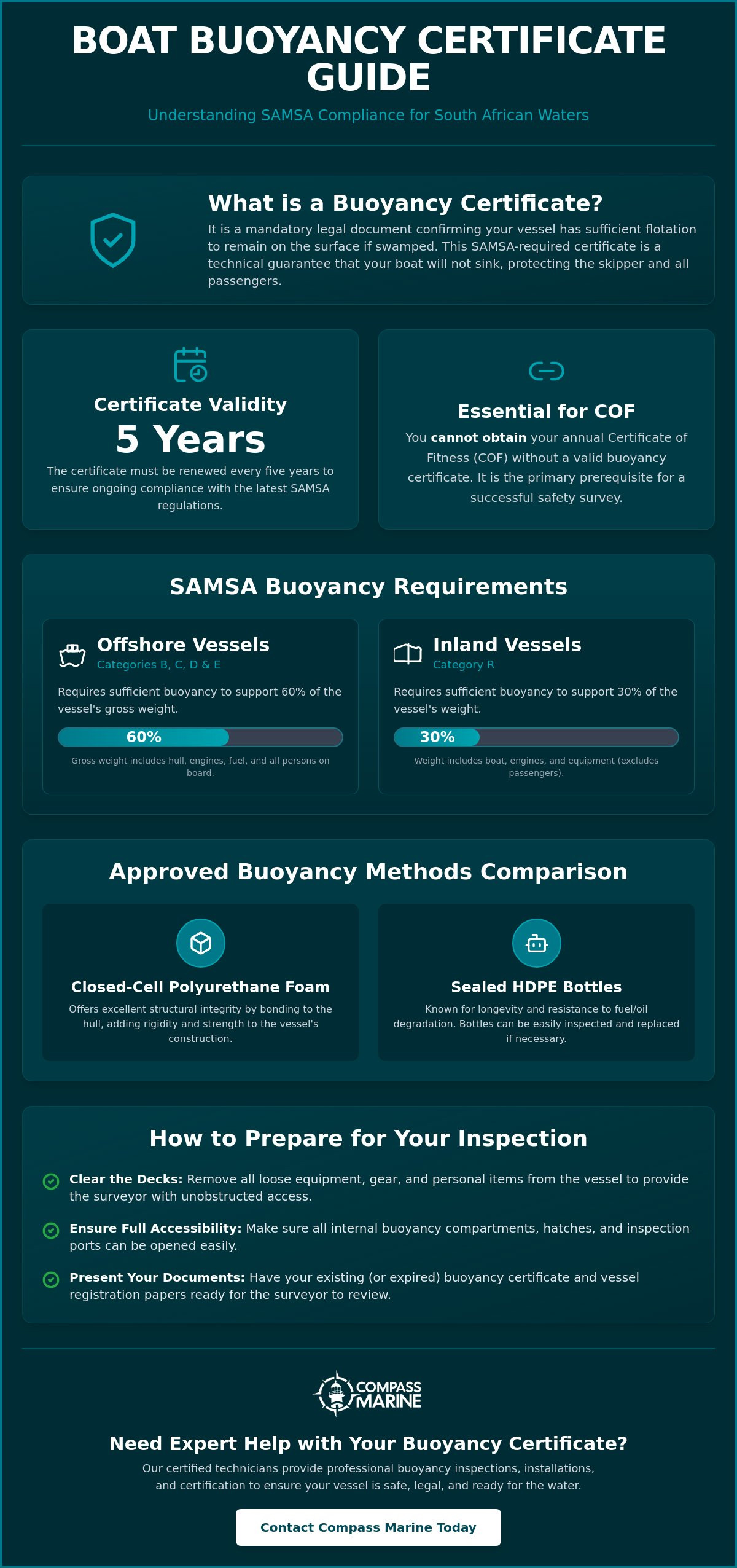
- Master the boat buoyancy certificate requirements south africa, specifically the 60% gross weight flotation rule for offshore categories and the 30% rule for inland vessels.
- Compare the effectiveness of closed-cell polyurethane foam against sealed HDPE bottles to determine the best method for your boat’s structural integrity and longevity.
- Prepare your vessel for a surveyor’s inspection by clearing loose equipment and ensuring all internal buoyancy compartments are fully accessible.
- Understand the essential link between a valid five-year buoyancy certificate and obtaining your annual Certificate of Fitness (COF) to maintain total maritime compliance.
What is a Boat Buoyancy Certificate and Why is it Mandatory?
A buoyancy certificate is a formal document verified by a competent person or authority that confirms your vessel possesses sufficient flotation to remain on the surface if swamped. This isn’t merely a piece of paper; it’s a technical guarantee that your boat won’t sink to the bottom if the hull is breached or flooded. In South Africa, the legal framework for this requirement is set by SAMSA (South African Maritime Safety Authority) under the Merchant Shipping Regulations. These rules apply to all small power-driven vessels, ensuring they meet a standard of safety that protects both the skipper and the passengers.
The core safety purpose is to ensure the boat remains afloat and stable even when completely filled with water. This relies on the fundamental physics of What is Buoyancy?, where the upward force exerted by the water must exceed the weight of the vessel. According to the latest SAMSA mandates, a buoyancy certificate is valid for five years from the date of issue. Whilst the physical foam or bottles inside your hull might last longer, the certificate itself must be renewed to ensure the vessel still complies with the latest boat buoyancy certificate requirements south africa.
The Link Between Buoyancy and the Certificate of Fitness (COF)
You cannot obtain a COF without a valid buoyancy certificate. Think of the buoyancy document as the prerequisite for your annual safety survey. When you present your boat for inspection in Durban or anywhere along the KZN coast, the surveyor will first check that your buoyancy papers are current and accurate. This link is vital because the COF certificate requirements are designed to ensure total vessel safety, and a boat that can’t stay afloat is fundamentally unfit for sea. Your boat insurance coverage usually hinges on this compliance; if you’re involved in an accident and your buoyancy isn’t legally certified, your insurer may refuse to pay out your claim.
Who Can Issue a Buoyancy Certificate in South Africa?
SAMSA is very specific about who is considered a “competent person” to issue these documents. Generally, this includes SAMSA officers, authorised agency safety officers, or accredited surveyors. For a new vessel, the manufacturer typically issues the initial certificate at the point of sale. If you own an older boat or have recently refurbished your hull, you must use a certified marine technical service to perform the necessary inspections and calculations. Using an expert ensures that the volume of flotation material is correctly calculated against the gross weight of your engines, fuel, and equipment, keeping you on the right side of the law.
SAMSA Buoyancy Regulations: Technical Requirements for Different Vessels
The South African Maritime Safety Authority (SAMSA) mandates specific technical standards based on where you plan to launch. For offshore vessels classified under Categories B, C, D, and E, the regulation is stringent. You must have enough buoyancy to support 60% of the vessel’s gross weight. This calculation includes the physical hull, the maximum weight of the outboard engines, full fuel tanks, and the weight of the maximum number of persons allowed on board. Meeting these boat buoyancy certificate requirements south africa ensures that even if the deck is awash, the boat remains a stable platform for survival.
In contrast, Category R vessels intended for inland waters operate under the 30% rule. This requirement is slightly less demanding because it calculates buoyancy based on the weight of the boat, engines, and equipment, whilst excluding the weight of the passengers. If you use your boat for commercial purposes, such as taking out fishing charters or harbour tours in Durban, be prepared for much stricter oversight. Commercial vessels are held to higher safety margins to ensure passenger protection during an emergency, often requiring additional stability tests and more frequent inspections.
Calculating Buoyancy Volume for Your Boat
Determining the correct volume of flotation material requires a precise understanding of displacement. You must account for every kilogram of weight, from the outboard motors to the batteries and stainless steel fittings. When calculating your needs, don’t forget the weight of fuel, which is roughly 0.74 kilograms per litre. We often recommend a “more is better” approach. Exceeding the minimum boat buoyancy certificate requirements south africa provides an extra safety margin, which is particularly useful in the heavy swells often found off the KZN coast.
The Importance of the SAMSA Number
Every buoyancy certificate is legally tied to a specific vessel identification, usually the SAMSA number or a hull identification number (HIN). If your boat is missing its identification stickers or the physical plate is corroded beyond recognition, you must rectify this before an inspection can proceed. This number ensures your safety records are correctly logged in national maritime databases, making it easier to renew your buoyancy certificates in the future. Having a clearly visible SAMSA number also helps authorities verify your compliance quickly during routine water-side checks, preventing unnecessary delays to your day on the water.
Comparing Buoyancy Methods: Polyurethane Foam vs Sealed Bottles
In South Africa, skippers generally choose between injected foam or sealed containers to meet flotation standards. Each method has distinct advantages depending on your hull’s construction and intended use. To comply with the boat buoyancy certificate requirements south africa, the materials used must be durable, non-absorbent, and resistant to the harsh saltwater environment of the Indian Ocean. Choosing the incorrect material or a substandard installation can lead to a failed inspection and, more importantly, a vessel that lacks the necessary lift in an emergency.
Closed-Cell Polyurethane Foam
Injected polyurethane foam is a popular choice for many modern GRP (Glass Reinforced Plastic) hulls. This material provides excellent structural rigidity and acts as a sound dampener, making for a quieter ride through choppy Durban swells. However, it is vital that only closed-cell foam is used. Older vessels often contain open-cell variants that can act like a sponge over time, absorbing water and adding hundreds of kilograms of dead weight to your hull. This water retention not only compromises safety but also leads to fuel inefficiency and potential delamination. A professional marine technical service will typically inspect foam by checking for weight discrepancies or using moisture meters to ensure the core remains dry and buoyant.
Sealed Plastic Bottles and Containers
Using sealed plastic bottles is a common and cost-effective alternative, particularly in aluminium boats or older refurbishments. According to the SAMSA Marine Notice 8 of 2012, these must be high-density polyethylene (HDPE) bottles with secure, watertight caps. It is a frequent mistake to assume that any plastic container will suffice. Simple milk cartons or thin-walled juice bottles don’t meet safety standards because they degrade quickly under coastal humidity and constant vibrations. HDPE Grade 2 bottles are required for their longevity and resistance to chemical breakdown. Maintenance involves ensuring these containers are tightly packed and secured within the hull so they cannot shift or rub against one another, which could lead to punctures. If you’re refurbishing a vessel, ensure your bottles are clearly marked and the quantity is recorded to simplify your next five-year certification.
The choice between foam and bottles often depends on the age and design of your boat. Foam is generally preferred for new builds due to its structural benefits, whilst bottles are easier to inspect and replace in older hulls. Regardless of the method, the goal is to ensure that the volume of flotation is sufficient to support the vessel’s gross weight as per the 60% or 30% rules discussed earlier. Always consult with a technical expert if you’re unsure which method provides the best protection for your specific boat type.
How to Prepare for a Buoyancy Inspection and COF Survey
Preparing for a survey doesn’t have to be a stressful ordeal. A little foresight ensures the process is smooth and your vessel remains compliant. Meeting the boat buoyancy certificate requirements south africa is much easier when you approach the survey with an organised boat and the correct documentation in hand. Follow these practical steps to ensure your vessel is ready for the surveyor’s eyes.
- Step 1: Clean and clear the vessel. Strip the deck of all loose gear including fishing tackle, anchors, and coolers. A surveyor needs a clear workspace to access internal compartments without digging through equipment.
- Step 2: Check inspection hatches. Ensure every hatch is accessible and functional. Durban’s salt air can seize hinges and latches quickly; grease them beforehand to ensure they open easily during the inspection.
- Step 3: Gather your paperwork. Have your SAMSA number, previous buoyancy certificates, and owner details ready. This speeds up the administrative side of the certification.
- Step 4: Conduct a preliminary hull check. Look for signs of water ingress or structural damage. If you notice “weeping” fibreglass or loose bungs, address these issues before the official survey begins. Pay particular attention to the area around your engine mount, as any flex or softness in this region may indicate transom fatigue that requires professional boat transom repair before your inspection can proceed. It is also worth inspecting your deck fittings and railings; if any hardware shows signs of corrosion or weld failure, reviewing a marine stainless steel fabrication Durban quality checklist can help you identify substandard metalwork before the surveyor does.
- Step 5: Book your specialist. Schedule your inspection with a certified professional who understands local maritime conditions.
Common Reasons for Buoyancy Failure
Waterlogged foam is the most frequent cause of failure during an inspection. If your boat feels unusually heavy on the trailer or sits lower in the water than usual, your internal foam may be saturated. This water retention reduces the vessel’s flotation capacity and adds dangerous dead weight. Another common issue involves loose buoyancy bottles. These containers should be tightly packed and secured; they should not rattle or move within the hull when the boat is in motion. Any structural modifications, such as cutting into the floor to add new storage lockers, can also compromise your original buoyancy volume and void your existing certificate.
What Happens During the Physical Inspection?
The surveyor uses specialised tools to verify the integrity of your flotation. This often includes the use of borescopes, which are small inspection cameras designed to peer into inaccessible areas of the hull without the need for destructive drilling. The surveyor will perform volume calculations based on your boat’s specific dimensions and the weight of your engines and fuel. They’ll compare these figures against the boat buoyancy certificate requirements south africa to ensure you meet the 30% or 60% thresholds. Once the technical verification is complete, you will be issued a stamped and signed certificate valid for the next five years. To ensure your vessel is fully compliant and safe, you can book your buoyancy certificates inspection with our technical team today.
Expert Marine Technical Services and Compliance Solutions
Compass Marine acts as a steady hand for skippers navigating the technicalities of maritime law. We specialise in ensuring your vessel doesn’t just meet the minimum legal standards but exceeds them for your own safety. Our comprehensive inspections are designed to address both your five-year buoyancy needs and your annual COF certificate requirements in a single, streamlined process. If your boat requires structural refurbishment to replace waterlogged foam or damaged HDPE bottles, our technical team possesses the craftsmanship to restore your hull to its optimal flotation capacity. Where structural issues extend to the engine mounting area, we also provide boat transom repair services to address softening or delamination before it becomes a safety hazard at sea.
Operating as a one-stop-shop in Durban, we provide everything from outboard engine repairs to the provision of SABS-approved safety gear. This integrated approach saves you the hassle of dealing with multiple contractors. It ensures that every aspect of your vessel’s upkeep is handled by certified professionals who understand the specific challenges of the KZN coastline. Whether you’re managing a single recreational craft or a commercial fleet, our expertise helps you stay compliant with the latest boat buoyancy certificate requirements south africa without the stress of technical guesswork. We handle the technical heavy lifting, from volume calculations to physical inspections, so you can focus on your time on the water.
Beyond the Certificate: Total Vessel Care
A valid certificate is only one part of the safety equation. Regular engine servicing is equally critical; a boat that floats but cannot move is still a liability in a heavy Indian Ocean swell. We recommend a full mechanical and safety audit before the start of each season to ensure your Yamaha or Suzuki outboard is performing at its peak. This proactive approach identifies potential issues like saltwater corrosion in electrical wiring or fuel degradation before they lead to a breakdown at sea. Knowing your vessel meets all national South African standards provides a level of quality assurance that every mariner deserves.
Get Your Vessel Compliant Today
Timing is everything for maritime certification. We strongly advise booking your buoyancy and COF inspections well before the December holiday rush when surveyors and technical workshops are at their busiest. Navigating SAMSA paperwork can be a daunting task for many owners, but our team is well-versed in the local administrative requirements. We assist in ensuring your SAMSA numbers are correctly recorded and your documentation is filed accurately. Don’t wait for your current papers to expire; ensure your peace of mind by contacting us for professional buoyancy and COF assistance. Our goal is to ensure your investment remains protected and your passengers stay safe throughout the 2026 season and beyond.
Securing Your Safety and Compliance for the Season Ahead
Ensuring your vessel is properly certified is more than a legal formality; it’s a technical verification that your boat remains a safe haven in a swamping scenario. By understanding the offshore 60% rule and the physical lifespan of your flotation materials, you’ve taken the essential steps to protect your investment. Staying current with boat buoyancy certificate requirements south africa ensures you won’t be caught off guard during your next COF survey or a routine water-side inspection.
At Compass Marine, we bring decades of experience in South African maritime safety to every hull we inspect. Our full-service marine chandlery and compliance centre, supported by certified Yamaha and Suzuki mechanics, is equipped to handle everything from volume calculations to complex refurbishments. We take the complexity out of maritime legalities, providing a steady hand to help you maintain a safe, seaworthy vessel. Contact Compass Marine for Professional Buoyancy and COF Certification today and let us handle the technical details. We look forward to seeing you out on the water with total confidence and peace of mind.
Frequently Asked Questions
How long is a boat buoyancy certificate valid in South Africa?
A buoyancy certificate is valid for five years from the date of issue. Even if your flotation material remains in good condition, SAMSA regulations require a formal re-inspection after this period to ensure the vessel still meets safety standards. This check is crucial for identifying issues like waterlogged foam or degraded HDPE bottles that could compromise your safety off the Durban coast.
What is the difference between a COF and a buoyancy certificate?
A buoyancy certificate confirms your hull’s flotation capacity for five years, whereas a Certificate of Fitness (COF) is an annual inspection of your safety equipment and mechanical state. You cannot renew your annual COF without a valid buoyancy certificate. The buoyancy document serves as the long-term technical foundation for your boat’s legal operation in South African waters.
How much buoyancy does my boat actually need?
The requirement depends on your vessel category and gross weight. Offshore boats (Categories B, C, D, and E) must have 60% buoyancy, covering the weight of the hull, engines, fuel, and all passengers. Inland vessels (Category R) require 30% buoyancy, which excludes passenger weight. These specific boat buoyancy certificate requirements south africa are designed to keep your vessel stable and afloat in the event of flooding.
What happens if I lose my original buoyancy certificate?
You should first contact the surveyor or authorised agency that originally issued the document, as they may have a copy on file. If no record exists, you’ll need to book a new physical inspection and calculation to re-issue the certificate. It’s a good practice to keep a digital scan and record your SAMSA number safely to avoid the cost of a full re-survey.
Do jet skis and other personal watercraft require a buoyancy certificate?
Most modern personal watercraft have inherent buoyancy built into the hull and don’t require a separate certificate. However, they still need an annual COF inspection to remain legal on the water. If your jet ski has undergone structural modifications, it’s wise to consult a technical expert to ensure it still meets national safety standards.