Imagine the moment you open the throttle out past the Durban breakwater, only to feel a sickening flex behind you as your outboard motor strains against a softening hull. You have likely spent nights worrying whether those hairline cracks around the engine mount are merely cosmetic or the first signs of a catastrophic failure. It is a stressful position for any owner, especially when you consider that the transom is the structural heart of your vessel. In our harsh KwaZulu-Natal climate, saltwater corrosion and high humidity can silently compromise your boat’s integrity, leading to the terrifying prospect of losing an engine at sea.
You need to know if your vessel is still safe and whether the investment in a professional boat transom repair makes financial sense for your craft. This article will help you identify the critical warning signs of transom fatigue and explain the technical restoration process required to handle heavy outboard loads safely. We will walk you through the differences between traditional timber and modern composite cores, providing the clarity you need to move from a state of concern to total confidence in your boat’s performance and longevity.
Key Takeaways
- Learn how to distinguish between minor gelcoat cracks and deep structural fractures using a simple “tap test” to detect internal delamination.
- Understand how the added weight of modern four-stroke outboards can exacerbate existing structural weaknesses in older hulls.
- Discover why a professional boat transom repair requires surgical precision to remove rotted cores whilst maintaining the original hull skin for maximum strength.
- Compare the long-term benefits of marine-grade plywood against modern, rot-proof composite materials for your vessel’s restoration.
- Evaluate the financial impact of a documented transom restoration on your boat’s resale value and overall safety in South African coastal waters.
Identifying the Warning Signs of Transom Fatigue and Rot
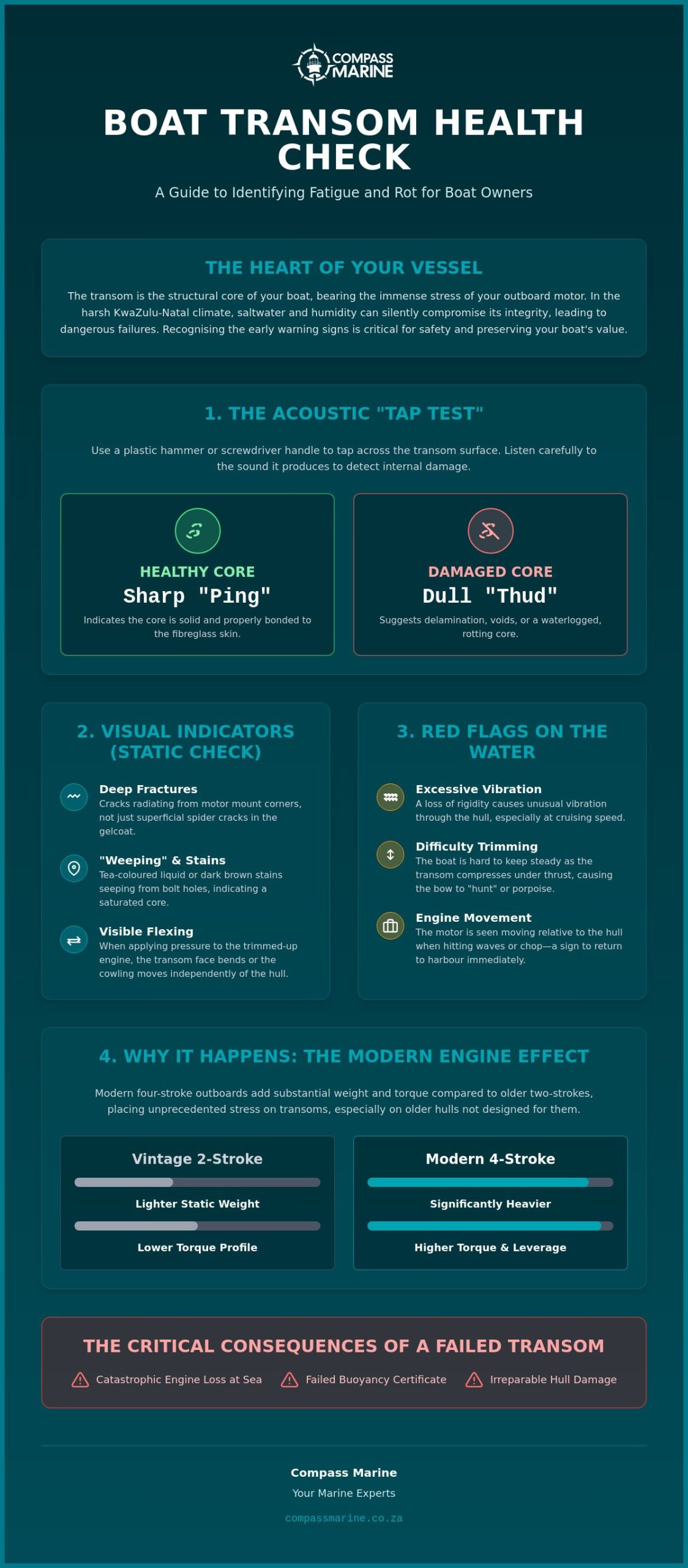
Detecting the early stages of decay can be the difference between a straightforward refurbishment and a total loss of the hull. Many boaters mistakenly assume that every crack in the fibreglass requires an immediate boat transom repair, but the reality is more nuanced. Understanding What is a Boat Transom? and how it functions as the primary structural bridge of your hull is the first step in a proper diagnosis. Superficial “spider cracks” in the gelcoat often result from the natural expansion and contraction of the hull in the South African sun. However, deep fractures that appear to radiate from the corners of the motor well or engine mounting bolts suggest that the internal core is no longer providing the necessary support.
A reliable method for assessing structural health is the acoustic “tap test.” Using a small plastic-headed hammer or the handle of a heavy screwdriver, tap the exterior surface of the transom in a grid pattern. A healthy, solid core will produce a sharp, crisp “ping.” If the sound transitions into a dull, hollow thud, you have likely identified an area of delamination or an internal void where the core has detached from the fibreglass skin. Identifying these signs early allows for a more targeted boat transom repair before the damage spreads to the stringers or floor.
Keep an eye out for “weeping” around the mounting hardware. If you notice a tea-coloured liquid seeping from bolt holes or drainage scuppers, it is a clear sign that the internal timber core is saturated and rotting. You can also perform a static trim test whilst the boat is on its trailer. With the engine trimmed halfway up, apply firm downward pressure to the motor’s lower unit. If you see the transom face flexing or the engine cowling moving independently of the hull, the structural bond has failed and the vessel is no longer safe to operate.
Visible Indicators of Internal Moisture
Moisture often leaves a trail before it causes a total failure. Look for dark brown staining around stainless steel fittings, which indicates that water has breached the sealant and is reacting with the core. Soft spots in the deck area immediately adjacent to the transom are another red flag; water often tracks forward from a compromised transom into the stringers. In the humid Durban climate, a persistent smell of damp timber inside the bilge or motor well often precedes visible rot.
Mechanical Red Flags During Operation
On the water, your boat will often “talk” to you. Excessive vibration through the hull whilst at cruising speed, even when the propeller is clean, can indicate a loss of rigidity. You might also find it difficult to maintain a steady trim; if the transom compresses under the thrust of the engine, the bow will hunt or porpoise unexpectedly. Watch the engine cowling closely when hitting chop. Any visible movement of the motor relative to the hull is a signal to return to the harbour immediately.
The Structural Risks of Outboard Motor Stress and Corrosion
Modern outboard motors have evolved significantly, but their increased weight and torque profiles place unprecedented demands on older hulls. Whilst a vintage two-stroke engine might have been relatively light, the transition to high-performance four-stroke Yamaha or Suzuki units adds substantial static weight to the rear of the vessel. This shift in mass changes the boat’s centre of gravity and increases the leverage exerted on the transom every time you power through a swell. If the internal core is compromised, this constant prying action can lead to catastrophic structural failure, making a professional boat transom repair a non-negotiable safety requirement.
The physics of a motor hanging off a weak transom are unforgiving. Think of the engine as a massive lever; as the propeller pushes the boat forward, the top of the transom is pulled backward whilst the bottom is pushed into the hull. A soft or rotted core cannot resist these opposing forces. This leads to compression of the laminate, which further allows water to bypass seals and accelerate the decay. Following industry best practices for structural reinforcement is the only way to ensure the hull can withstand these dynamic loads over the long term.
In South Africa, structural integrity is directly tied to your vessel’s legal standing. A transom that shows signs of excessive flex or delamination will almost certainly result in a failed buoyancy certificate inspection. Without a valid certificate, you cannot secure your annual COF (Certificate of Fitness), effectively grounding your vessel. Ensuring your hull is sound is a prerequisite for any COF and buoyancy certification process, especially for those operating in the challenging conditions of the Indian Ocean.
The Role of the Transom in Hull Integrity
The transom acts as the primary junction where the engine’s thrust is distributed into the boat’s stringer system and hull skin. If this connection point is weak, the entire boat loses its rigidity. For Cat C vessels operating up to 15 nautical miles offshore, this loss of integrity is particularly dangerous. Structural fatigue can cause the hull to twist or “oil-can” in rough seas, which directly compromises the performance of your safety equipment and the overall stability of the craft.
Saltwater: The Silent Catalyst of Decay
Durban’s high coastal humidity and saltwater environment create a perfect storm for internal rot. Saltwater ingress triggers a chemical reaction that breaks down the bond between the fibreglass resin and the timber core. Once moisture is trapped, it cannot escape, leading to a dark, anaerobic environment where fungi thrive. This also introduces the risk of electrolysis; when stainless steel mounting bolts are submerged in wet timber, they can corrode from the inside out, weakening the very hardware holding your engine in place.
Professional Transom Repair: The Core Restoration Process
Whilst many online DIY tutorials suggest that a boat transom repair is a simple matter of pouring resin or replacing timber, the structural reality is far more complex. A professional restoration is a precision engineering task that requires maintaining the hull’s original geometry whilst ensuring a chemically perfect bond between new and old materials. Unlike amateur attempts that often result in heavy, unbalanced, or poorly bonded transoms, a professional approach focuses on restoring the vessel to its original factory strength, or often exceeding it, to accommodate modern engine weights.
The core of the process involves surgical removal of the rotted material. In most professional settings, we access the core by removing the inner fibreglass skin, which allows us to preserve the original outer hull and gelcoat. This method maintains the aesthetic lines of the boat and ensures the primary structural envelope remains intact. Once the rotted core is cleared, the remaining laminate is ground down to fresh glass to provide a high-surface-area mechanical bond for the new lamination schedule. This schedule is calculated to achieve the ideal resin-to-glass ratio, preventing the transom from becoming brittle or excessively heavy. Once structural work is complete, protecting the exterior with the correct marine paint for fiberglass boats is essential to guard against osmosis and the harsh KwaZulu-Natal coastal environment.
Preparation and Engine Removal
Precision begins with the safe removal of the power plant. We use a professional gantry system to lift and stabilise heavy outboards, preventing any stress on the hull during the transition. Modern Yamaha and Suzuki engines feature sophisticated electrical looms and fuel diagnostic systems that must be carefully disconnected and protected from fibreglass dust. Before any cutting begins, we document the original hull geometry and transom angle. This step is vital for ensuring that, once the repair is complete, the engine alignment remains perfect for optimal plane and fuel efficiency.
Rebuilding with Marine-Grade Materials
Material selection is the foundation of longevity. We never use standard construction timber, as it lacks the rot resistance and structural consistency of marine-grade cores like BS 1088 plywood or high-density composite boards. For owners looking for a permanent, rot-proof solution, modern composites offer superior strength-to-weight ratios. To further enhance the structural integrity of the motor mount area, we often integrate custom marine stainless steel fabrication durban to distribute the massive torque of modern engines more effectively across the new core. To achieve a void-free bond, we utilise vacuum bagging or high-pressure clamping, which eliminates air pockets that could lead to future delamination. The process concludes with a colour-matched gelcoat finish, ensuring the repair is as visually seamless as it is structurally sound.
Evaluating Repair vs. Replacement: A Long-Term Value Framework
Deciding between a professional boat transom repair and decommissioning a hull requires a clear-eyed assessment of the vessel’s total value. For many boaters in KwaZulu-Natal, an older hull has a proven track record in our local swells, making a structural restoration more attractive than the high cost of a brand-new craft. A professional repair typically costs a fraction of a new hull, yet it can extend the vessel’s service life by decades. However, this investment only makes sense if the rest of the boat remains structurally sound. We often find that transom rot is a symptom of wider issues, so we always inspect the stringers and floor timbers for concurrent decay before proceeding with a major restoration.
A documented, professional restoration acts as a significant value-add rather than a liability. When you eventually decide to upgrade, a hull with a certified composite transom is often more desirable than a factory-standard boat with a hidden timber core. It provides potential buyers with the peace of mind that the structural heart of the vessel has been engineered to modern standards. Whilst a DIY patch might save money today, it often devalues the boat on the secondary market because it lacks the structural warranties and precision of a professional shop.
When is a Boat Beyond Repair?
There is a point where a vessel becomes economically unviable to restore. We generally refer to “hull cancer” as the stage where rot has spread through 50% or more of the stringer system and internal grid. If the cost of the structural work exceeds the market value of the boat once restored, it may be time to consider a hull replacement. Before making this difficult decision, it is wise to consult marine technical services for a professional survey. This ensures you aren’t walking away from a salvageable asset or throwing good money after a lost cause.
The ROI of Professional Refurbishment
Investing in high-quality structural work protects your long-term equity in pre-owned boats for sale durban. By switching to rot-proof composite cores, you eliminate the risk of future moisture intrusion, which is a major selling point in our humid climate. Furthermore, a professionally restored transom ensures your vessel remains compliant during future cof certificate for boats surveys. If you are questioning whether your hull is worth the investment, our team can provide a detailed condition report to guide your decision at Compass Marine.
Restoring Structural Integrity with Compass Marine
Compass Marine operates as a dedicated partner for boaters who demand technical mastery and unwavering reliability. We don’t just patch hulls; we rebuild them to withstand the rigorous conditions of the KwaZulu-Natal coastline. Our approach is defined by transparency and a commitment to safety, moving methodically from a detailed diagnostic phase to the final application of marine-grade finishes. By choosing a professional boat transom repair, you are ensuring that your vessel remains a safe, high-performance asset for years to come—a level of structural dedication also found in the construction and maintenance work of Cardwell Property Services Inc..
A critical component of any transom restoration is the precision re-mounting of the power plant. Our facility provides access to certified Yamaha and Suzuki mechanics who understand the specific torque requirements and mounting specifications for modern, heavy four-stroke outboards. This integrated service ensures that your engine is perfectly aligned and secured, preventing the uneven stress distribution that often leads to premature hull fatigue. We combine this mechanical expertise with custom stainless steel fabrication to reinforce the motor mount area, creating a structural bond that is often stronger than the original factory build.
Protecting your newly restored hull from the harsh Durban environment is just as important as the repair itself. Constant exposure to coastal humidity and salt spray can slowly degrade even the highest quality work. Selecting the right marine paint for fiberglass boats is a critical final step that shields your structural restoration from osmosis, UV degradation, and fouling in our demanding saltwater conditions. To safeguard your investment, we offer secure indoor boat storage. This controlled environment prevents moisture from sitting on the hull and protects the gelcoat from UV degradation, ensuring the longevity of your structural restoration and maintaining the boat’s resale value.
Our Technical Expertise
With decades of experience in the refurbishment of boats and trailers, we have refined our techniques for composite bonding and structural diagnostics. Our workshop is equipped with specialised tools to ensure every lamination is void-free and perfectly cured. We use only the highest quality marine resins and paints, specifically selected for their ability to endure the high humidity levels typical of Durban harbour and the surrounding KZN waters.
Next Steps for Your Vessel
Don’t wait for a hairline crack to develop into a catastrophic failure whilst you are out at sea. Booking a professional structural assessment is the most effective way to catch fatigue before it compromises your safety. We can review your maritime compliance needs, including buoyancy certificates and COF surveys, alongside your repair schedule to minimise your time off the water. Once your boat transom repair is complete, we will provide you with a practical maintenance plan to keep your core dry and your hull sound for the long term.
Securing Your Vessel’s Structural Future
A sound hull is the foundation of every successful launch. We have explored how to identify the silent signs of internal rot and why the massive torque of modern engines requires a precision-engineered core. Whether you are dealing with moisture ingress or upgrading to a heavier four-stroke motor, a professional boat transom repair is the only way to ensure your vessel remains compliant and safe for the Indian Ocean’s unpredictable swells. Protecting the structural heart of your boat today prevents catastrophic failure tomorrow.
Our team brings decades of maritime technical experience to every project, acting as a safe pair of hands for your investment. As structural refurbishment specialists, we combine advanced composite bonding with the mechanical expertise of certified Yamaha and Suzuki technicians to restore your boat to factory standards or better. We don’t just solve the immediate problem; we provide the long-term structural integrity required for total peace of mind at sea.
Take the first step toward a safer, more reliable vessel today. Book a Professional Transom Assessment with Compass Marine and enjoy the confidence that comes with a professionally restored hull.
Frequently Asked Questions
Can I repair a boat transom without removing the engine?
No, a proper structural repair requires the motor to be completely removed from the hull. Attempting a repair whilst the engine is mounted prevents the technician from accessing the entire core and achieving a seamless bond with the fibreglass skins. Removing the engine on a professional gantry also ensures that the heavy weight of the outboard doesn’t distort the hull geometry whilst the new resins are curing.
How much does a typical boat transom repair cost in South Africa?
The total investment for a restoration depends on several variables, including the vessel’s beam, the complexity of the motor well, and your choice of core material. Additional factors like the labour required for engine removal and the extent of concurrent stringer rot will also influence the final project scope. We recommend a physical structural assessment to provide an accurate quote based on your boat’s specific engineering needs.
What is the best material for a transom core replacement?
High-density polyurethane foam reinforced with fibreglass is widely considered the superior choice because it is entirely rot-proof. Whilst marine-grade BS 1088 plywood remains a durable and traditional option, modern composites offer a better strength-to-weight ratio for high-performance hulls. The choice often depends on your long-term goals for the vessel and your budget for a boat transom repair.
How long does a professional transom restoration take?
A professional restoration generally requires between two to four weeks to complete from start to finish. This duration allows for the meticulous removal of rotted materials, thorough drying of the fibreglass skins, and the necessary curing times for multi-layer lamination. In Durban’s high humidity, rushing the chemical bonding process can compromise the structural integrity, so we maintain a methodical and steady pace.
Will a repaired transom be as strong as the original?
A professionally restored transom is frequently stronger and more rigid than the original factory installation. We utilise advanced lamination schedules and superior resins that are specifically designed to manage the high torque and weight of modern four-stroke engines. By reinforcing the mounting points and using superior core materials, we ensure the new structure is better equipped for the dynamic loads of coastal operation.
Does boat insurance cover transom rot or structural fatigue?
Most South African marine insurance policies do not cover rot or fatigue, as these are classified as gradual deterioration or lack of maintenance. Insurance is designed to protect against sudden, accidental events like collisions, fire, or storm damage. Because rot occurs over a long period due to water ingress through unsealed fittings, it is usually viewed as the owner’s responsibility to manage through regular inspections.
How can I prevent my boat transom from rotting in the future?
You can prevent future decay by ensuring every fitting, from transducer brackets to mounting bolts, is perfectly sealed with high-quality marine-grade polyurethane sealant. We recommend the “drill-fill-drill” method for all new installations; this involves over-drilling holes and filling them with epoxy before the final mounting hole is made. This creates a permanent waterproof sleeve that protects the core even if the external sealant eventually fails.
Is it safe to use a transom support plate on a soft transom?
Using a support plate on a compromised transom is a temporary cosmetic fix that does not address the underlying structural failure. Whilst a plate may stop the engine bolts from pulling through the fibreglass skin, it cannot restore the lost bond between the rotted core and the hull. Relying on a plate to support a heavy engine on a soft transom is dangerous and can lead to the motor breaking away in heavy chop.