What if the most expensive sound on your boat isn’t the roar of the engine, but the sudden silence that follows a mechanical failure twenty kilometres off the coast? Most South African mariners share that same underlying anxiety; the fear that a hidden fault is waiting to turn a perfect day on the water into a costly recovery mission. It’s difficult to feel confident when you’re uncertain about the health of a pre-owned engine or struggling to explain a stuttering idle to your mechanic.
At Compass Marine, we understand that your vessel is a significant investment that deserves a professional, data-driven approach to maintenance. This guide explores how modern marine engine diagnostics have evolved from simple troubleshooting tools into comprehensive predictive health systems. You’ll discover how these digital check-ups identify issues before they lead to breakdowns, ensuring you achieve maximum fuel efficiency and a longer engine lifespan. We will preview the latest 2026 software standards and show you how a structured diagnostic programme provides the unwavering reliability you need for total peace of mind every time you leave the jetty.
Key Takeaways
- Understand how modern digital assessments replace mechanical guesswork by establishing direct communication with your vessel’s Engine Control Unit (ECU).
- Learn why retrieving historical “freeze frame” data is essential for catching intermittent faults before they lead to unexpected breakdowns at sea.
- Discover the specific advantages of using brand-authorised systems for marine engine diagnostics to ensure your Yamaha or Suzuki outboard receives precise, expert care.
- Identify how proactive sensor monitoring can significantly reduce fuel consumption and protect your high-value investment from catastrophic repair bills.
- Explore the safety benefits of integrating electrical fault finding with mechanical servicing to guarantee total reliability during offshore trips in South African waters.
What are Marine Engine Diagnostics and Why Do They Matter?
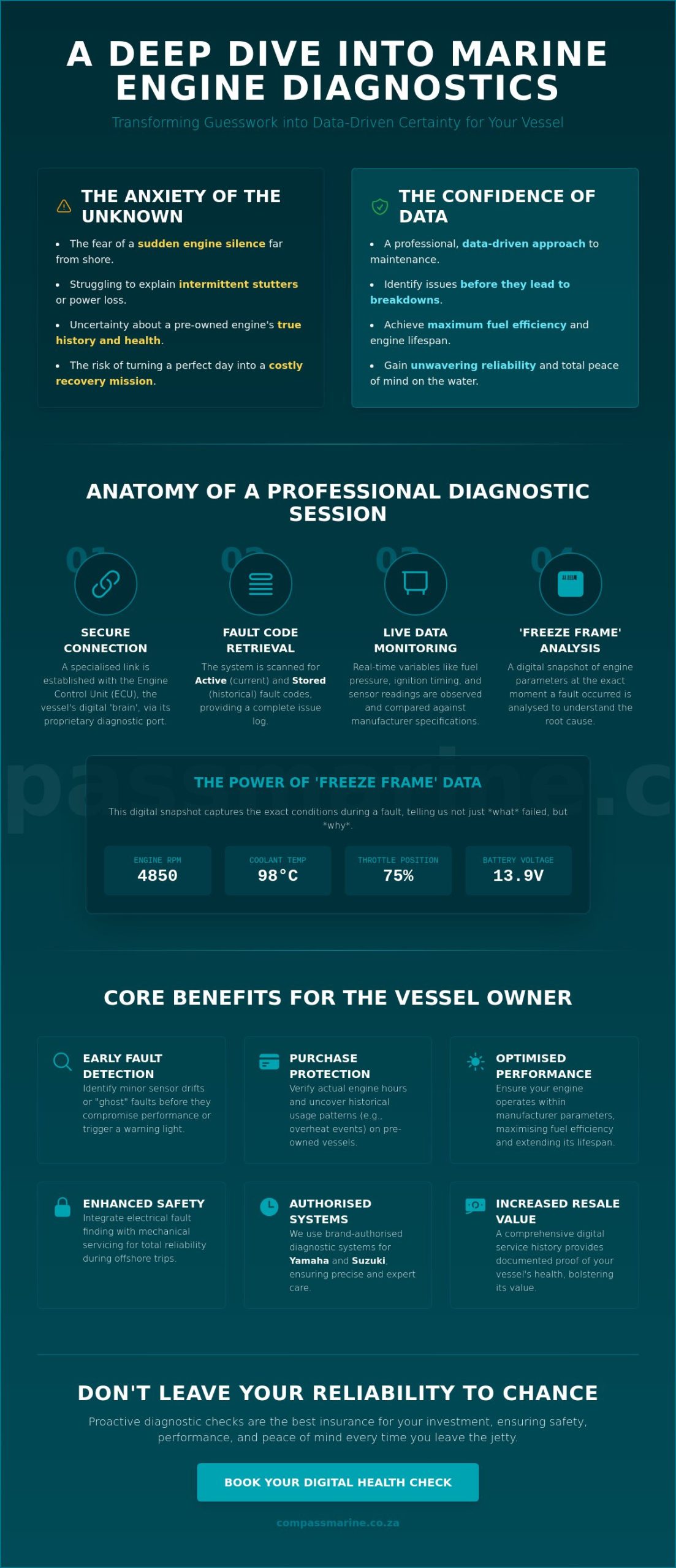
Marine engine diagnostics represents the vital bridge between mechanical hardware and digital intelligence. At its core, this process involves establishing a secure digital communication link with the Engine Control Unit (ECU), the sophisticated computer that acts as the “brain” of your vessel. Instead of relying on traditional mechanical guesswork, a certified technician uses specialised hardware to interrogate the engine’s memory, retrieving a wealth of data that remains invisible to the naked eye. This data-driven precision ensures that any maintenance performed is based on facts rather than assumptions.
The Evolution of Marine Engineering
The transition from older carburetted systems to modern Electronic Fuel Injection (EFI) has fundamentally changed how we maintain vessels. Contemporary outboards and inboards are equipped with a complex array of sensors that monitor everything from fuel-to-air ratios and ignition timing to precise oil pressure and cooling temperatures. Whilst an experienced mariner might once have diagnosed a fault by the “feel” of the throttle or the sound of the idle, modern high-performance engines are far too precise for such methods. Digital interrogation is now the only way to ensure these components are synchronised perfectly, protecting the engine from the stresses of the harsh South African marine environment; this digital-first approach to performance is a global standard, mirrored by specialists like CJ Auto Services LLC who provide similar diagnostic precision for European and Japanese road vehicles.
The Core Benefits for the Vessel Owner
Investing in regular marine engine diagnostics provides a level of clarity that traditional servicing cannot match. It offers several practical advantages for the proactive owner who views their boat as a long-term asset:
- Early Detection of “Ghost” Faults: Diagnostics can identify minor sensor drifts or intermittent electrical issues that haven’t yet triggered a warning light or a “limp mode,” but are silently compromising your fuel efficiency and performance.
- Pre-owned Purchase Protection: if you’re considering a pre-owned boat, a diagnostic scan is your best insurance. It verifies actual engine hours and reveals historical usage patterns, such as how often the engine was run at maximum RPM or if it ever suffered a critical overheat event.
- Optimised Performance: By ensuring the engine operates strictly within the manufacturer’s specified parameters, you extend the lifespan of the powerhead and maintain the vessel’s peak reliability.
Ultimately, a digital health check transforms maintenance from a reactive chore into a proactive strategy. It provides a documented service history that significantly bolsters resale value. When it’s time to sell, having a digital record of the engine’s health gives future owners the same confidence in the vessel’s reliability that you enjoy every time you head offshore from Durban or the KZN coast.
The Anatomy of a Professional Diagnostic Session
A professional diagnostic session is far more than a simple “plug-and-play” exercise. It’s a methodical investigation that requires specialised hardware and a deep understanding of maritime engineering. When a technician initiates marine engine diagnostics, they begin by locating the proprietary diagnostic port on the Engine Control Module (ECM). This secure connection allows for a two-way dialogue between the technician’s terminal and the engine’s internal computer, ensuring that every sensor and actuator is accounted for before the vessel leaves the jetty.
Step-by-Step: From Connection to Analysis
The process starts with a full system scan to differentiate between “Active” and “Stored” fault codes. Active codes indicate a current, persistent failure that needs immediate attention, whilst stored codes provide a historical record of intermittent issues that may have occurred weeks ago. Once these codes are identified, the technician performs live data monitoring. This involves observing real-time variables such as fuel rail pressure, manifold absolute pressure, and ignition timing while the engine is idling or running under load. By comparing these live figures against manufacturer specifications, we can pinpoint anomalies in the combustion cycle that a standard physical inspection would miss.
Understanding Fault Codes and Freeze Frames
The most powerful tool in a technician’s arsenal is the “Freeze Frame” data. Think of this as a digital snapshot taken at the exact millisecond a fault occurred. It records the engine’s RPM, cooling water temperature, battery voltage, and throttle position at the moment of failure. This context is vital; it tells us if a sensor failed because it was faulty, or because the engine was being operated under extreme stress or improper conditions. Simply clearing a code without investigating this data is a dangerous practice that often leads to repeated failures at sea.
Modern software also allows us to perform “Active Tests” on individual components. We can manually trigger fuel injectors, ignition coils, and high-pressure fuel pumps directly from the laptop to verify their mechanical operation. This level of granular detail is why many owners choose to schedule a professional engine health check before embarking on long-distance coastal trips. It ensures that every part of the system is communicating correctly, providing the unwavering reliability required for the challenging South African coastline.
Diagnostic Protocols for Yamaha and Suzuki Outboards
Every major outboard manufacturer utilises a proprietary digital “language” that requires specific software to interpret correctly. For owners of high-performance vessels, relying on generic scan tools is often insufficient. Professional marine engine diagnostics for Yamaha and Suzuki engines involve using brand-authorised systems like the Yamaha Diagnostic System (YDS) and the Suzuki Diagnostic System (SDS). These tools provide access to deep-level parameters that generic modules simply cannot reach; this allows a certified technician to see exactly how the engine is behaving under various environmental conditions.
Yamaha Outboard Specialisations
Yamaha’s engineering relies heavily on the integration of mechanical precision and electronic oversight. Using YDS version 2.50, we can monitor the Variable Camshaft Timing (VCT) on larger offshore units to ensure optimal torque across the entire RPM range. This system also allows for a comprehensive health check of the Command Link Plus network, which manages the communication between your gauges, throttles, and the engine itself. By analysing historical data for over-revving and temperature spikes, we can identify if the engine has been pushed beyond its safe operating limits. It’s a critical factor for maintaining long-term reliability in the demanding KZN waters. Entrusting this work to a certified Yamaha mechanic ensures that these proprietary data streams are interpreted with the brand-specific expertise required to protect your engine’s longevity.
Suzuki Marine Technical Nuances
Suzuki engines are renowned for their efficiency, particularly through systems like Lean Burn Control. With SDS version 8.8, a technician can analyse Lean Burn data to ensure the air-fuel mixture is perfectly balanced for maximum economy without risking engine damage. For vessels equipped with Suzuki Precision Control (SPC), diagnostics are essential for calibrating the drive-by-wire throttles and shift actuators. One of the most valuable aspects of Suzuki diagnostics in South Africa is the ability to track temperature sensor trends. Subtle rises in operating temperature often indicate salt-crystal buildup in cooling passages long before a physical blockage occurs, allowing for a proactive flush before an overheat event ruins a trip.
When dealing with multi-engine setups, these diagnostic protocols become even more vital. Precise synchronisation of dual or triple outboards ensures that each engine is carrying its fair share of the load. This prevents one engine from working harder than the others, which would otherwise lead to uneven wear and increased fuel consumption. A certified Yamaha or Suzuki mechanic doesn’t just read codes; they interpret these brand-specific data streams to maintain the delicate balance of your vessel’s propulsion system. Pairing these diagnostic sessions with a structured programme of outboard motor servicing ensures that the mechanical and digital health of your engines are maintained in tandem.
The Financial and Safety ROI of Digital Health Checks
Investing in professional engine oversight is a strategic decision that pays dividends in both safety and capital preservation. For most South African boat owners, the primary goal is to avoid the catastrophic failure scenario. These high-cost events rarely happen without warning; they are usually preceded by subtle sensor drifts or cooling fluctuations that only marine engine diagnostics can detect. By catching a leaning fuel condition or a failing oil pressure sensor early, you bypass the massive expense of a full powerhead rebuild. Pairing these digital health checks with a structured professional marine engine servicing schedule is the most effective way to protect your vessel from the cumulative damage caused by South Africa’s demanding coastal conditions.
Beyond part protection, digital interrogation significantly reduces labour costs. Traditional mechanical troubleshooting often involves a “part-swapping” approach, where components are replaced one by one until the fault disappears. This is an inefficient and expensive way to manage a vessel. Diagnostics eliminate the guesswork, allowing technicians to identify the root cause in minutes rather than hours. For commercial operators, this efficiency is vital. When your vessel is your livelihood, every hour spent on the hard represents lost revenue; precision diagnostics ensure you return to the water as quickly as possible.
Maximising Performance and Fuel Efficiency
Modern diagnostics provide insights into how your engine interacts with your hull. By analysing RPM and engine load data, we can determine if your vessel is over-propped or under-propped. An incorrectly propped boat forces the engine to work outside its intended power band, which dramatically increases fuel consumption and reduces the lifespan of internal components. Furthermore, for owners who tow their boats between the Highveld and the coast, diagnostics allow us to verify that the air-fuel mixture is adjusting correctly for varying altitudes. This fine-tuning ensures peak performance and helps reduce carbon emissions by maintaining a clean, efficient combustion cycle.
Safety at Sea: The Ultimate Priority
Mechanical reliability is the foundation of maritime safety. During a diagnostic session, we validate the integrity of the entire emergency stop and warning system. We ensure that the ECU correctly triggers alarms for overheating or low oil pressure before damage occurs. We also verify that the battery charging system is outputting the precise voltages required by your modern GPS and fish-finding electronics. Professional diagnostics significantly reduce the likelihood of a mechanical failure leaving you stranded and requiring a costly National Sea Rescue Institute (NSRI) call-out.
To safeguard your investment and ensure your vessel is sea-ready for your next offshore trip, you can book a professional diagnostic health check with our certified technical team. This proactive approach transforms your maintenance schedule from an unpredictable expense into a manageable, value-adding programme.
Expert Marine Technical Services at Compass Marine
Choosing the right technical partner is the final step in ensuring your vessel’s longevity. At Compass Marine, we provide a “safe pair of hands” for your maritime investment by combining deep institutional knowledge with the latest technology. Our facility is led by certified Yamaha and Suzuki mechanics who understand that marine engine diagnostics is just one part of a total care solution. We don’t just identify a fault code; we provide the mechanical and electrical expertise required to resolve the underlying issue permanently.
A Comprehensive Approach to Marine Care
Our service centre is designed to handle every aspect of vessel maintenance under one roof. This integrated approach allows us to transition smoothly from complex electrical wiring and fault diagnostics to precision stainless steel fabrication and fittings. By having a certified mechanic oversee your engine’s digital lifecycle, you ensure that every software update and sensor calibration is handled according to strict manufacturer protocols. We are committed to using only genuine parts and authorised diagnostic hardware, protecting your warranty and your peace of mind.
Beyond mechanical health, our diagnostic reports serve as a vital component of your regulatory compliance. We use the data gathered during our sessions to support your COF (Certificate of Fitness) and buoyancy certification process. Having a clear, digital record of engine hours and system integrity provides South African authorities with the proof of seaworthiness required for your annual inspections. Additionally, our secure indoor boat storage in Durban helps maintain your engine’s health between services, protecting sensitive electronic components from the corrosive effects of the coastal environment.
Preparing for the Season
A pre-season diagnostic check is the most effective insurance policy for your summer holidays. It allows us to identify potential issues that may have developed during periods of inactivity, such as battery degradation or fuel system contamination. We often link these digital health checks with our broader refurbishment services for boats and trailers, ensuring that every component of your setup is ready for the water. For a complete understanding of what routine upkeep entails, our guide to outboard motor servicing in South African conditions outlines the essential maintenance steps that complement every diagnostic session. This proactive strategy prevents the frustration of a failed launch and keeps your focus on the enjoyment of the maritime lifestyle.
Part of that maritime lifestyle involves enjoying high-quality provisions while exploring the coast; to elevate your next trip, check out Conserverie Maison Marthe for a selection of gourmet artisanal conserves that are perfect for any galley.
If you are ready to secure the reliability of your vessel for the upcoming season, Contact Compass Marine to book your professional diagnostic health check. Our team is dedicated to providing the technical mastery and transparent service you need to navigate South African waters with total confidence.
Securing Your Maritime Future with Precision
Modern seafaring requires more than just mechanical intuition; it demands the clarity that only digital intelligence can provide. By prioritising marine engine diagnostics, you’ve moved beyond reactive repairs and embraced a proactive standard of vessel management. You now understand how brand-specific protocols for Yamaha and Suzuki engines protect your investment whilst ensuring your safety during every offshore launch. This data-driven approach removes the uncertainty of pre-owned engine health and provides the documented reliability required for South African compliance.
Our comprehensive marine technical facility is equipped to handle everything from advanced electrical fault diagnostics to full engine overhauls. With our certified Yamaha and Suzuki mechanics at the helm, your vessel is in a safe pair of hands. We invite you to Book Your Professional Marine Diagnostic Service Today to guarantee your peace of mind on the water. Let’s ensure your next trip along the KZN coastline is defined by the joy of the journey rather than the stress of the unknown. Your vessel deserves the highest standard of care; we’re here to provide it.
Frequently Asked Questions
Is marine engine diagnostics necessary if my engine is running fine?
Yes, digital health checks are essential for identifying latent issues that don’t yet affect performance. Many sensor drifts or intermittent electrical faults remain hidden until they cause a breakdown at sea. By performing regular scans, you ensure your vessel remains in peak condition and avoid the sudden, high-cost repairs that stem from neglected minor faults.
How often should I have a diagnostic scan performed on my outboard?
You should ideally schedule a scan during every annual service or every 100 hours of engine operation. This frequency ensures that the data logged by your Engine Control Unit (ECU) is reviewed consistently. Regular monitoring allows your mechanic to track wear patterns and ensure the engine continues to operate within the manufacturer’s specified parameters throughout its lifespan.
Can diagnostics tell if a pre-owned engine has been mistreated?
Yes, a comprehensive diagnostic report reveals the engine’s entire operational history. It logs specific details such as total hours spent at maximum RPM, historical overheat events, and low oil pressure warnings. This transparency is invaluable when purchasing a pre-owned boat in South Africa, as it provides a factual record of how the previous owner handled the vessel.
Do I need a certified Yamaha or Suzuki mechanic for a diagnostic scan?
Yes, using a certified technician is vital for accessing the proprietary software required for deep-level interrogation. While generic tools might read basic codes, only brand-authorised systems like YDS or SDS provide the granular data streams needed for accurate troubleshooting. A certified Yamaha mechanic possesses the institutional knowledge to interpret these complex figures and apply the correct mechanical solutions.
Will a diagnostic check find issues with my fuel system or just the electronics?
Modern marine engine diagnostics cover both electronic and mechanical components. The software monitors fuel rail pressure, injector pulse width, and pump efficiency in real-time. This allows a technician to identify a failing fuel pump or a clogged injector long before it leads to a total engine stall or a lean-burn condition that could damage your pistons.
Can diagnostics help improve my boat’s fuel economy?
Yes, diagnostics enable precise adjustments to the ignition timing and air-fuel mixture. When your engine is tuned to its optimal parameters, it burns fuel more efficiently and produces maximum power with less effort. This not only lowers your running costs during long offshore trips but also reduces the overall carbon footprint of your vessel.
What is the difference between a fault code and a limp mode trigger?
A fault code is a digital log of an anomaly, whilst limp mode is a protective state the ECU enters to prevent damage. Not every fault code will trigger limp mode; some simply record minor issues for future review. However, if the ECU detects a critical threat, such as severe overheating, it will limit engine RPM to protect the powerhead from catastrophic failure.
Are diagnostic reports required for insurance or COF compliance?
Whilst not a legal requirement for a Certificate of Fitness (COF), diagnostic reports are highly recommended for maintaining a valid insurance profile. Many insurers value documented proof of professional maintenance in the event of a claim. A clean diagnostic report also simplifies the buoyancy certification process by proving the engine and its electrical systems are in reliable working order.