Could the “all-rounder” mechanic you trust with your vessel actually be the biggest threat to its long-term survival? It’s a common belief that any experienced hand can fix a modern engine, but as marine technology evolves, the gap between general knowledge and specialised expertise continues to widen. You likely prioritise regular maintenance because you want to avoid the nightmare of an engine failure whilst miles offshore. However, trusting a generalist with your high-precision hardware often leads to more anxiety than peace of mind. To truly protect your investment, partnering with a certified yamaha mechanic is no longer a luxury; it’s a technical necessity.
In this guide, you’ll discover the critical differences between generic repairs and certified Yamaha expertise. We’ll explore how proprietary tools like the YDIS 2.50 diagnostic system ensure your engine operates at peak performance whilst adhering to current EPA Tier 3 standards. You’ll gain a clear understanding of how professional certification safeguards your manufacturer’s warranty and protects your boat’s resale value. We’re here to replace the confusion of technical jargon with a structured, transparent look at what happens during a certified service, giving you the confidence to enjoy your time on the water with total peace of mind.
Key Takeaways
- Understand why decades of general mechanical experience cannot replace the brand-specific technical updates required for modern outboard systems.
- Learn how a certified yamaha mechanic utilises proprietary YDIS software to access critical data that generic diagnostic tools simply cannot reach.
- Discover the rigorous training hierarchy and testing requirements that separate a standard factory-trained technician from an elite Master Technician.
- Protect your financial investment by ensuring your service history validates your manufacturer warranty and maximises future vessel resale value.
- Recognise the value of a holistic maintenance approach that combines precision engine diagnostics with expert electrical and structural care.
Busting the Myth: Is Certification Just a Marketing Label?
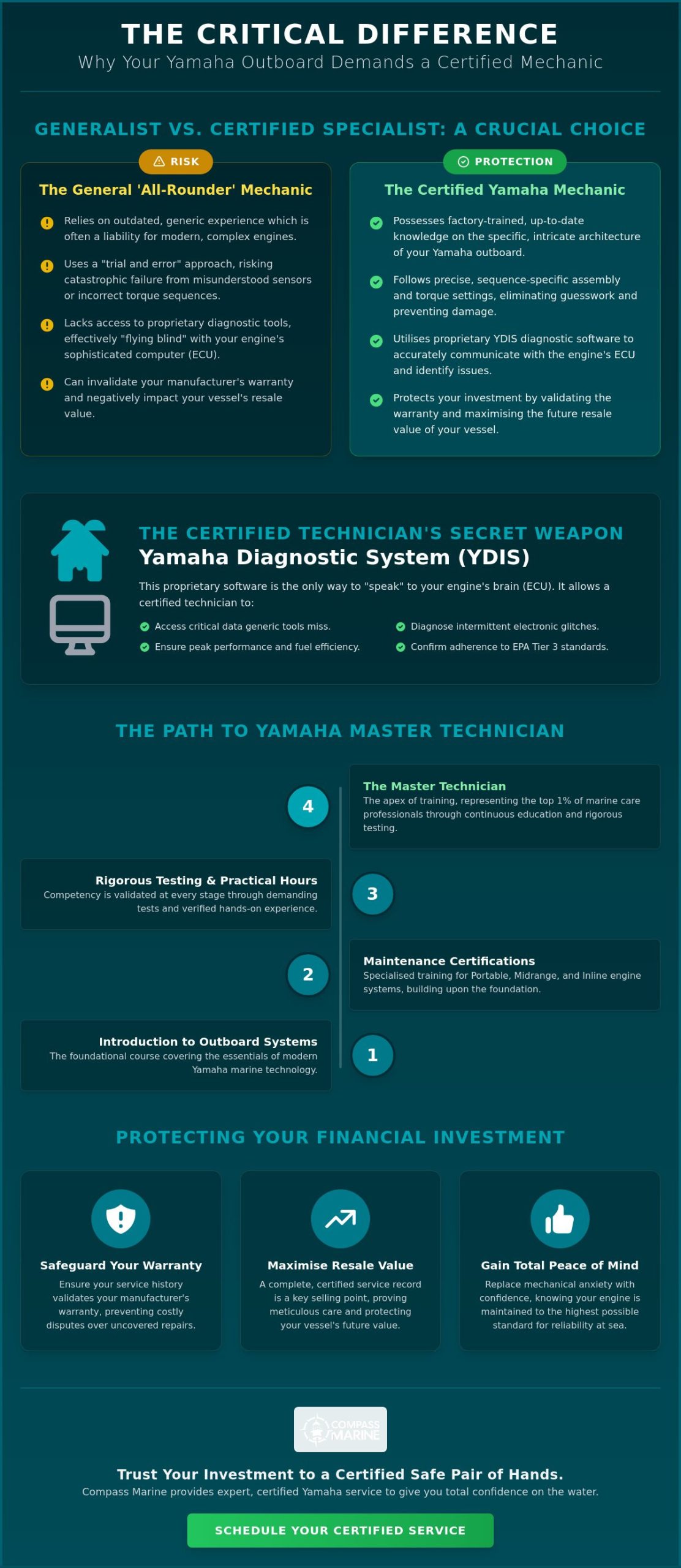
Many boat owners believe that a seasoned mechanic with decades of grease under their fingernails is always the best choice for their vessel. Whilst experience is undeniably valuable, the maritime industry has undergone a radical transformation. A certified yamaha mechanic is not simply a title designed for a marketing brochure. It represents a factory-trained specialist who has completed a structured path of education and verified practical hours. In the technical world, a professional certification serves as a guarantee that the person working on your engine understands the specific, intricate architecture of your machine.
Relying on thirty years of generic repair experience can actually be a liability. The engines produced in the late nineties share almost no DNA with today’s high-performance outboards. Without brand-specific updates, even the most well-meaning “all-rounder” is essentially guessing. Choosing a certified yamaha mechanic eliminates this guesswork and prevents the “trial and error” approach that frequently damages high-value outboards. It often leads to catastrophic failure, frequently caused by something as simple as an incorrect torque sequence or a misunderstood sensor reading. You wouldn’t let a general handyman service a modern luxury car—and you can read more about the meticulous standards Euro Performance Auto Shop LLC applies to high-end European engines—so your marine investment deserves the same level of specialised care.
The Complexity of Modern Outboard Engineering
Modern engineering has moved far beyond simple mechanical linkages and carburettors. We now see high-pressure direct injection systems and variable camshaft timing that require absolute precision to function. These systems demand specialised torque settings and sequence-specific assembly that a generalist simply won’t find in a standard workshop manual. Every component is designed to work in perfect harmony. The modern Yamaha ECU acts as the engine’s “brain,” a sophisticated computer that only certified tools can communicate with effectively. Without the ability to “speak” to this computer, a mechanic is flying blind, potentially overlooking small electronic glitches that could lead to a complete engine seize whilst you are at sea.
Why “General Marine Knowledge” is No Longer Enough
The days of fixing every problem with a standard set of spanners are gone. Yamaha-specific tolerances are now measured in microns, and proprietary sensors govern everything from fuel trim to cooling cycles. A “good mechanic” might understand the basics of internal combustion, but they lack access to the ongoing curriculum of the Yamaha Marine University. This is not a one-time course. It is an ongoing education that ensures technicians stay ahead of the curve. It covers everything from the latest EPA Tier 3 emission standards to the specific electrical wiring required for modern accessories. This level of dedication ensures that your engine remains a reliable partner for years to come, rather than a source of constant mechanical anxiety. For a deeper understanding of what routine upkeep entails, our outboard motor servicing guide outlines the essential maintenance steps required to keep your engine performing at its best in South African waters.
Mastering the Hierarchy: Understanding Technician Levels
The journey to becoming a certified yamaha mechanic is a demanding, multi-year commitment that separates the hobbyist from the professional. It’s a structured ladder of expertise. It begins with the Introduction to Outboard Systems and progresses through specific maintenance certifications for Portable, Midrange, and Inline engines. This process ensures that every technician has a foundational understanding before they move toward more complex systems. According to the U.S. Bureau of Labor Statistics, the role of a marine technician requires a sophisticated blend of mechanical aptitude and technical troubleshooting skills. Testing is not a mere formality; it is a rigorous validation of competency that must be proven at every stage.
A dealership’s “Five Star” rating serves as a vital indicator for the boat owner. This designation is not just about the tools in the workshop. It reflects a comprehensive commitment to the customer service experience and an investment in continuous staff education. Certification is also a moving target. As Yamaha pioneers new technology, such as the high-output XTO Offshore models, mechanics must return to the classroom. Stale knowledge is a risk in a field that evolves this rapidly. Regular recertification ensures that the person handling your engine is as modern as the hardware itself.
The Master Technician: The Top 1% of Marine Care
The Master Technician designation represents the absolute pinnacle of marine engineering. It’s a title held by a tiny fraction of the workforce. These individuals must typically accumulate several years of documented field experience before they are even eligible to sit for the Master Tech examinations. They are the final authority on complex engine behaviours. A Master Tech doesn’t just replace parts; they understand the intricate relationship between the engine’s electronic brain and its mechanical heart. When a vessel presents a “ghost in the machine” that stumps standard mechanics, the Master Tech provides the definitive solution.
Factory Trained vs. Self-Taught Mechanics
The most significant advantage of factory training is privileged access. Certified centres receive restricted technical bulletins and service updates that never reach the public domain or general repair shops. These documents contain vital information on parts revisions, software patches, and specific maintenance sequences. This access directly leads to significantly higher “First Time Fix” rates. A self-taught mechanic might be talented, but they are often working with an incomplete set of information. For those seeking professional marine engine servicing, this distinction is the difference between a reliable vessel and a lingering mechanical headache. If you want to ensure your boat remains a safe pair of hands for your family, you can book a technical assessment with our qualified team today.
Proprietary Diagnostics: The Secret Weapon of Certified Pros
Modern Yamaha outboards are essentially high-performance computers that operate in a harsh saltwater environment. To understand exactly what is happening beneath the cowling, a certified yamaha mechanic utilises the Yamaha Diagnostic System (YDIS). This isn’t a generic tool you can find at a local hardware store. It’s a proprietary software suite designed to communicate with the engine’s Electronic Control Unit (ECU) at a deep-layer level. Whilst a general mechanic might see a basic fault code, a certified specialist sees the entire story of the engine’s performance.
Many boaters mistakenly believe that diagnostics are a “plug and play” affair. They assume the computer simply tells the technician which part to replace. In reality, interpreting these logs requires a high degree of technical mastery. Organisations like the Equipment & Engine Training Council (EETC) emphasise that technical certification is about understanding the “why” behind the data. A certified professional looks at the relationship between different sensor readings to find the root cause of a problem. This expertise ensures that a small electronic glitch doesn’t turn into a catastrophic mechanical failure whilst you are miles offshore.
The “Engine Run History” is perhaps the most powerful feature of YDIS. It records every second of the motor’s life, including over-revving, overheat events, and oil pressure drops. This data is vital for distinguishing between operator error and genuine mechanical failure. It also reveals “intermittent faults”—those frustrating glitches that only happen occasionally—preventing a mid-ocean breakdown that could put your crew at risk. Having this data interpreted by a professional gives you a clear, objective view of your engine’s health. For vessel owners who also run inboard systems, understanding inboard engine electrical diagnostics is equally critical, as a single corroded wire hidden in the bilge can cause the same kind of intermittent power loss that stumps mechanics who rely on parts-swapping rather than root-cause analysis.
YDIS vs. Generic OBD Scanners
Generic scanners often rely on basic protocols that only scratch the surface of engine management. They might show a general fault code, but they cannot see sensor voltage history or real-time fuel pressure fluctuations. Yamaha uses proprietary protocols to shield this sensitive data from third-party tools. Essentially, marine engine diagnostics act as a preventative health check for the motor, allowing a technician to spot a declining sensor before it triggers a total system shutdown. This level of insight is simply impossible with off-the-shelf equipment.
Predictive Maintenance: Stopping Failures Before They Occur
Certified mechanics don’t just fix what is broken; they use data to predict what might fail next. By analysing cooling system pressure and temperature logs, they can often predict a water pump or thermostat failure before it happens. Software updates are another critical component. Systems like the Helm Master EX frequently receive updates that improve fuel economy and shift smoothness. Non-certified shops often resort to “parts-swapping” because they cannot see the underlying data. This blind approach leads to higher costs and longer downtime for the owner, whereas a data-driven approach ensures a “first-time fix” and total reliability.
The Warranty and Resale Myth: Protecting Your Investment
Your vessel is a significant financial asset. Protecting that asset requires more than just mechanical skill; it requires administrative diligence. Many owners don’t realise that uncertified work can jeopardise their manufacturer warranty. If a major fault occurs, Yamaha will often request a documented service history from an authorised provider. Without it, you could be left to cover the full cost of a replacement powerhead or lower unit. Hiring a certified yamaha mechanic ensures that your coverage remains intact and your investment is legally protected. This technical expertise is the only way to guarantee that your high-performance outboard is treated with the precision it requires.
Vetting your service provider is a simple but essential step. Before handing over your keys, use this checklist to confirm their credentials:
- Verify their dealer number: Authorised centres have a unique identifier provided by the manufacturer.
- Check for current certificates: Ensure training has been updated for the latest model years.
- Ask about diagnostic logs: Confirm they provide official YDIS reports with every major service.
- Confirm part origins: Insist on the exclusive use of genuine Yamalube and factory components.
Resale Value: The “Certified Service History” Premium
Savvy buyers in the pre-owned market look for one thing above all else: a stamped service log from an authorised centre. This “paper trail” is gold for resale value. It provides an objective record that the engine has never missed a critical update or a preventative maintenance milestone. In many cases, a certified service history can add a significant percentage to the final sale price. It removes the risk of “hidden” damage caused by neglect or amateur repairs. A buyer feels a deep sense of confidence knowing the engine was maintained to factory standards from day one, making your boat a far more attractive prospect on the market.
Genuine Parts and the Saltwater Challenge
The saltwater environment is unforgiving. Generic “marine-grade” oils and filters simply do not offer the same level of protection as Yamalube. These factory-formulated lubricants contain specific anti-corrosive additives designed to withstand the extreme temperatures and humidity of coastal operation. A certified yamaha mechanic understands this challenge. They prioritise the replacement of sacrificial anodes and the lubrication of specialised grease points that generalists often overlook. To understand the full scope of what a professional outboard motor servicing schedule should include in a harsh coastal environment, our comprehensive guide covers every critical maintenance interval and warning sign to watch for. To secure your vessel’s future, you can view our full range of certified services and ensure your motor receives the care it deserves.
Why Compass Marine is Your “Safe Pair of Hands”
Choosing a service provider for your vessel is a decision that impacts both your safety at sea and the longevity of your investment. At Compass Marine, we pride ourselves on being more than just a repair shop; we are your dedicated maritime partners. Our team features a certified yamaha mechanic and Suzuki specialists who represent the pinnacle of technical expertise in Durban. We understand that a boat is a complex ecosystem where mechanical reliability must be matched by structural integrity and electrical precision. This is why we offer a holistic approach that covers everything from advanced engine diagnostics to stainless steel fabrication and full vessel refurbishment.
Compliance is the bedrock of maritime safety. We handle the critical administrative and technical requirements that keep you legal and safe on the water, including COFs (Certificates of Fitness) and buoyancy certificates. Our commitment to professional calm means that we manage the complexities of regulation and repair so you don’t have to. We believe in building long-term trust through transparency and technical mastery, ensuring that every vessel leaving our care is fit for the challenges of the Indian Ocean. Our goal is to move you from a state of mechanical concern to a state of total confidence.
Comprehensive Care Beyond the Engine
A truly reliable vessel requires a coordinated effort across multiple disciplines. Our mechanics work in close partnership with our on-site chandlery and electronics experts to provide a total solution for your boating needs. Whether you are installing the latest Lowrance fish finders or require custom stainless steel fittings, our departments collaborate to ensure seamless integration. Between your adventures, our secure indoor boat storage provides a controlled environment that protects your engine and hull from the corrosive coastal elements. This comprehensive care model prioritises long-term performance over quick, temporary fixes, ensuring your boat remains in peak condition year-round.
Your Next Step to Maritime Confidence
The best way to ensure a trouble-free season is to baseline your engine’s condition before you head out. We encourage all vessel owners to book a comprehensive diagnostic health check. This assessment provides a clear, data-driven overview of your motor’s current status, identifying potential issues before they become costly failures. Safety at sea is never a matter of luck; it begins with technical mastery in the workshop. Taking a proactive approach today means you can enjoy the water with the confidence that your vessel is in the best possible hands. Contact Compass Marine to book your certified Yamaha service today and experience the peace of mind that comes from true professional expertise.
Technical Mastery for Total Maritime Peace of Mind
Protecting a high-performance outboard requires a move away from generalist “all-rounder” repairs toward technical precision. You’ve seen how specific factory training and advanced YDIS diagnostic logs are the only ways to truly verify engine health whilst safeguarding your manufacturer’s warranty. By prioritising a certified yamaha mechanic, you aren’t just fixing a motor; you’re investing in the long-term reliability and resale value of your vessel. These standards ensure that every component, from the electronic brain to the mechanical heart, operates within factory tolerances.
At Compass Marine, we bring decades of professional marine technical experience and specialised YDIS diagnostic capabilities to every service. Our on-site team of certified Yamaha and Suzuki mechanics provides the expert care and professional calm your investment deserves. We understand that your time on the water is precious, and safety begins with precision in the workshop. Don’t leave your family’s safety at sea to chance or outdated methods. Take the proactive step toward total maritime confidence today.
Secure your vessel’s future with a certified Yamaha service at Compass Marine
We look forward to helping you enjoy every moment on the water with the unwavering reliability you expect from a world-class engine.
Frequently Asked Questions
How can I verify if a mechanic is truly a certified Yamaha technician?
You can verify a technician’s credentials by asking to see their current Yamaha training certificates or checking the business’s official dealer number. Authorised service centres are listed on the manufacturer’s official network. A genuine certified yamaha mechanic will have completed specific courses such as the Introduction to Outboard Systems (ITOS) and subsequent maintenance modules. This documentation ensures the technician has proven their competency through rigorous testing rather than just attendance.
Will using a non-certified mechanic automatically void my Yamaha warranty?
Using a non-certified mechanic won’t automatically void your warranty, but it places your coverage at significant risk. If a mechanical failure occurs, Yamaha often requires proof that the engine was maintained according to factory standards using genuine parts. If an uncertified hand performs incorrect work that leads to a fault, the manufacturer can legally deny your claim. Maintaining a certified service history is the safest way to ensure your warranty remains valid.
Is there a difference between “factory-trained” and “Master Technician”?
There is a significant difference in the level of expertise and experience required for these titles. Factory-trained technicians have completed the initial core modules for specific engine ranges. In contrast, a Master Technician represents the elite top tier of the industry. These professionals must have several years of field experience and pass a comprehensive examination covering advanced troubleshooting and complex system integration. It’s the highest level of technical mastery available.
What specific tools do certified Yamaha mechanics have that others do not?
Certified technicians have exclusive access to the Yamaha Diagnostic System (YDIS) and restricted technical bulletins. They also use brand-specific speciality tools designed for tasks like flywheel removal or fuel injector testing on modern high-pressure systems. These proprietary tools allow for precision that generic equipment cannot match. Without this specialised hardware, a mechanic is often forced to use “workarounds” that can damage sensitive, high-value components over time.
How often should my Yamaha outboard be serviced by a professional?
You should have your outboard professionally serviced every 100 hours of operation or at least once every twelve months, whichever comes first. This schedule ensures that critical components like water pumps, spark plugs, and sacrificial anodes are inspected before failure. Regular professional attention helps maintain peak performance and prevents the build-up of salt and corrosion in cooling passages. Frequent checks are especially vital for engines operating in harsh coastal environments.
Does a certified service history actually increase the resale value of my boat?
A certified service history significantly enhances the resale value of your vessel by providing transparency and peace of mind to buyers. Savvy purchasers look for a stamped service book from an authorised centre as proof that the engine has been maintained to factory standards. This documentation often allows you to command a higher price. It proves that the motor hasn’t suffered from neglect or amateur repairs, making your boat a more secure investment.
Can a certified Yamaha mechanic also work on my Suzuki or Mercury engine?
Many certified professionals hold multiple qualifications, such as being a certified yamaha mechanic and a Suzuki specialist. At Compass Marine, our team is trained across both brands to provide a comprehensive service. Whilst the mechanical principles are similar, each brand requires specific diagnostic software and technical knowledge. You should always confirm that your chosen centre has the correct tools and training for your specific engine brand before booking.
What is YDIS, and why is it important for my outboard engine service?
YDIS stands for the Yamaha Diagnostic System, which is the proprietary software used to communicate with your engine’s ECU. The latest version, YDIS 2.50, is compatible with most models from 2010 through to 2026. It allows technicians to see live engine data, run history, and fault codes that generic scanners cannot access. This tool is essential for identifying intermittent glitches and ensuring your engine meets current EPA Tier 3 emission standards.