You’re pushing through a heavy swell off the KwaZulu-Natal coast when the steady rhythm of your engine suddenly falters. For many Durban boaters, this isn’t just a stressful thought; it’s a genuine fear that often stems from inconsistent outboard motor servicing. Neglecting these routine checks doesn’t only risk a breakdown in the surf; it frequently leads to major repair costs that could have been avoided with proactive care.
We understand that manufacturer intervals can be confusing and that our local marine environment is particularly harsh on your equipment. You want the peace of mind that comes with a reliable engine, a valid warranty, and a high resale value. This guide provides a professional perspective on maintaining your outboard for peak performance in South African waters. We’ll outline the essential steps for routine upkeep, explain the warning signs of mechanical fatigue, and clarify which tasks require a certified technician to ensure your safety offshore.
Key Takeaways
- Comprehensive outboard motor servicing involves far more than a simple oil change; it is a meticulous technical inspection designed to prevent mechanical failure in the surf.
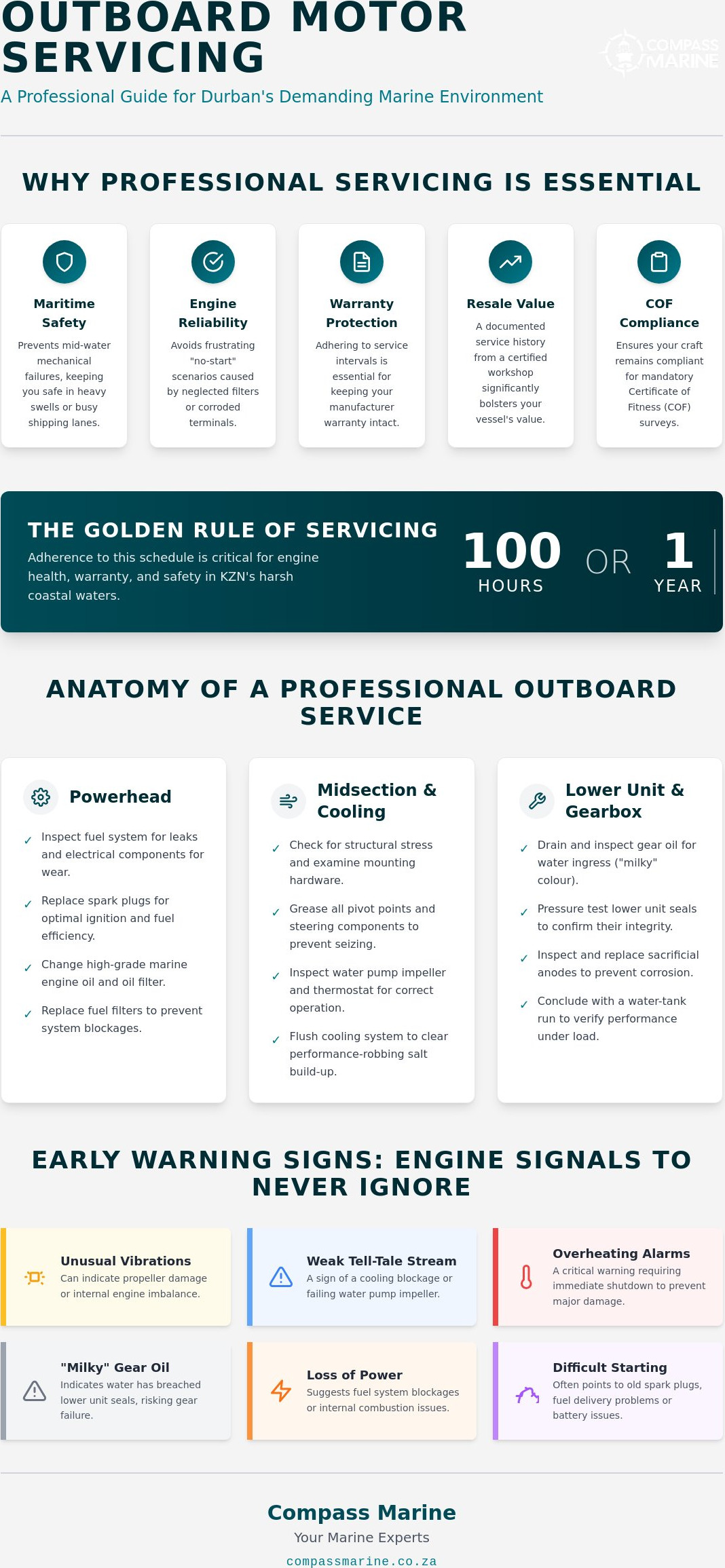
- Adhering to the 100-hour or annual service interval is essential for maintaining your manufacturer warranty and ensuring engine reliability in Durban’s demanding marine conditions.
- Recognising early warning signs, such as changes in the tell-tale stream or unusual vibrations, can save you from the high costs of major powerhead repairs.
- Managing galvanic corrosion through the regular inspection and replacement of sacrificial anodes is a non-negotiable task for any vessel operating in high-salinity coastal waters.
- Professional maintenance not only guarantees peace of mind during offshore trips but also ensures your craft remains compliant for COF surveys whilst protecting its resale value.
What is Outboard Motor Servicing and Why is it Essential?
Professional outboard motor servicing is a comprehensive technical audit that goes far beyond a basic oil change. Whilst some owners believe that swapping out a filter and checking the dipstick constitutes a full service, a professional workshop approach involves a deep-dive into the engine’s mechanical and electrical integrity. In the demanding conditions of the South African coastline, this process is your primary defence against the corrosive effects of saltwater and the high humidity levels found in Durban.
Preventative maintenance is the cornerstone of maritime safety. A well-maintained engine rarely fails without warning; instead, it provides subtle signals that only a trained eye can detect. By identifying these issues early, you avoid the risk of a mid-water mechanical failure that could leave you stranded in a heavy swell or a busy shipping lane. The standard for technical reliability is universal across the globe, from local South African craft to the long history of shipping support provided by Panama Ship Service at the Panama Canal. Beyond safety, regular servicing is a sound financial strategy. A documented service history from a certified workshop significantly bolsters the resale value of your vessel and ensures that your manufacturer warranty remains intact.
The Core Components of a Marine Service
A thorough service covers the three main sections of the engine: the powerhead, the midsection, and the lower unit. To understand the complexity of these machines, it helps to review the fundamentals of What is an Outboard Motor? and how its integrated design requires specialised tools for proper adjustment. The powerhead inspection involves checking for fuel leaks and electrical wear, whilst the midsection is examined for structural stress. The lower unit requires a gear oil change and a pressure test to ensure seals haven’t been compromised by discarded fishing line.
The cooling system is arguably the most vulnerable part of an outboard. Salt crystals can build up within the water jackets, restricting flow and leading to overheating. A professional service includes an inspection of the water pump impeller and the thermostat, components that are often overlooked during basic owner checks. Whilst an owner can perform routine tasks like flushing the engine with fresh water, technical workshop requirements involve diagnostic software and precision adjustments that ensure the engine runs at its peak efficiency.
Reliability on the Water
Engaging in professional marine engine servicing is the most effective way to prevent “no-start” scenarios at the boat ramp. These frustrating moments are often caused by neglected fuel filters or corroded battery terminals, issues that are easily rectified during a scheduled service. When you know your engine has been meticulously checked, the stress of offshore angling or family trips evaporates. This peace of mind allows you to enjoy the water, knowing that your vessel is seaworthy and your investment is protected against the harsh KZN environment.
The Essential Steps of a Professional Outboard Service
A professional service begins long before the first bolt is turned. We initiate the process with a comprehensive visual inspection, looking for hairline cracks in the cowling, salt encrustation around gaskets, and signs of heat stress on the powerhead. This stage is vital for identifying external symptoms that might indicate deeper internal issues. Once the initial audit is complete, we proceed to replace vital consumables. This includes high-grade marine oils, fuel filters, and spark plugs. In our local KZN environment, these components face rapid degradation due to high humidity and salt air, making their regular replacement non-negotiable for engine health.
Modern outboard motor servicing also requires a deep-cleaning and synchronisation of the fuel delivery system. Whether your engine uses carburettors or sophisticated electronic fuel injection, ensuring that every cylinder receives the correct fuel-to-air ratio is essential for smooth idling and throttle response. We also focus heavily on the chassis of the motor, applying marine-grade grease to all pivot points and steering components. This prevents the common and costly issue of steering arms seizing due to saltwater ingress. The process concludes with a final pressure test and a water-tank run, where we verify that the cooling system and gear shifts operate perfectly under load.
Managing the Lower Unit and Gearbox
The lower unit lives a hard life submerged in Durban’s coastal waters. During a service, we drain the gear oil and inspect it for a “milky” appearance. This discolouration is a clear sign that water has bypassed the seals and is emulsifying the oil, which can lead to catastrophic gear failure if left unchecked. We perform a vacuum and pressure test on the gearbox to ensure watertight integrity. Our technicians also remove the propeller to check the shaft for discarded fishing line, a silent killer that can easily cut through rubber seals and invite saltwater into the housing.
The Role of Advanced Diagnostics
Modern outboard engines are as much about software as they are about hardware. Many DIY enthusiasts overlook the importance of marine engine diagnostics during their maintenance routines. Using specialised interface tools, we can access historical fault codes on Yamaha and Suzuki engines that aren’t always apparent during a standard test run. This allows us to identify intermittent sensor failures or cooling spikes that happened weeks ago. By calibrating these sensors and reviewing run-time data, we ensure your engine operates at peak efficiency whilst maintaining its long-term reliability. If you haven’t had a digital health check recently, it’s a wise addition to your maintenance schedule.
Recognising Warning Signs and Service Intervals
Maintaining a strict schedule is the most effective way to ensure your engine remains dependable. For new or rebuilt units, the 20-hour break-in service is non-negotiable. This initial check allows a technician to drain the oil and remove any microscopic metal shavings produced as new components seat together. Once this milestone is passed, the industry standard for outboard motor servicing transitions to the 100-hour or annual rule. Even if you haven’t reached 100 hours of run-time, the internal lubricants and rubber seals degrade over time, especially in the humid KZN climate.
Your engine often communicates its needs through subtle changes in behaviour. The “tell-tale” water stream is your primary indicator of cooling system health. If the stream appears weak, erratic, or excessively hot, it suggests a blockage in the water jackets or a failing impeller. Similarly, any new vibration felt through the throttle or steering, or a sudden change in the engine’s acoustic profile, warrants an immediate inspection. These symptoms often precede mechanical failure and should never be ignored whilst at sea.
Durban’s high ambient temperatures can cause fuel to stabilise poorly during the off-season. Stale fuel is a leading cause of “no-start” issues and poor performance. Over time, petrol loses its volatility and can form a gummy residue that clogs injectors or carburettor jets. If your boat has been sitting in storage for several months, it is vital to check the fuel system integrity before your next launch to avoid mid-water stalling.
When to Call a Professional Mechanic
Certain visual cues require the expertise of a technician. If you notice salt-crust buildup around the thermostat housing or gaskets, it indicates a slow leak that could lead to external corrosion or overheating. Performance issues like “bogging down” under heavy load often point to fuel restriction or ignition timing faults. You should also pay close attention to exhaust smoke colours. White smoke typically indicates steam or a head gasket issue; blue smoke suggests the engine is burning oil; and black smoke points to an overly rich fuel mixture or faulty injectors. Electrical faults can produce similarly confusing symptoms, and owners of inboard vessels may benefit from reviewing a dedicated inboard engine electrical diagnostics checklist to rule out wiring issues before assuming a mechanical cause.
The Importance of Genuine Parts
Quality assurance starts with the components used during maintenance. A certified yamaha mechanic will always prioritise OEM (Original Equipment Manufacturer) filters, spark plugs, and lubricants. Whilst “will-fit” aftermarket parts may seem cost-effective, they often lack the precise tolerances required for high-stress marine environments. Using non-approved components can compromise your engine’s longevity and, crucially, may void your manufacturer warranty. Sticking to genuine parts ensures that every component is designed to withstand the specific rigours of saltwater operation.
Combating Saltwater Corrosion and Coastal Challenges
Durban’s coastline is one of the most aggressive marine environments globally. The high salinity of the Indian Ocean combined with KwaZulu-Natal’s relentless humidity creates a perfect storm for electrolysis and galvanic corrosion. Electrolysis occurs when stray electrical currents accelerate the breakdown of metal components, whilst galvanic corrosion happens when two dissimilar metals are submerged in saltwater. Without intervention, these chemical processes will literally eat through your engine’s alloy components, leading to porous metal and structural failure.
Sacrificial anodes are your engine’s primary line of defence. These blocks of zinc or aluminium are designed to corrode so that your engine doesn’t. During routine outboard motor servicing, we meticulously check every anode. A common rule of thumb is to replace them once they have degraded by 50%. Ignoring a wasted anode is a costly mistake that leads to permanent damage to the midsection and lower unit, often requiring the replacement of entire components rather than simple parts.
Coastal humidity is another silent threat that many boaters overlook. In KZN, the air is thick with salt-laden moisture that penetrates the cowling and settles on electrical terminals. This leads to “green death”—the copper oxidation that causes intermittent electrical faults and “no-start” scenarios. We apply specialised marine-grade dielectric greases and corrosion blockers to all connections to ensure your wiring remains conductive and protected from the elements. For a deeper understanding of how corroded wiring can trigger complex faults, our guide on inboard engine electrical diagnostics provides a thorough technical checklist that applies equally to diagnosing hidden wiring issues across all marine engines.
Internal Cooling System Protection
When saltwater sits inside an engine, it evaporates and leaves behind salt crystals. These crystals eventually form hard blockages in the narrow water jackets surrounding the cylinders, leading to hotspots and potential engine seizure. We recommend a thorough flushing process using fresh water after every outing in the harbour or offshore. For superior protection, using a salt-neutralising solution during the flush helps dissolve existing deposits that fresh water alone cannot budge. Always monitor your tell-tale for consistent flow; a hot or weak stream suggests that salt buildup is already restricting your cooling capacity.
External Armour: Paint and Polishes
The exterior of your motor requires a dedicated maintenance regime to survive the local climate. We use professional corrosion inhibitors on the powerhead to create a moisture-repellent barrier that doesn’t attract dust. Protecting the cowling and midsection from Durban’s intense UV rays is equally important, as sun damage can make the plastic brittle and prone to cracking. We also prioritise the use of high-quality stainless steel fittings to prevent “tea staining” and structural rust. If you want to ensure your engine survives the harsh KZN coast, book an outboard engine service with our technical team to secure your investment.
Professional Solutions for Long-Term Engine Health
Professional engine maintenance is the foundation of a seaworthy vessel, but it shouldn’t exist in isolation. Effective outboard motor servicing integrates seamlessly with broader marine technical services to ensure every system on your boat works in harmony. Whilst the powerhead and gearbox are the heart of the machine, their performance depends entirely on the integrity of your fuel lines, electrical looms, and steering hydraulics. Neglecting these peripheral systems often leads to mechanical failure, even if the engine itself is internally sound.
There is also a direct link between mechanical health and your legal standing on the water. In South Africa, passing your annual Certificate of Fitness (COF) survey requires more than just valid flares and lifejackets. A surveyor needs to be confident that your propulsion system is reliable enough to handle an offshore emergency. A well-serviced engine is a prerequisite for safety compliance, as a breakdown in the surf zone isn’t just an inconvenience; it’s a life-threatening situation. Maintaining a detailed service log is essential for these regulatory audits and provides vital documentation for insurance claims should an incident occur.
Compliance and Safety Certification
Our technicians play a critical role in verifying the functionality of your Cat C safety equipment during a routine service. We check that your battery isolation switches are functioning and that your fuel shut-off valves are accessible and operational. This level of scrutiny ensures that your vessel remains compliant with SAMSA regulations. Keeping an organised service record also helps maintain the validity of your buoyancy certificates, providing a clear history of professional oversight that protects both your safety and your financial investment.
Comprehensive Vessel Care
Total vessel reliability requires a holistic approach that combines engine servicing with trailer inspections and hull maintenance. In Durban, wheel bearings on trailers are notorious for failing due to saltwater immersion, often at the most inconvenient times. We recommend aligning your engine service with a thorough trailer audit to ensure your journey to the ramp is as smooth as your time on the water. Additionally, preparing your vessel for the off-season involves more than just a wash-down; just as you might explore Standard Wash services at East Coast Parking when using cruise terminal parking in Brisbane, professional indoor storage is one of the most effective ways to protect a newly serviced engine from the corrosive KZN humidity.
For boaters who demand unwavering reliability, partnering with a seasoned expert is the only way to guarantee long-term engine health. Whether you require a certified Yamaha or Suzuki outboard service, our team provides the technical mastery needed to keep you on the water. By combining preventative maintenance with a proactive approach to safety, we ensure your vessel remains a source of leisure rather than a source of stress. Contact Compass Marine to discuss a tailored maintenance plan that covers your engine, trailer, and storage requirements.
Secure Your Reliability on the Water
Maintaining a high-performance vessel in KwaZulu-Natal requires a proactive approach to mechanical care. Professional outboard motor servicing is the most effective way to shield your investment from the aggressive effects of saltwater corrosion and coastal humidity. By adhering to strict service intervals and prioritising the use of genuine parts, you ensure that your engine remains a dependable partner for every offshore launch or harbour cruise; protecting your safety and your boat’s resale value simultaneously.
At Compass Marine, we bring decades of maritime expertise to every technical audit. Our workshop is equipped with comprehensive electrical diagnostics to uncover hidden faults, and our certified Yamaha and Suzuki mechanics are dedicated to craftsmanship that exceeds industry standards. Whether you’re preparing for a COF survey or planning a long-distance angling trip, we provide the technical mastery and peace of mind you deserve. Book your professional outboard motor service with Compass Marine today and enjoy the confidence that comes from expert care. We look forward to seeing you at the water’s edge.
Frequently Asked Questions
How often is servicing required for an outboard motor in South Africa?
You should follow the 100-hour or annual service interval, whichever comes first. In KwaZulu-Natal, the annual check is critical even if you haven’t used the boat frequently, as the high humidity and salt air can degrade internal seals and fuel quality whilst the vessel is stationary. This ensures that your engine remains reliable for your next launch into the Durban swell and keeps your manufacturer warranty intact.
Is it possible to perform my own outboard motor servicing?
Whilst owners can handle basic tasks like flushing and external cleaning, professional outboard motor servicing requires specialised diagnostic tools and technical expertise. Modern engines rely on sophisticated electronics that store fault codes which only a certified technician can access and interpret. Professional oversight also guarantees that your maintenance history is valid for insurance purposes and protects your engine’s future resale value.
What causes a weak or non-existent tell-tale water stream?
A failing water pump impeller or a salt blockage in the cooling passages are the most common culprits. If the stream is hot, weak, or completely absent, you must shut down the engine immediately to prevent catastrophic overheating. In our local waters, salt crystals can quickly bridge narrow cooling jackets, making it essential to have the cooling system professionally inspected and the impeller replaced during your annual service.
How can I tell if my gearbox oil has been contaminated?
Contaminated gear oil typically takes on a milky or creamy appearance, which indicates that water has breached the lower unit seals. You can check this by loosening the bottom drain plug and inspecting the first few drops of oil. If you find discolouration, it is vital to have the seals pressure-tested and replaced before the water causes permanent damage to the gears or bearings, often caused by discarded fishing line.
What are the key differences between a 2-stroke and 4-stroke service?
A 4-stroke service focuses heavily on the lubrication system, including engine oil and filter replacements similar to a motor vehicle. Conversely, a 2-stroke service prioritises the fuel system and carburettor or injector synchronisation, as these engines lack an internal oil sump and rely on oil-mixing. Both types require lower unit gear oil changes, spark plug replacement, and a thorough inspection of the cooling system to handle the rigours of saltwater operation.