
You’re halfway through a routine engine service in the Durban humidity when a single, seized bolt snaps off flush with the block. What should have been a straightforward maintenance task quickly transforms into a costly, multi-day extraction project. This scenario is a common reality for many local boaters who underestimate the aggressive nature of the Indian Ocean. Choosing the right marine fasteners Durban is not just about aesthetics; it’s a critical safety decision that affects the long-term reliability of your vessel.
We understand how frustrating it is to deal with rust stains on a fresh refurbishment or the hidden danger of crevice corrosion in a transom mount. You want to spend your time on the water, not fighting with degraded hardware. This guide will help you navigate the technical differences between stainless steel grades and show you how to implement a maintenance routine that keeps your boat secure. We’ll explore why Grade 316 is the non-negotiable standard for our coastline, how to prevent galvanic reactions between dissimilar metals, and the specific signs of failure to look for before your next COF inspection.
- Prioritise Grade 316 (A4) stainless steel for all external and structural fittings to ensure long-term resistance against the high-salinity Indian Ocean environment.
- Always apply a marine-grade anti-seize lubricant or dielectric barrier when installing hardware to prevent catastrophic seizing and galvanic corrosion.
- Replace nyloc nuts and inspect structural bolts during every engine service to maintain safety in high-vibration outboard environments.
- Ensure all safety equipment and deck hardware are secured with premium hardware to guarantee compliance during your annual COF survey.
- Sourcing the correct marine fasteners Durban from a professional chandlery reduces long-term maintenance costs and protects your vessel’s resale value.
The Fundamentals of Marine Fasteners and Saltwater Corrosion
Durban’s coastal conditions are amongst the most aggressive in the world for metal components. Marine fasteners are hardware specifically engineered to survive these high-salinity environments without losing structural strength. When standard steel meets saltwater, a rapid chemical reaction occurs. The chloride ions in the Indian Ocean act as a catalyst, accelerating oxidation and turning iron into iron oxide, or rust, at an alarming rate. This isn’t just a cosmetic issue. For a boat owner, a rusted bolt represents a potential point of mechanical failure that could happen at the worst possible moment out at sea.
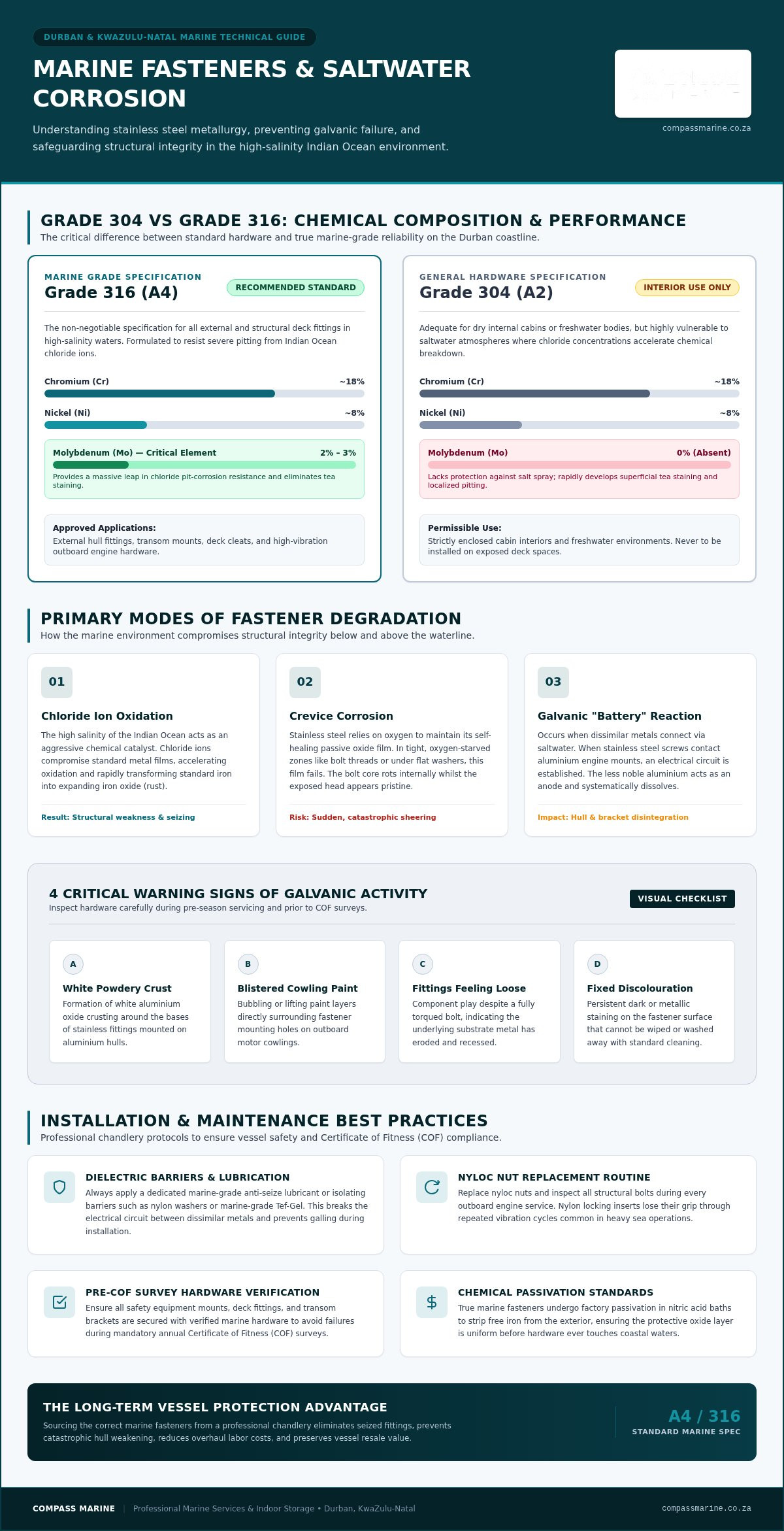
One of the most dangerous forms of degradation is crevice corrosion. This occurs in tight, oxygen-starved spaces like the threads of a bolt or the area behind a washer. Since stainless steel requires oxygen to maintain its protective film, these sealed areas become vulnerable. If a bolt fails internally while the head looks perfectly clean, the structural integrity of your engine mount or cleat is compromised. This is why choosing the correct marine fasteners Durban is a matter of safety, not just maintenance.
What Makes a Fastener ‘Marine Grade’?
A true marine fastener relies on a specific metallurgical balance. High-quality marine grade stainless steel contains significant levels of chromium and nickel. These elements react with oxygen to form a microscopic, self-healing oxide layer on the surface. Standard galvanised steel lacks this internal chemistry; once the thin zinc coating is scratched or weathered, the core metal begins to rot immediately. Professional manufacturers also use a process called passivation. This involves a nitric acid bath that removes surface iron and ensures the protective oxide layer is uniform and robust before the fastener ever reaches the water.
The Threat of Galvanic Corrosion
Galvanic corrosion is often called the “battery effect” because it involves the flow of electrical current between two different metals. When you drive a stainless steel screw into an aluminium outboard motor bracket, the saltwater acts as an electrolyte. The aluminium, being the less noble metal, becomes an anode and begins to dissolve to “protect” the stainless steel. This results in the softer metal literally crumbling away over time.
Signs of galvanic activity to look for during a pre-season check include:
- White, powdery crusting around the base of stainless fittings on aluminium hulls.
- Bubbling or blistering paint near fastener holes on outboard engine cowlings.
- Fittings that feel loose despite the bolt being tight, indicating the surrounding metal has recessed.
- Discolouration on the fastener itself that doesn’t wipe away with a cloth.
Using the wrong screw in an aluminium component is a critical mistake that can lead to permanent damage. Always ensure you’re using an insulating barrier, such as a nylon washer or a dedicated marine-grade Tef-Gel, to break the electrical circuit between dissimilar metals.
Grade 304 vs 316 Stainless Steel: The Comparison for Boaters
Choosing between Grade 304 and 316 stainless steel is a decision that defines the lifespan of your hardware. While these two metals appear identical on a chandlery shelf, their performance in the Indian Ocean differs significantly. Grade 304, often referred to as A2 in technical catalogues, is composed of roughly 18% chromium and 8% nickel. It is a robust material, but it lacks the critical element required to survive the high-chloride environment of the KwaZulu-Natal coastline. For effective marine fasteners Durban, you must look for Grade 316, also known as A4.
The “secret ingredient” in Grade 316 is molybdenum. This addition, typically between 2% and 3% of the total mass, provides a massive leap in corrosion resistance. The British Stainless Steel Association offers a technical selection of 316 and 304 stainless steels for seawater applications, which clarifies that 304 is highly susceptible to pitting when exposed to salt spray. Visually, 304 will often “tea stain”, developing a superficial brown film that ruins the aesthetic of your boat. Grade 316 stays bright and maintains its structural integrity far longer, making it a superior investment for your vessel’s long-term value.
When Can You Use Grade 304?
Grade 304 has its place, but it shouldn’t be on your deck. It’s appropriate for freshwater environments or internal cabin fittings that are completely shielded from the elements. You might use A2 screws for a galley cabinet door or a dry storage locker under a bunk. Using 304 for hull fittings or cleats is a mistake that leads to internal weakening. You can identify the grade by checking the bolt head; A2 denotes 304, whilst A4 signifies the marine-grade 316 you need for external use.
The 316 Advantage in Saltwater
The primary benefit of Grade 316 is its resistance to chloride-induced stress corrosion cracking. In our subtropical climate, the combination of high humidity and heat accelerates chemical reactions. Grade 316 is the industry standard for professional marine stainless steel fabrication Durban because it handles these conditions without failing. It provides peace of mind for critical components like transom bolts, steering linkages, and fuel tank straps.
While 316 hardware has a slightly higher initial cost, it reduces long-term maintenance expenses by avoiding the need for frequent replacements. If you are unsure which grade of hardware is currently securing your deck fittings, our team at Compass Marine can conduct a thorough inspection of your stainless steel fittings during your next scheduled service to ensure everything is up to standard.
Essential Fastener Categories for Marine Maintenance and Repair
Maintaining a vessel in KZN requires a precise understanding of hardware categories. A one-size-fits-all approach often leads to mechanical failure or damage to the hull. When sourcing marine fasteners Durban, you must match the fastener type to the specific mechanical load and environmental exposure it will face. At Compass Marine, we ensure our chandlery is stocked with the specific categories required for local conditions, helping you avoid the common pitfalls of using incorrect hardware.
Structural Bolts and Nuts
Structural integrity often hinges on the reliability of hex bolts and nuts, particularly for engine mounts and trailer assemblies. In the high-vibration environment of an outboard motor, standard nuts can work loose over time. We always recommend using nyloc nuts, which feature a nylon insert that grips the bolt threads to prevent accidental loosening. It’s also vital to select the correct bolt length. If a bolt is too long, it may “bottom out” in a blind hole, providing a false torque reading while leaving the joint loose. For those maintaining trailers, remember that these fasteners endure repeated submersion in saltwater. Regular inspections are critical, as trailer hardware often faces the most severe corrosion resistance of stainless steel in seawater challenges due to trapped salt and lack of rinsing.
Deck and Cabin Screws
Securing accessories to a fibreglass deck requires self-tapping screws designed for marine use. For areas with foot traffic, counter-sunk screws are the safest choice as they sit flush with the surface, preventing trips or snags. Pan-head screws are better suited for trim and internal fittings where a flat bearing surface is needed. Regardless of the head style, using a wide washer is essential when fastening to fibreglass. This distributes the clamping force over a larger area, preventing the gelcoat from cracking under stress. While Phillips drive screws are common, some mariners prefer slotted heads for external fittings because they are easier to clean if they become clogged with salt or polish.
Electrical panels and precision instruments rely on machine screws for exact fitment. These fasteners have finer threads and require a pre-tapped hole or a matching nut. Beyond standard screws, your maintenance kit should include specialised hardware such as U-bolts for bow eyes, eye bolts for safety tethers, and shackles for anchor rigging. Each of these components must meet the same high standards for corrosion resistance to ensure your vessel remains seaworthy. When you browse the marine fasteners Durban available at our technical store, you’ll find that we prioritise A4-grade components to ensure your repairs last the distance.
Best Practices for Installing and Maintaining Marine Hardware
Correct installation is the first line of defence against the harsh Indian Ocean. Even the highest quality marine fasteners Durban can fail if they are fitted incorrectly. One of the most common mistakes boat owners make is installing hardware “dry”. When stainless steel meets aluminium in a saltwater environment, the resulting galvanic reaction can fuse the metals together. This makes future repairs nearly impossible without drilling out the fastener. Always apply a high-grade, marine-specific anti-seize lubricant or a dielectric barrier paste to threads before assembly.
Preventing Seized Bolts
Seizing is a particular risk for outboard engine bolts and transom fittings. When mounting an engine, the torque must be applied evenly and to the manufacturer’s exact specifications. Over-tightening can strip the threads in soft alloy blocks, while under-tightening allows for vibration that leads to fatigue. For stainless-to-aluminium connections, we recommend using PTFE-based pastes that provide a physical barrier between the two metals. If you encounter a stubborn bolt, avoid using excessive force immediately. Instead, use a penetrating oil and gentle heat to break the salt bond. We prioritise these preventative measures during every professional marine engine servicing to ensure your vessel remains easy to maintain.
Cleaning and Passivation Maintenance
Routine cleaning is essential to preserve the passive oxide layer of your hardware. After a day of heavy spray off the KZN coast, rinse all deck fittings with fresh water to remove salt crystals. If you notice “tea staining” or superficial brown spots, use a dedicated marine stainless cleaner to restore the finish. However, be vigilant for “bleeding” rust. If rust streaks are running from beneath a fitting, it often indicates internal crevice corrosion. At this stage, cleaning is no longer enough. For the sake of safety, the fastener should be removed and replaced with new A4-grade hardware from our chandlery.
Fasteners and Compliance
Hardware integrity is a key component of maritime safety and legal compliance. Corroded or loose fasteners are a common reason for a failed COF certificate for boats. Surveyors pay close attention to safety equipment brackets and steering linkages, especially for Category C vessels operating offshore. Trailer fasteners must also be checked for road-legal compliance in South Africa. A rusted U-bolt on an axle can lead to a catastrophic failure on the highway. If you are preparing for an inspection, you can contact our Durban workshop to assist with a pre-survey hardware check.
Professional Marine Fasteners Durban: The Compass Marine Advantage
At Compass Marine, we treat hardware as the foundation of seaworthiness. Our technical store and chandlery for quality marine hardware in Durban are curated specifically for the Durban maritime community, ensuring that every component we stock can withstand the local climate. We don’t just sell components; we use them daily in our workshop. Our certified Yamaha and Suzuki mechanics prioritise Grade 316 stainless steel for every engine service and mechanical repair. This commitment ensures that the work we do today won’t be undone by corrosion in six months, providing you with long-term peace of mind.
For boaters with unique requirements, we offer custom stainless steel fabrication and fittings. Whether you need a bespoke bracket for a new fish finder or a reinforced transom plate, our team can design and install hardware that meets the highest safety standards. This bespoke approach allows us to solve technical challenges that off-the-shelf parts cannot address, ensuring a perfect fit for your specific hull or engine configuration.
Expert Sourcing and Advice
Navigating the specific hardware needs of modern outboards can be complex. We provide expert sourcing for Yamaha and Suzuki components, ensuring that every bolt matches the manufacturer’s metallurgical requirements. If you’re undertaking a boat refurbishment, our team offers professional guidance on selecting the right fasteners for deck hardware, electrical panels, and hull fittings. Having a one-stop-shop for both parts and technical services in the KZN region reduces the stress of maintenance and ensures consistency across your vessel. We help you choose the right marine fasteners Durban boaters can rely on for years to come.
Protecting Your Maritime Investment
Quality fasteners are a direct investment in the resale value of pre-owned boats. A buyer inspecting a vessel will immediately notice rusted screw heads or tea-stained rails. These are red flags that suggest neglect in more critical, hidden areas. By implementing preventative hardware upgrades, you reduce long-term repair costs and ensure your boat remains attractive to future owners. Sourcing premium marine fasteners Durban is a small cost compared to the structural repairs required when inferior hardware fails.
High-quality fasteners are also essential for passing annual COF inspections. A surveyor will not issue a certificate if safety equipment is secured with degraded or inferior hardware. Integrating a fastener check into your annual maintenance schedule is a proactive way to maintain safety and compliance. If you’re unsure about the state of your vessel’s hardware, contact Compass Marine for professional installation and technical support. Our team is ready to help you secure your investment against the Durban salt air.
Securing Your Vessel Against the KZN Coastline
Maintaining the structural integrity of your boat shouldn’t be a source of constant stress. By choosing the correct marine fasteners Durban and adhering to professional installation standards, you protect your vessel from the aggressive Indian Ocean. Remember that Grade 316 stainless steel is the baseline for any external fitting, whilst the use of marine-grade lubricants remains the most effective way to prevent seized components during future servicing. These small details ensure your boat remains safe, compliant, and ready for your next launch. Safety is our priority.
Our team is here to act as a steady hand for all your technical needs. With certified Yamaha and Suzuki technicians on-site and a full-service marine chandlery, we provide the expertise required to keep your hardware in peak condition. We specialise in 316 stainless steel fabrication and fittings, ensuring that every repair or upgrade meets the highest maritime standards. Reliability is our standard.
Contact Compass Marine today for expert advice on marine fasteners and professional engine servicing to ensure your investment is protected for years to come. Enjoy the water with total confidence in your equipment.
Frequently Asked Questions
Can I use 304 stainless steel for my boat’s hull fittings?
You should avoid using Grade 304 for any fittings that are submerged or exposed to heavy salt spray. While Grade 304 is technically stainless, it lacks the molybdenum required to resist the aggressive chloride pitting common along the South African coastline. For hull fittings, cleats, and through-hull components, Grade 316 (A4) is the non-negotiable standard to ensure the structural integrity of your vessel remains intact over several seasons.
Should I use nyloc nuts for all marine applications?
Nyloc nuts are specifically designed for high-vibration areas, such as outboard engine mounts and steering linkages, where they prevent hardware from backing off. However, they aren’t suitable for high-heat environments like engine exhaust manifolds, as the nylon insert will melt and fail. It is also a professional standard to replace nyloc nuts every time they are removed, as the nylon loses its locking capability after the first installation.
What are the best fasteners for a boat trailer used in saltwater?
Trailer hardware must withstand repeated submersion and high mechanical loads. For structural components like axles and U-bolts, hot-dip galvanised steel is often used for its thick protective layer, but for brackets and rollers, Grade 316 stainless steel is superior. When sourcing marine fasteners Durban trailer owners should prioritise A4-80 high-tensile hardware to ensure the trailer remains road-legal and safe for long-distance towing after launching in the harbour.
Do I need to replace my boat’s fasteners every year?
Annual replacement is not necessary provided the hardware is inspected and shows no signs of structural failure. During your annual service, we recommend checking for “bleeding” rust or deep pitting, which indicates crevice corrosion. If the fastener head has thinned or if the threads have seized, replacement is essential. Proactively upgrading hardware during an engine service is a cost-effective way to prevent catastrophic failures and ensure you pass your next COF survey.
Why do my stainless steel screws still show signs of rust?
Surface rust, often called “tea staining”, occurs when salt crystals are left to dry on the metal, blocking oxygen and preventing the protective chromium-oxide layer from self-healing. This is usually cosmetic and can be removed with a dedicated marine stainless cleaner. However, if the rust persists after cleaning or appears to be originating from within a joint, it may indicate internal degradation. Regular fresh-water rinsing after every launch is the best preventative measure.