
Your driveway might feel like the most convenient place to park your vessel, but it is often the most expensive choice you can make. Whilst it costs nothing in monthly fees, the hidden toll of UV radiation, gelcoat oxidation, and the constant threat of electronic pilferage can strip thousands from your boat’s resale value in a single season. Most mariners understand the frustration of uncovering their boat only to find faded upholstery or a seized engine that refuses to turn over when the sun finally shines.
Investing in secure indoor boat storage is not just about finding a parking space; it is a calculated strategy to protect your mechanical and structural integrity. We agree that your boat should be a source of leisure rather than a mounting list of expensive repairs and refurbishment projects. You deserve the peace of mind that comes with knowing your high-value asset is shielded from the elements and kept in a “turn-key” state.
This guide explores why indoor facilities represent the gold standard for maritime care. We will examine how to choose a provider that safeguards your investment, ensuring your vessel remains in showroom condition whilst significantly reducing your long-term maintenance costs. Discover the essential criteria for selecting a facility that offers both technical mastery and unwavering reliability for your maritime lifestyle.
Key Takeaways
- Learn why a fully enclosed, access-controlled environment is the only way to effectively eliminate the risks of theft and environmental degradation.
- Understand how secure indoor boat storage preserves sensitive marine electronics and prevents the moisture buildup that leads to engine corrosion.
- Compare different storage methods to see why indoor solutions provide the highest return on investment by maintaining your vessel’s showroom condition.
- Master a methodical wash-down and preparation routine to ensure your boat remains “turn-key” ready for the next season.
- Discover the strategic advantage of choosing a facility where certified Yamaha and Suzuki mechanics can perform essential maintenance whilst your boat is off the water.
The Strategic Importance of Secure Indoor Boat Storage
Secure indoor boat storage is defined as more than just a physical shelter; it’s a fully enclosed, access-controlled environment designed specifically for high-value maritime assets. Whilst many owners view storage as a seasonal inconvenience, the most successful mariners treat it as a strategic component of their maintenance schedule. By choosing a controlled environment, you aren’t just paying for a roof; you’re investing in the mechanical longevity of your engine and the structural integrity of your hull.
The common adage “Bust Out Another Thousand” (BOAT) is frequently a self-fulfilling prophecy born from neglectful storage habits. Leaving a vessel exposed to the elements or in an unmonitored lot leads to a compounding list of mechanical failures and aesthetic decay. These issues don’t happen overnight, but the cumulative effect of rain, sun, and wind can result in repair bills that far exceed the cost of professional storage.
Shifting your mindset from simple “storage” to an “asset preservation” strategy is essential for long-term value. This approach is rooted in understanding dry dock principles, where the primary goal is to remove the hull from a hostile environment to prevent deterioration. The financial logic is clear: the monthly fee for a professional facility is a fraction of the cost required for a full hull refurbishment or a complete rewire of salt-corroded electronics. It’s a proactive choice that ensures your vessel remains an asset rather than a liability.
Mitigating the Hidden Costs of Environmental Exposure
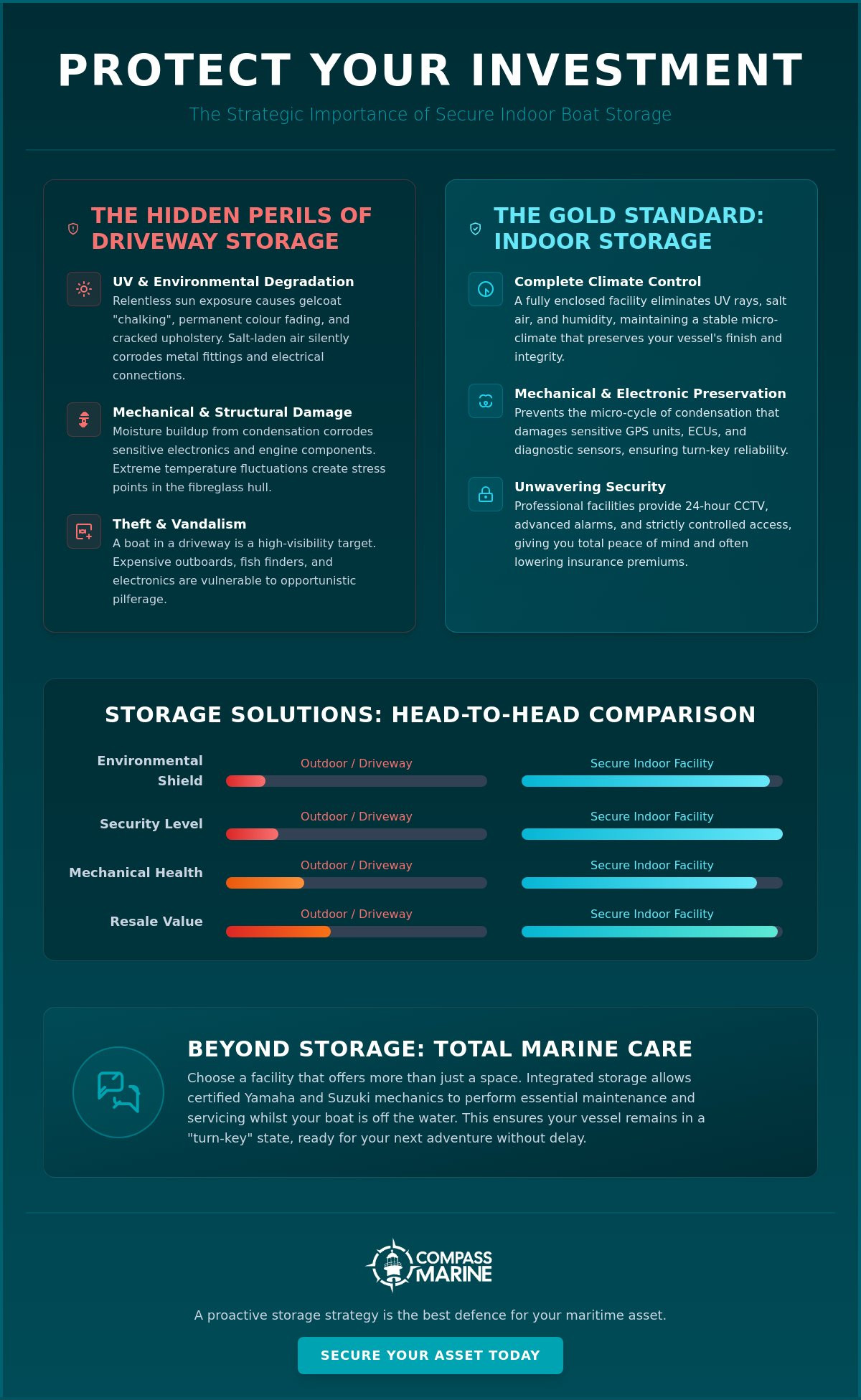
UV radiation is a relentless adversary for maritime hardware. It aggressively degrades gelcoats, leading to “chalking” and permanent colour fading that cannot always be polished out. Beyond aesthetics, temperature fluctuations inside an open or poorly insulated space cause upholstery to crack and create stress points in the fibreglass. In coastal regions, salt-laden air acts as a silent corrosive agent, pitting stainless steel fittings and degrading electrical connections even whilst the boat is stationary. A fully enclosed facility eliminates these variables, maintaining the vessel in a stable micro-climate.
Security and Peace of Mind: Beyond the Locked Gate
A boat parked on a trailer in a residential driveway is a high-visibility target for opportunistic theft. Residential security rarely matches the requirements for high-end maritime assets, leaving expensive outboards and fish finders vulnerable to pilferage. Professional secure indoor boat storage facilities provide a level of protection that individual owners cannot replicate. This includes 24-hour CCTV, advanced alarm systems, and strictly restricted personnel access. Many insurance providers recognise this reduced risk profile, often offering lower premiums when a vessel is documented as being stored in a professional, monitored facility. This transition from a state of constant concern to a state of total confidence is perhaps the greatest benefit of a managed storage solution.
Protecting Mechanical Integrity and Structural Longevity
Mechanical reliability is built on more than just regular oil changes; it requires a stable environment that prevents the slow creep of humidity into vital components. Moisture is the primary enemy of modern marine electronics. High-end GPS units, fish finders, and engine control units (ECUs) are incredibly sensitive to the “micro-cycle” of condensation that occurs when temperatures fluctuate in outdoor settings. Utilising secure indoor boat storage provides a consistent thermal mass that prevents the dew point from crossing, ensuring your circuitry remains dry and your diagnostic sensors stay corrosion-free.
This level of environmental control is a fundamental part of an asset preservation strategy. When a vessel is kept in a professional facility, the mechanical systems are shielded from the extreme heat cycles that cause metal fatigue and seal failure. It’s a proactive way to ensure your boat is always ready for the water, rather than sitting in a workshop for avoidable repairs. If you’re looking to maintain your vessel in peak condition, exploring professional storage options is the next logical step for any serious mariner.
Shielding Outboard and Inboard Systems
Fuel systems are particularly vulnerable during periods of inactivity. When a vessel sits in an uncontrolled environment, the air space in the fuel tank “breathes,” drawing in humid air that eventually condenses into water. This leads to fuel phase separation and microbial growth. Storing your vessel indoors significantly slows this process. It also protects the investment you’ve made in professional marine engine servicing by keeping external seals, belts, and rubber hoses from perishing under UV heat. Certified technicians often find that boats kept in climate-controlled spaces require far fewer diagnostic interventions for electrical faults and sensor failures.
Preserving Hull and Deck Refurbishments
Structural longevity is equally dependent on environmental control. For owners who have invested in high-quality marine paint or fresh anti-fouling treatments, indoor storage ensures these applications reach their full service life without premature peeling or blistering. It also prevents the specific type of deck fatigue caused by standing water. When water pools on a deck in an open lot, it can find its way into the smallest fissures, leading to transom rot or core delamination over time. By maintaining a standard of Total Marine Care, you ensure that custom upholstery and boat canopies don’t succumb to mould or sun-rot. Even custom marine stainless steel fabrication and fittings stay polished longer when they aren’t subjected to the abrasive salt spray and industrial fallout found in outdoor yards.
Comparing Storage Solutions: Why Indoor Facilities Outperform the Rest
Choosing the right environment for your vessel requires a cold-eyed assessment of risk versus convenience. Whilst there are several ways to house a boat, they aren’t created equal in their ability to preserve mechanical and structural integrity. Wet slips offer the ultimate convenience for immediate departure, but they subject your hull to constant biological fouling, electrolysis, and the risk of osmosis. Even with high-quality anti-fouling, a boat kept in the water is in a state of slow, constant battle with the elements.
Outdoor or covered storage is often seen as a middle ground, yet it frequently introduces its own set of challenges. Protective covers can trap moisture against the gelcoat, creating a greenhouse effect that accelerates mould growth and upholstery rot. Additionally, these environments offer little protection against rodents or opportunistic theft. Transitioning to a professional secure indoor boat storage facility removes these variables entirely, providing a 360-degree barrier that neither a canvas cover nor a marina berth can replicate.
To determine which solution fits your needs, consider this framework for assessment:
- Vessel Value: High-value assets with modern electronics require the highest level of environmental control.
- Maintenance Tolerance: If you prefer “turn-key” boating over spending your weekends cleaning and polishing, indoor storage is essential.
- Resale Strategy: Boats with a documented history of indoor storage command significantly higher prices on the pre-owned market.
Indoor vs. Outdoor: The True Cost Analysis
The financial impact of storage goes far beyond the monthly rental fee. Owners who choose outdoor lots often find themselves paying for professional detailing multiple times a year to combat “chalking” and oxidation. When you factor in the cost of these restorative treatments, alongside the increased risk of electronics theft or trailer vandalism, the “cheaper” outdoor option often becomes the more expensive choice. Whilst the monthly premium for indoor facilities is higher, it is the most cost-effective long-term choice because it prevents the thousands of Rands in depreciation and refurbishment costs caused by environmental neglect.
Special Considerations for Jet Skis and Small Craft
Small recreational craft face unique challenges that larger vessels might avoid. Jet Skis are particularly susceptible to engine bay corrosion because their compact designs trap salt-laden air in tight spaces, which can lead to seized components whilst the craft is idle. Utilising rack-based secure indoor boat storage allows these smaller vessels to stay high and dry, away from the damp ground-level humidity found in many outdoor yards. This environment makes it far easier to organise the engine bay for the off-season, ensuring that your jetski service remains a routine check-up rather than a major mechanical overhaul. Keeping small engines in a climate-stable facility ensures that fuel stays stable and electrical sensors remain functional for your next launch.
Essential Preparation: Organising Your Vessel for Long-Term Storage
Effective vessel preparation is the bridge between a successful storage period and a seamless launch day. Whilst secure indoor boat storage provides the ideal environment, the condition in which you leave your boat determines how much work you’ll face next season. A methodical approach ensures your vessel remains in a “turn-key” state, ready for the water at a moment’s notice.
Begin with a meticulous wash-down. Removing every trace of salt and organic residue is vital, as salt is hygroscopic and will draw moisture from the air even in a sheltered environment. Pay close attention to the trailer, ensuring the brakes and bearings are rinsed and greased. Managing your electrical systems is equally critical. Deep-discharge damage can ruin expensive marine batteries if they’re left connected without a charge. Disconnect the terminals or utilise a high-quality trickle charger to maintain voltage throughout the idle months.
This level of care doesn’t just protect your current enjoyment; it safeguards your future resale value. A well-documented storage and maintenance routine simplifies the pre-owned boat ownership inspection for any prospective buyer. It demonstrates that the vessel has been treated as a high-value asset rather than a seasonal toy. To ensure your boat is ready for its next chapter, you can contact our team for expert vessel preparation.
Mechanical and Fuel System Winterisation
Fuel systems require specific attention to prevent internal gumming. Modern fuels can degrade in as little as 30 days, so adding a high-quality stabiliser is essential for protecting injectors or carburettors. Flush the cooling system with fresh water to clear out any remaining salt deposits and check all hoses for signs of perishing. For those with long-term storage plans, fogging the engine cylinders provides a protective coating that prevents internal rust from forming on the piston rings and cylinder walls. This small step prevents significant mechanical heartbreak when you first turn the key next season. For a comprehensive walkthrough of every technical step involved, our professional guide on how to prepare a boat for storage covers the full process in detail, from fuel stabilisation to electrical system management.
Compliance and Safety Equipment Audit
The off-season is the perfect opportunity to audit your maritime compliance. Check your Cat C safety equipment for expiry dates on flares and fire extinguishers whilst the vessel is easily accessible. Using secure indoor boat storage provides a stable, dry platform for conducting structural integrity checks without the interference of wind or rain. Ensure your hull is ready for upcoming COF certificate for boats surveys and verify that your buoyancy certificates are up to date. Addressing these administrative and safety requirements now prevents a last-minute scramble when the season reopens and the fish start biting. It is also the ideal time to inspect your boat mooring equipment, checking shackles, ropes, and chains for corrosion or wear so that everything is ready for a safe return to the water.
Total Marine Care: The Advantage of Integrated Storage and Service
Choosing a facility with on-site technical expertise is a game-changer for vessel owners who value their time and mechanical reliability. Most storage providers offer little more than square footage, but an integrated approach transforms your storage period into a proactive maintenance window. This is where the secure indoor boat storage model evolves from a simple parking solution into a comprehensive care programme. By housing your vessel where certified Yamaha and Suzuki mechanics are already on-hand, you eliminate the logistical headache of towing your boat between different service centres during the off-season.
The advantage of this integration is the ability to address mechanical requirements whilst the boat is already off the water. Instead of discovering a fault during your first launch of the season, a professional team can identify and rectify concerns during the idle months. This “Safe Pair of Hands” philosophy ensures that every aspect of your vessel’s lifecycle, from structural integrity to engine performance, is managed by experts who understand the technical nuances of maritime hardware. It’s a supportive, stress-reducing strategy that positions your boat for optimal performance.
Leveraging Professional Technical Expertise
Professional on-site support prevents minor issues from developing into major mechanical failures. Having access to specialist services like electrical wiring fault diagnostics or marine stainless steel fabrication in Durban whilst your boat is stored allows for seamless upgrades without interrupting your boating season. It’s also the ideal time to coordinate trailer repairs and axle maintenance, as well as to review and replace any worn boat mooring equipment such as cleats, lines, and galvanised chains before the season begins. Trailers are frequently the most neglected part of a maritime setup, yet they’re critical for safety. Ensuring your trailer is refurbished and roadworthy whilst the boat is in secure indoor boat storage ensures a truly “turn-key” experience when the next season begins.
The Logical Conclusion for Discerning Owners
Secure indoor storage is the only logical choice for discerning owners who view their vessel as a significant financial investment. It protects your lifestyle by ensuring that your time on the water is spent enjoying the ocean rather than managing avoidable mechanical failures. By consolidating your storage and maintenance needs, you create a documented history of professional care that significantly bolsters resale value. Transitioning your vessel into a professional care programme is a straightforward process that yields immediate peace of mind and long-term savings.
Taking the next step in protecting your maritime asset is essential for any serious mariner. To discuss your specific requirements and learn how our integrated approach can safeguard your vessel’s future, you should contact the experts at Compass Marine. We are dedicated to providing the technical mastery and secure environment your investment deserves, ensuring you stay on the water with total confidence.
Securing Your Vessel’s Legacy for the Next Season
Protecting your maritime investment requires a shift from viewing storage as a passive parking solution to an active preservation strategy. By choosing secure indoor boat storage, you effectively eliminate the environmental stressors that cause rapid depreciation and mechanical failure. You’ve seen how a controlled environment preserves sensitive electronics and how integrated technical support ensures your vessel remains in showroom condition whilst its resale value is protected.
Compass Marine provides a safe pair of hands backed by decades of professional experience in marine refurbishment and engine care. Our facility offers more than just shelter; you gain direct access to certified Yamaha and Suzuki mechanics who can maintain your engine whilst it’s off the water. We also streamline your administrative requirements by providing comprehensive maritime compliance assistance, including COF certificates for boats and buoyancy certificates. You can trust our team to handle the complex technical details whilst you focus on the lifestyle you love.
Secure your boat’s future with professional indoor storage from Compass Marine. We look forward to helping you maintain your vessel in peak condition so it’s always ready for your next launch.
Frequently Asked Questions
Is indoor boat storage really worth the extra cost?
Indoor storage is absolutely worth the investment because it halts the rapid depreciation caused by UV damage and gelcoat oxidation. Whilst the monthly fees are higher than outdoor alternatives, you save significantly on long-term refurbishment and detailing costs. It is the most effective way to maintain a vessel in showroom condition for a better resale value.
How do I prepare my outboard engine for long-term indoor storage?
Preparing an outboard involves flushing the cooling system with fresh water and treating the fuel with a high-quality stabiliser. You should also fog the cylinders to prevent internal rust and check the gear oil for any signs of water ingress. Having a certified Yamaha or Suzuki mechanic perform these tasks ensures your engine is truly turn-key ready for its next launch. For a full step-by-step breakdown of every procedure involved, refer to our detailed resource on how to prepare a boat for storage to ensure nothing is overlooked.
Can I access my boat whilst it is in a secure indoor storage facility?
Access policies vary between facilities, but most high-security providers require advance notice to maintain strict personnel control. This restricted access is a core feature of secure indoor boat storage, as it prevents unauthorised individuals from entering the premises. You should check with your specific provider to understand their operational hours and retrieval procedures.
Does indoor storage help with passing my annual COF survey?
Indoor storage significantly simplifies the process of passing your annual Certificate of Fitness (COF) survey. Storing the vessel in a dry environment prevents the structural decay, such as transom rot or floor delamination, that often leads to survey failure. It also ensures that safety equipment stays dry and functional, reducing the risk of expiry or damage before inspection.
Will storing my boat indoors reduce my insurance premiums?
Many insurance providers offer reduced premiums for boats kept in professional storage facilities due to the significantly lower risk profile. Storing your boat indoors eliminates the possibility of storm damage and drastically reduces the likelihood of theft or vandalism. You should provide your insurer with documentation of your secure indoor boat storage arrangement to discuss potential policy discounts.
Should I still use a boat cover if my vessel is stored indoors?
Utilising a light, breathable boat cover whilst indoors is highly recommended to protect your vessel from ambient dust and bird activity. Whilst the boat is shielded from UV rays and rain, a cover maintains the “as-new” appearance of your upholstery and prevents dust from settling into the gelcoat pores. Ensure the cover is not so tight that it traps moisture, which could lead to mould growth.
What is the difference between climate-controlled and standard indoor storage?
Climate-controlled storage actively regulates temperature and humidity levels, whereas standard indoor storage simply provides a fully enclosed physical barrier. Climate control is the premium choice for vessels with highly sensitive marine electronics or expensive upholstery that might be affected by extreme ambient temperature shifts. Standard indoor storage is still vastly superior to any outdoor option for general vessel protection.
How far in advance should I book my indoor storage space for the off-season?
You should ideally book your storage space at least two to three months before the end of the peak boating season. High-quality facilities often face a structural undersupply, meaning that the best spots are claimed quickly as the weather turns. Organising your space early ensures you aren’t forced to settle for a less secure outdoor alternative when the rush begins.