What if the difference between a successful launch and a hefty fine at the slipway isn’t your engine’s health, but a single piece of paper you haven’t checked since last season? We know that keeping track of your cof certificate for boats can feel like a moving target, especially with the recent regulatory overhauls affecting South African waters. It’s common to feel a sense of anxiety when preparing for a survey, wondering if your safety gear is truly up to SAMSA standards or if your buoyancy certificate has quietly expired whilst your boat was in storage.
You deserve to head out from Durban harbour with the absolute peace of mind that your vessel is legally seaworthy and your crew is protected. This guide helps you master the complexities of compliance by breaking down the specific requirements for different safety categories. We provide a clear checklist of required equipment, explain the vital link between buoyancy and your COF, and highlight exactly when you need professional mechanical support to ensure a first-time pass. We’ve organised the latest 2026 standards into a simple, actionable roadmap so you can focus on the water rather than the paperwork.
Key Takeaways
- Understand that a cof certificate for boats is an annual legal requirement mandated by SAMSA to ensure your vessel meets specific safety standards for its operating category.
- Identify the correct safety category for your vessel, from Category R to B, to ensure your onboard equipment matches your intended distance from the shore.
- Ensure your buoyancy certificate is current, as this document is a vital prerequisite for any COF survey and typically requires renewal every five years.
- Perform a proactive pre-inspection of your hull, transom, and vessel identification numbers to resolve potential issues before your official survey takes place.
- Adopt a long-term maintenance strategy to protect your safety gear and engine components from the aggressive saltwater corrosion common in KwaZulu-Natal waters.
What is a COF Certificate and Why is it Mandatory?
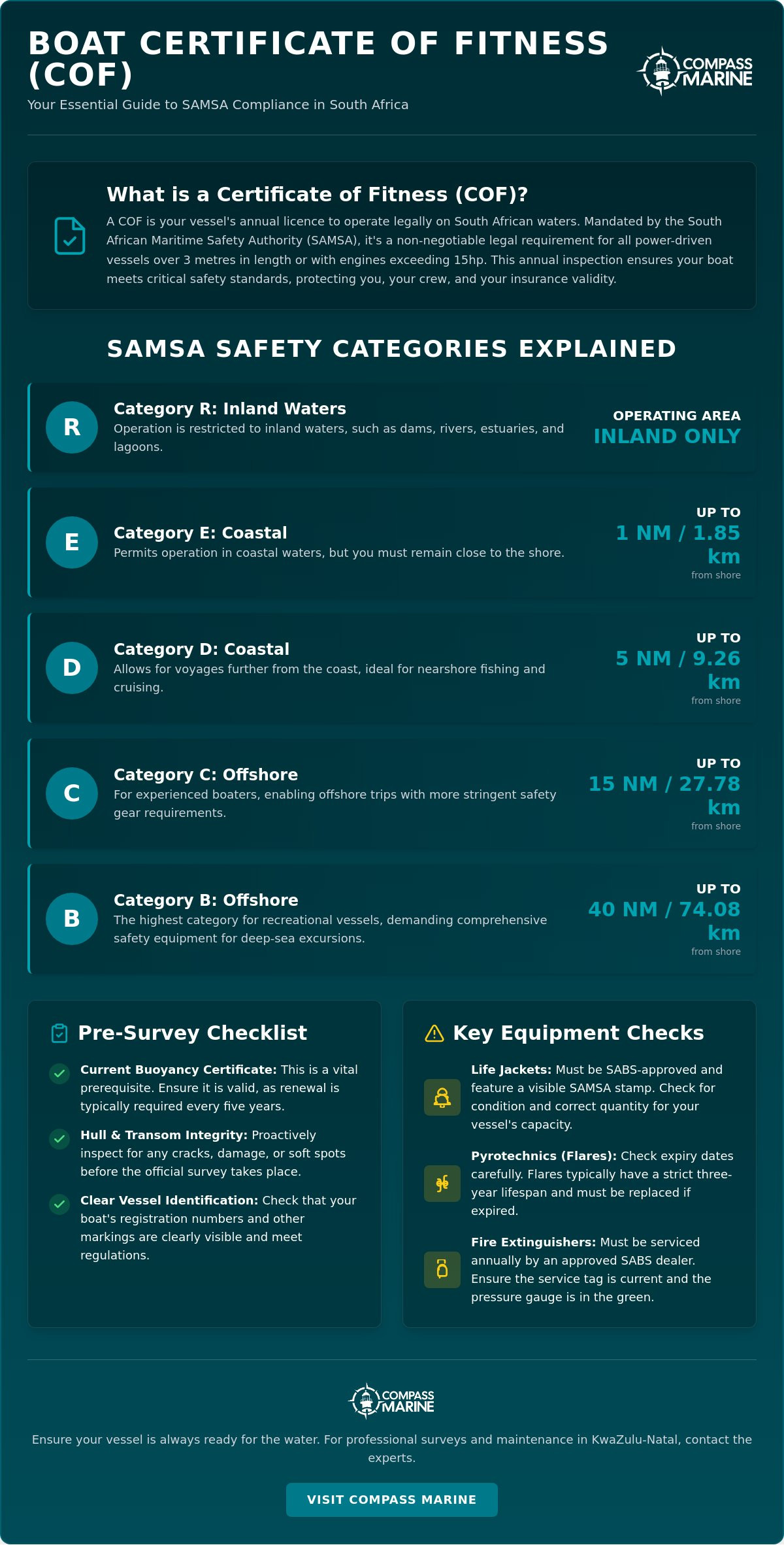
A Certificate of Fitness (COF) functions as your vessel’s annual licence to operate on South African waters. Think of it as a technical audit that ensures your boat meets the minimum safety standards required for its specific usage. The South African Maritime Safety Authority (SAMSA) oversees these regulations, acting as the national guardian of our coastlines and inland waterways. Every 12 months, your boat must undergo a physical inspection to renew this document. This isn’t a suggestion; it’s a legal necessity for all power-driven vessels with engines exceeding 15hp or hulls longer than 3 metres. Whether you’re launching a 14-foot skiff at Vetch’s Pier or a large catamaran from the Durban marina, a valid cof certificate for boats is your ticket to a legal day on the water.
The Legal Framework for South African Boaters
The legal foundation for these inspections lies in the Merchant Shipping (National Small Vessel Safety) Regulations. These laws are currently being updated to reflect modern maritime challenges, with the draft 2025 regulations set to replace the older 2007 framework. Operating without a valid certificate amongst our coastal waters can lead to heavy fines or the impoundment of your vessel by authorities. Beyond the threat of legal action, your marine insurance policy is almost certainly tied to your COF. If you’re involved in an incident without a valid certificate, your insurer has every right to reject your claim. This leaves you personally liable for expensive repairs or third-party damages that could have been avoided with a simple annual check.
Who Can Issue a COF?
Obtaining your cof certificate for boats involves a physical survey conducted by an authorised professional. You can deal directly with SAMSA surveyors, though many recreational boaters in KwaZulu-Natal prefer working through authorised agencies or local boating clubs. These organisations employ safety officers who are trained to perform the survey on SAMSA’s behalf. They ensure your gear is in date and your hull is sound before signing off on your seaworthiness. Once issued, the original certificate must remain on the boat at all times. In the humid environment of Durban, we recommend keeping it in a waterproof sleeve inside a dedicated safety file. If you’re stopped for a routine inspection in the harbour, failing to produce this document is a quick way to end your outing prematurely.
Decoding SAMSA Safety Categories and Equipment Requirements
When applying for a cof certificate for boats, the first detail a surveyor checks is your vessel’s designated category. This classification determines exactly how far from the shore you are legally permitted to operate and, consequently, the level of safety gear you must carry. These standards are dictated by SAMSA’s Small Vessel Safety Regulations, which aim to ensure that every boat is equipped to handle the specific risks of its environment. As you move from inland dams to the open ocean, the technical requirements become significantly more stringent to account for the increased difficulty of a rescue operation.
- Category R: Restricted to inland waters such as dams, rivers, and lagoons.
- Category E: Coastal waters, limited to 1 nautical mile (1.85 kilometres) from the shore.
- Category D: Coastal waters, limited to 5 nautical miles (9.26 kilometres) from the shore.
- Category C: Coastal waters, limited to 15 nautical miles (27.78 kilometres) from the shore.
- Category B: Coastal waters, limited to 40 nautical miles (74.08 kilometres) from the shore.
Every piece of equipment on your vessel must be in prime condition to pass a survey. Life jackets are a common point of failure; they must be SABS-approved and feature a visible SAMSA stamp. Don’t assume that because a jacket looks new, it will pass. Surveyors also pay close attention to expiry dates on pyrotechnics. Flares typically have a three-year lifespan, whilst fire extinguishers require an annual service by an approved SABS dealer. In the humid KwaZulu-Natal climate, corrosion can quickly render safety gear useless, so regular inspections are vital.
Essential Safety Gear for Inland and Coastal Waters
The jump from Category R to Category E involves adding specific coastal gear like a red distress rocket and a waterproof torch. However, Category C introduces the most significant technical shift. At 15 nautical miles out, you are required to carry a fixed or handheld VHF radio, which requires an operator’s licence. Regardless of your category, every boat should have a well-stocked capsize canister. This buoyant container must hold your flares, a first aid kit, and space blankets, kept in a “grab-and-go” position near the helm. If you need to update your inventory, our marine store stocks a full range of SAMSA-compliant safety equipment.
Maintaining Your Safety Equipment
Safety gear is not a “set and forget” investment. Over time, the buoyancy foam in life jackets can compress, reducing its effectiveness in an emergency. You should regularly check for tears in the fabric or salt-encrusted zips that might jam. Fire extinguishers must be mounted in accessible brackets, not rolling around in a locker where the gauge could be damaged. Because saltwater corrosion is a constant threat in Durban, we recommend wiping down all electronic safety gear with a damp cloth after every outing to prevent salt buildup from compromising the battery seals or switches. For a thorough breakdown of mandatory items across all vessel categories, our guide to essential marine safety gear for South African boaters in 2026 covers the specific requirements and practical advice for selecting durable equipment that withstands KZN’s harsh coastal environment.
The Critical Link Between Buoyancy Certificates and Your COF
You cannot obtain a cof certificate for boats without first presenting a valid buoyancy certificate. It is the technical foundation of your vessel’s safety. Whilst your COF requires an annual visit from a surveyor, a buoyancy certificate is generally valid for five years. This discrepancy often catches owners off guard. If your buoyancy document has lapsed, your annual COF renewal will grind to a halt. It’s a non-negotiable prerequisite that proves your boat has enough upward thrust to stay afloat if it’s swamped or capsized. For a comprehensive breakdown of the specific percentages, approved materials, and inspection steps involved, our guide to the boat buoyancy certificate South Africa requirements for 2026 provides a detailed roadmap to help you meet every SAMSA standard with confidence.
For vessels operating at sea, specifically Categories E through B, SAMSA requires that the boat has at least 60% buoyancy. This ensures that even if the hull is completely filled with water, the vessel remains afloat and stable enough to support the full weight of the crew, engines, and equipment. Inland vessels in Category R typically require 30% buoyancy. Any major structural work, such as replacing a soft deck or altering the transom, immediately voids your existing certificate. You must have the vessel re-inspected to ensure the integrity of the buoyancy media wasn’t compromised during the repairs. According to SA Sailing’s safety inspection process, buoyancy is one of the most critical technical checks for any small vessel.
Types of Approved Buoyancy Media
Selecting the right material is about more than just flotation; it is about longevity and chemical resistance. Closed-cell polyurethane foam is a popular choice because it provides excellent structural support and is easy to install in tight cavities. However, it must be high-quality foam that won’t absorb water over time. Alternatively, many South African boaters use SABS-approved plastic bottles. These are often easier to inspect later, but they must be capped correctly and secured so they don’t rattle or shift. Using unapproved materials like polystyrene or empty oil cans is a dangerous mistake. These materials can dissolve if they come into contact with fuel or oil spills in the bilge, leaving you with zero protection when you need it most.
The Buoyancy Inspection Process
During a survey, a technician doesn’t just glance at your deck. They verify the volume of the buoyancy media against the total weight of the boat, including the heavy four-stroke engines and full fuel tanks common in Durban. This “verified volume” calculation is the heart of the certificate. If you are building a boat or refurbishing an old hull, take clear photos of the buoyancy installation before the deck is sealed. These photos, combined with a “declaration of buoyancy” signed by the installer, provide the paper trail a surveyor needs. Without this documentation, obtaining a new cof certificate for boats becomes significantly more complicated, as a surveyor might require you to cut inspection holes in your deck to verify the volume underneath.
Step-by-Step: Preparing Your Boat for a COF Inspection
Preparing for a survey is less about passing a technical test and more about ensuring your vessel remains a safe environment for your crew. A proactive approach saves time and prevents the frustration of a failed inspection. Start with a thorough physical examination of the hull and deck. In KwaZulu-Natal, the heavy surf launches at places like Umkomaas or Shelly Beach put immense strain on the transom and motor mounts. You should look for stress cracks or signs of delamination that could indicate structural fatigue. If you discover any soft spots in the deck, these must be addressed before securing your next cof certificate for boats, as they often hint at compromised buoyancy underneath.
Visibility and functionality are the surveyor’s primary focus during the walk-around. Your SAMSA registration numbers must be clearly visible on both sides of the hull, following the specific size and colour contrast requirements for your category. Test your navigation lights and bilge pumps early in the process. Saltwater corrosion is a relentless enemy in Durban, often causing electrical contacts to fail whilst the boat is in storage. Ensure your steering system is fluid and responsive; any “dead spots” or visible hydraulic leaks at the seals will result in an immediate fail. For a more granular look at every technical requirement, you can refer to our comprehensive compliance guide.
Mechanical and Electrical Readiness
Engine reliability is a cornerstone of maritime safety. A breakdown in the harbour mouth is a dangerous situation that puts your vessel at the mercy of the swell. Inspect your fuel lines for signs of “alligatoring” or hardening, which often happens when rubber is exposed to coastal humidity and fuel vapours. You should also test the “kill switch” lanyard to ensure the engines cut out instantly if the skipper is thrown from the helm. If your engines haven’t been run in several months, consider booking a professional outboard engine service to resolve any underlying mechanical issues before the surveyor arrives. It is also worth inspecting your railings, T-tops, and other structural fittings at this stage; corroded or poorly fabricated hardware can raise concerns during a survey, and investing in marine stainless steel fabrication in Durban ensures these components meet the structural demands of the Indian Ocean environment.
Administrative Requirements
The administrative side of obtaining a cof certificate for boats is as much about the paperwork as it is about the hardware. You will need to have your original ID, a recent proof of address, and your previous year’s COF document ready for the inspector. Surveyors also check the vessel’s data plate, which lists the maximum carrying capacity and engine ratings. Ensure this plate is legible and hasn’t been painted over during a refurbishment. Having these documents organised in a dedicated safety file demonstrates that you are a responsible owner who takes the technical upkeep of your high-value asset seriously.
Beyond the Certificate: Ensuring Long-Term Maritime Safety
A valid cof certificate for boats ensures you are legally compliant, but it should never be mistaken for a guarantee of absolute reliability. Whilst the annual survey confirms that your safety equipment is present and your hull is sound, it is merely the minimum baseline for maritime safety. Real peace of mind comes from a rigorous maintenance schedule that addresses the hidden wear and tear caused by the aggressive KwaZulu-Natal coastline. Saltwater corrosion is a silent threat that can seize a steering cable or degrade an electrical connection long before your next inspection is due. Partnering with professionals who offer comprehensive marine technical services ensures that every system on your vessel is evaluated with the precision required to keep you safe and compliant throughout the season.
Regular intervals for professional marine engine servicing are essential to prevent mid-season failures. An engine that starts easily in the driveway might struggle under load in a heavy swell if the fuel filters are partially clogged or the spark plugs are fouled. We recommend a full technical review at least once every 100 hours of operation or annually, whichever comes first. This proactive approach ensures that your vessel isn’t just legally seaworthy, but mechanically dependable when you are kilometres from the shore.
The Value of Professional Technical Support
Working with certified mechanics provides an extra layer of protection that a standard safety survey might miss. A professional eye can spot the subtle warning signs of impending failure, such as salt crystals forming around a gasket or minor play in a propeller shaft. Using a dedicated marine store or chandlery for your gear also ensures that every item, from your life jackets to your fire extinguishers, is SAMSA-approved and suited for the local environment. At Compass Marine, we view ourselves as your partner in both compliance and performance, helping you protect your high-value investment through technical mastery.
Off-Season Protection and Storage
The environment is often your boat’s greatest enemy whilst it is not in use. Constant exposure to coastal humidity and UV rays can perish upholstery and compromise the integrity of your safety gear. Exploring the benefits of secure indoor boat storage is one of the most effective ways to extend the lifespan of your vessel. By keeping your boat in a climate-controlled, dry environment, you significantly reduce the risk of electrical faults and hull degradation. Ultimately, maritime safety is a continuous process of care and vigilance, rather than a single annual event. Staying ahead of the maintenance curve ensures that when you do head out, your focus remains entirely on the water.
Heading Out with Absolute Confidence
Maintaining a seaworthy vessel is a commitment that extends far beyond a simple annual inspection. By aligning your safety equipment with the correct SAMSA category and ensuring your buoyancy certificate is current, you build a foundation of technical reliability that protects your investment. Proactive hull checks and electrical testing prevent small issues from becoming expensive failures whilst you’re navigating the Durban coastline or launching into the KZN surf.
Securing your cof certificate for boats should be a seamless part of your vessel’s lifecycle. Our team of certified Yamaha and Suzuki mechanics is here to streamline the entire process, from conducting deep mechanical audits to facilitating your buoyancy and COF documentation. Our comprehensive marine safety gear range also carries the specific safety gear required for every category, ensuring you’re always compliant with the latest 2026 regulations.
Book your boat for a professional COF survey and mechanical check with Compass Marine to ensure your vessel is truly ready for the season ahead. We’re dedicated to keeping your craft in peak condition so you can enjoy the water with absolute peace of mind. We look forward to seeing you at the harbour.
Frequently Asked Questions
How long is a COF certificate valid for in South Africa?
A Certificate of Fitness is valid for exactly 12 months from the date of issue. You must renew it annually to remain legally compliant with SAMSA regulations. It is a good idea to schedule your survey at least two weeks before the expiry date to avoid any downtime during the peak boating season.
Do I need a COF for a jet ski or small boat with a 15hp motor?
You require a cof certificate for boats if your vessel has an engine larger than 15hp or if the hull is longer than 3 metres. This includes jet skis, motorised fishing craft, and power boats. If your motor is exactly 15hp or smaller and the boat is under 3 metres, you are generally exempt, but you still must carry basic safety gear for your own protection.
What is the difference between a buoyancy certificate and a COF?
A buoyancy certificate proves your vessel has enough flotation to stay upright if swamped, whilst a COF is your annual operating licence. The buoyancy document is a prerequisite for the COF and typically remains valid for five years. In contrast, the COF focuses on your current safety equipment and hull condition, requiring a fresh inspection every year. For a full explanation of what the boat buoyancy certificate South Africa process involves, including the specific materials and percentages required for each vessel category, our dedicated 2026 compliance guide covers every detail you need to know.
Can I do my own buoyancy installation for a COF survey?
You can physically install the buoyancy media yourself, but a qualified safety officer or authorised agency must verify the installation to issue the certificate. You should take clear photographs of the foam or bottles before sealing the deck. These images act as vital evidence for the surveyor to calculate the verified volume required for your specific vessel category.
What happens if my COF expires whilst my boat is in storage?
An expired certificate simply means you cannot legally launch or operate the vessel on public waters. If your boat has been in storage, you must arrange a new survey and obtain a valid cof certificate for boats before your first outing. Use the time in storage to check for saltwater corrosion or battery degradation that might have occurred during the off-season.
Are digital copies of the COF acceptable during a water-side inspection?
SAMSA regulations currently require the original, physical Certificate of Fitness to be kept on the vessel at all times. Whilst having a digital photo on your phone is a helpful backup, it won’t satisfy an official inspection by the water police or a harbour master. Keep your original documents in a waterproof safety file stored in a dry, accessible locker.
What are the specific requirements for Category C safety equipment?
Category C vessels, which operate up to 15 nautical miles from the shore, must carry advanced gear including a fixed or handheld VHF radio. You also need specific pyrotechnics like red rocket distress flares and smoke markers. Because these requirements are more technical, ensure your radio operator’s licence is also current before heading out into the deep sea.
How much does a boat survey for COF typically cost?
Inspection fees vary depending on the size of your vessel and the authorised agency or club performing the survey. Costs are generally determined by the time required for the physical inspection and the administrative processing of the SAMSA documents. You should contact your local safety officer or marine service centre for a current quote tailored to your boat’s specific category.